
URANUS
The coldest planet.
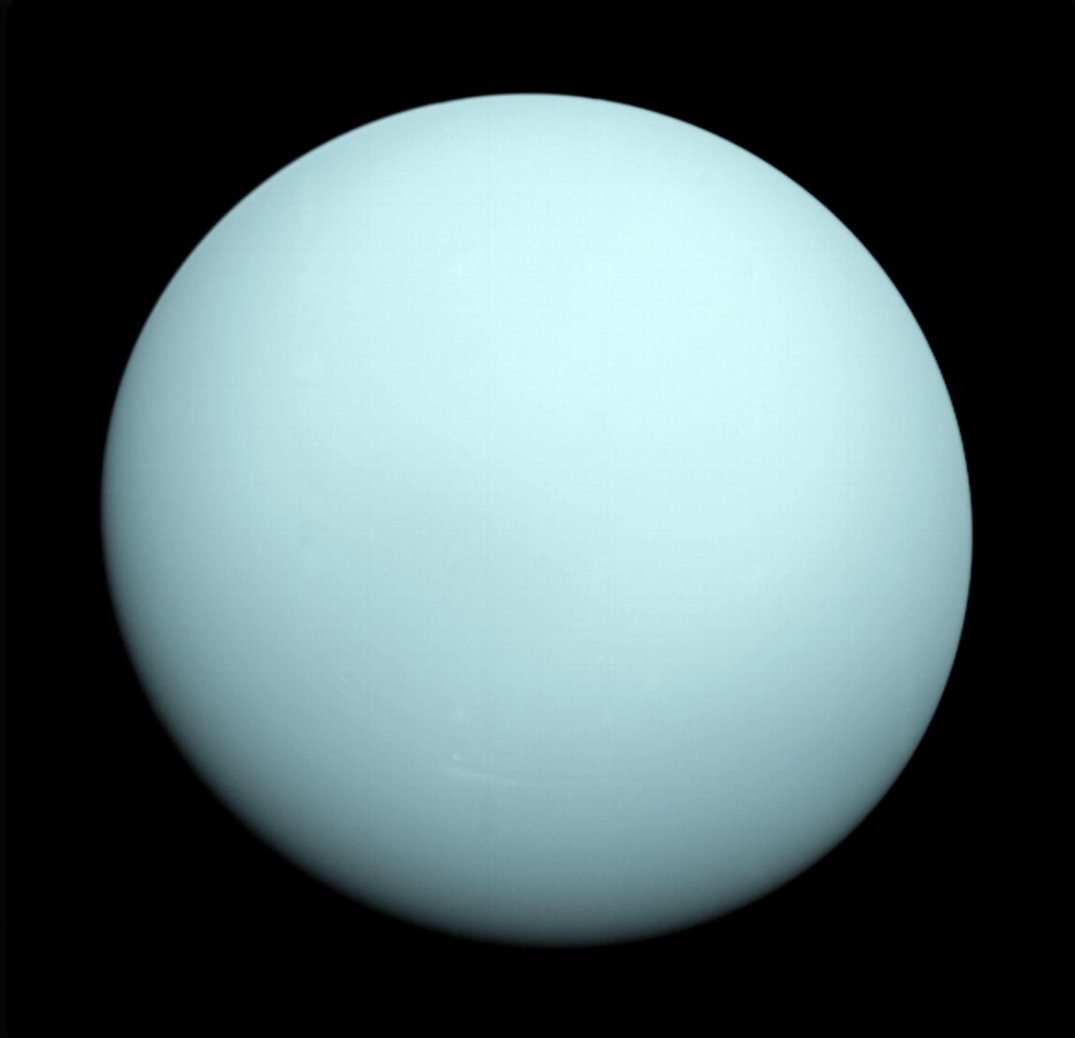
Distance from the Sun: 2.9 billion km (20 AU or 2.7 light hours)
Diameter: 51,120 km
Rotation period: 17 hours, 15 minutes
Orbital period: 84 years
For most of human history, there were only five planets known beyond our Earth: Mercury, Venus, Mars, Jupiter and Saturn. It wasn’t until 1781 that German-British astronomer William Herschel, assisted by his sister Caroline Herschel, spotted what he first thought was a comet. It drifted across the sky and appeared larger than the background stars at higher magnifications, though Herschel did find the lack of a coma and tail puzzling. When the object’s orbit was calculated to be nearly circular, it was determined instead to be a planet. For the first time ever, the number of known planets had increased by one and the solar system had quadrupled in size.
Initially, Herschel wanted to name the new planet Georgium Sidus (George’s Star) in honor of his patron, King George III (yeah, that one). As you can imagine, this was not a very popular choice outside Britain and Herschel’s German hometown, Hanover. Many alternatives were put forward until they landed on a name that followed the same tradition as the other planets. The name Uranus came from the Latinized version of the Greek god of the sky, Ouranos. This was also fitting as Uranus was the father of Saturn which was the father of Jupiter. Some today think that Uranus’ Roman equivalent, Caelus, was more appropriate, but for now we are stuck with it.
As soon as it was discovered, Uranus was immediately categorized as a gas giant due to its large size and gaseous appearance. Uranus has the third-largest diameter and fourth-largest mass of the current eight planets. However, it is substantially smaller, with less than 5% of Jupiter’s mass and 15% of Saturn’s. It also differs in appearance. Where Jupiter and Saturn display distinct bands with warmer tones like orange and beige, Uranus appears as pale cyan, fuzzy and featureless. Upon closer inspection of both Uranus and Neptune by the Voyager 2 space probe in the late 1980’s, which remains the only spacecraft to have ever visited them, scientists learned that these planets are fundamentally different than their gas giant counterparts. While the outer atmospheres still mostly consist of hydrogen and helium gas, the masses of Uranus and Neptune were found to mostly contain icy volatiles (compounds with low melting points) such as water, ammonia and methane, deeper within their fluid mantles. This led scientists to recategorize Uranus and Neptune as members of a new class of planet: ice giants.
Fun fact: It is the greater presence of methane, which notably absorbs redder wavelengths of light, that gives the ice giants their cooler tones.