
VENUS
Earth’s lead-melting twin sister.

Distance from the Sun: 108 million km (0.7 AU or 6 light minutes)
Diameter: 12,100 km
Rotation period: 243 days
Orbital period: 224 days
At certain times throughout the year, our twilight skies are graced with the radiant white light of what looks like a luminous star. It’s not only brighter than Sirius but often brighter than Jupiter, too. In fact, ancient observers began referring to it as the “morning star” or the “evening star” depending on whether it appeared at dawn or dusk. Of course, we know that stars don’t make these dramatic movements across the sky. This “star” is actually the planet Venus. It was this radiance that inspired the ancient Romans to name it after the goddess of beauty (the Greek equivalent being Aphrodite). We see Venus make these back-and-forth swings from one side of the Sun to the other because its orbit is interior to Earth, just like Mercury.
As the second planet from the Sun, Venus comes closer to Earth than any other planet (within 0.3 AU), hence why it appears so luminous. Venus is often referred to as Earth’s twin, mostly due to it being a terrestrial world of similar size. It is ~95% of Earth’s diameter and ~80% of its mass. Both planets have a layered internal structure, with cores composed primarily of iron and nickel surrounded by rocky mantles rich in silicates and other minerals, with thin crusts on their exteriors. Venus even has a thick atmosphere. This close proximity, size and composition suggest that Venus and Earth formed around the same time and from the same building blocks.
These are, however, where the similarities end.
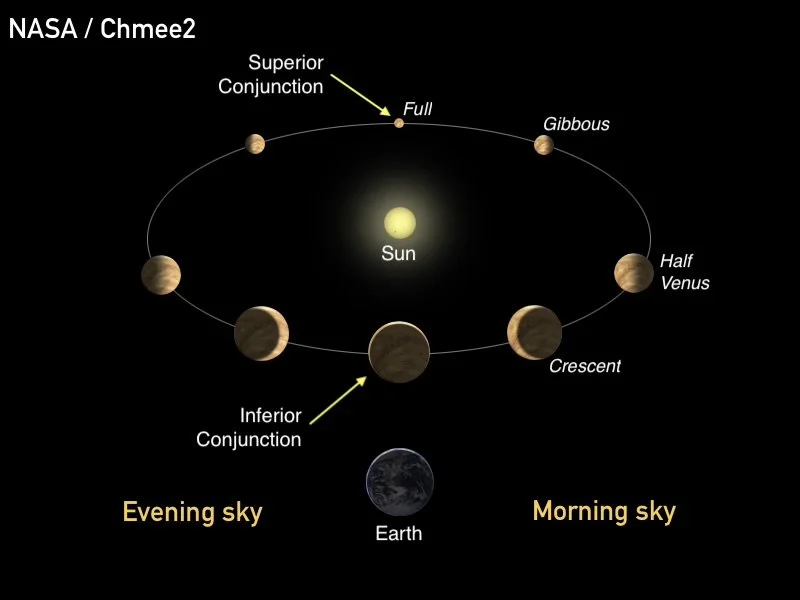
Because its orbit is interior to Earth’s orbit, Venus always appears relatively close to the Sun in our sky, though its invisible leash is not as tight as Mercury’s. Venus moves away from the Sun until it reaches its greatest elongation, the maximum apparent separation it can achieve. Then, it appears to turn around and head back toward the Sun. It eventually passes between the Earth and Sun before reappearing on the other side and beginning the cycle again.
With a telescope, you’ll see Venus not only change in apparent size but also pass through different phases as its angle to the Sun changes, much like our Moon! It appears full when it is on the far side of the Sun, then becomes increasingly gibbous as it moves toward greatest elongation, where it appears half-lit. As Venus approaches Earth, its illuminated portion shrinks from gibbous to crescent while its apparent size grows. It reaches its greatest brightest as a crescent before disappearing into the Sun’s glare. Later, it reemerges in the morning sky and repeats the cycle in reverse, eventually returning to a full phase.
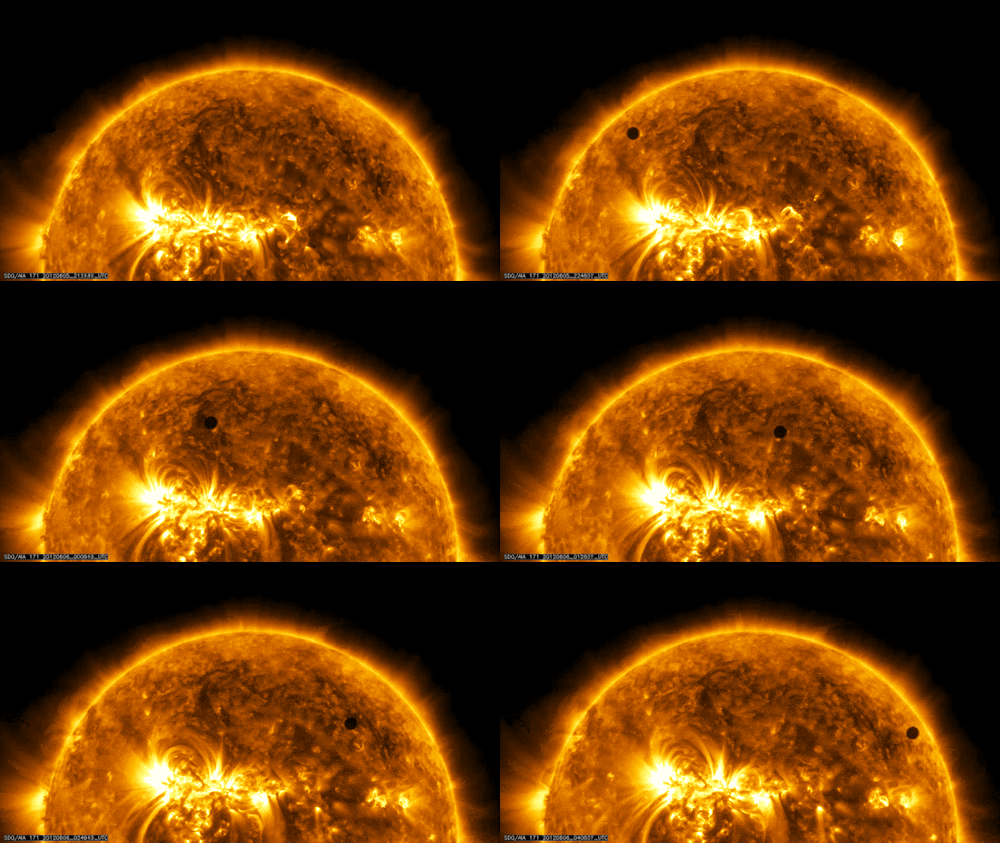
Also like Mercury, it occasionally transits the Sun, though it is much rarer. They happen in a repeating cycle starting with a pair of transits eight years apart, then a long gap of 121.5 years, followed by another eight years and then 105.5 years. If you were hoping to see one of these with your own eyes you unfortunately have a long wait ahead of you. The last two transits took place in 2004 and 2012, so we are early into one of the long intervals. The next transits of Venus will occur in 2117 and 2125.
⚠️Warning: Never look directly at the Sun without approved solar glasses or solar telescope filter. Otherwise, you could risk permanent eye damage and/or blindness.
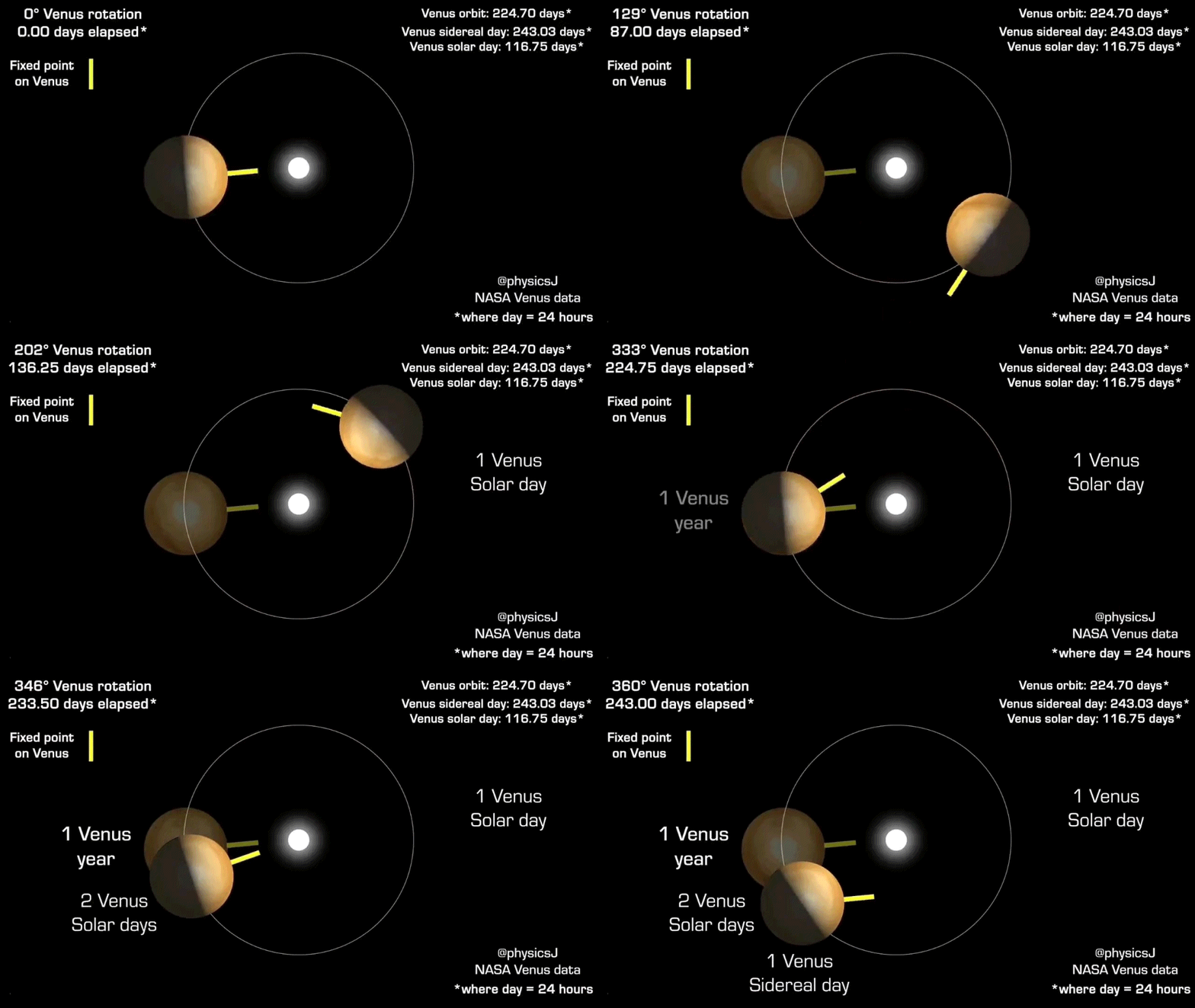
The rotation of Venus is even more peculiar than that of Mercury because it rotates clockwise. Most planets in the solar system rotate counterclockwise, a feature borrowed from the motion of the protoplanetary disk they formed from. This means Venus more or less rotates backwards, also known as retrograde. Various explanations have been proposed. One possibility is that Venus was struck by a protoplanet long ago and flipped it upside down (great impact). Another hypothesis is that the Sun’s heat expanded Venus’ thick atmosphere (thermal tides), turning it into a “handle” for the Sun’s gravity to pull back on and slow the planet’s orbit, or even reverse it. We aren’t all that sure which it is. Maybe it’s both.
Fun fact: Because of the “right-hand rule,” scientists consider the north pole of a planet to be whichever side the planet appears to rotate counterclockwise from. Therefore, Venus is technically considered upside down.
Fun fact: The only other planet in the solar system with such a bizarre axial tilt would be Uranus, which is tilted on its side.
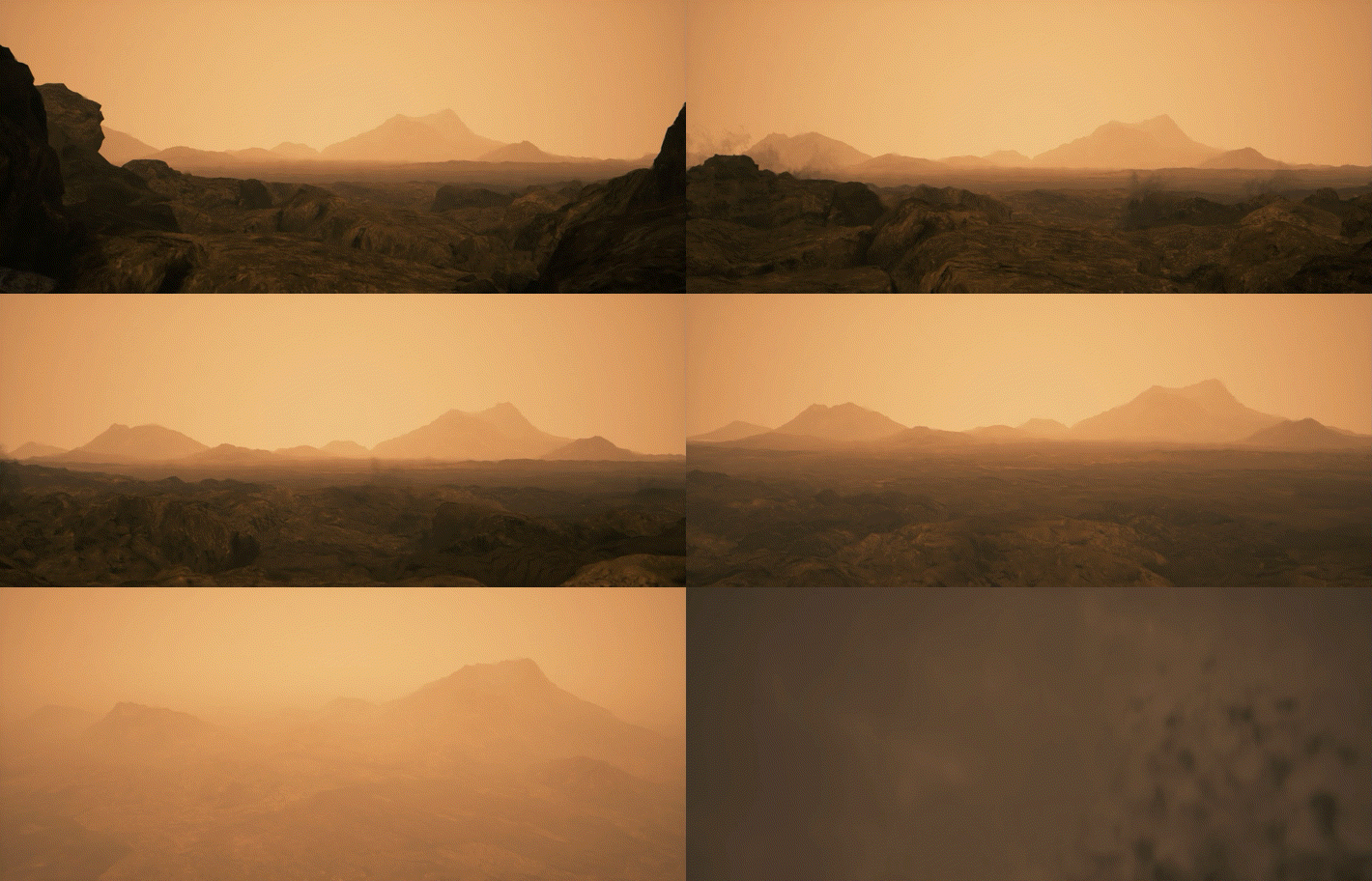
Not only does Venus rotate backwards but it does it very, very slowly. Venus easily has the slowest rotation of all the planets in the solar system. So slow, in fact, that a sidereal day on Venus (one rotation relative to the background stars) lasts longer than its entire year. Meanwhile, a solar day on Venus (one rotation relative to the Sun) lasts about half its year. If you were to stand on the surface of Venus, the Sun would rise in the west, travel across the cloudy, opaque sky for two months, then set in the east followed by two months of pitch-black darkness. Not that you’d ever want to stand on the surface of Venus…
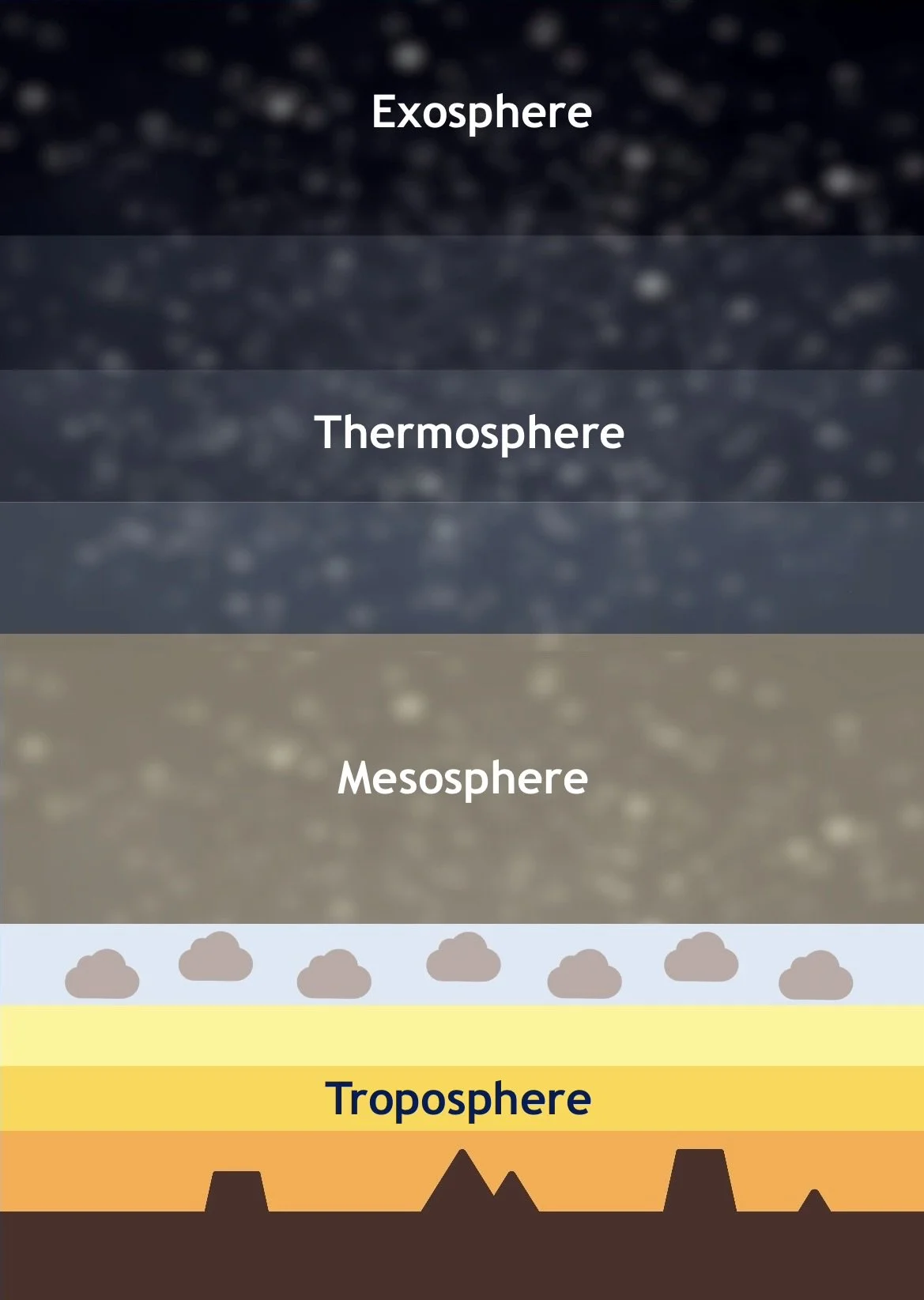
Venus has an incredibly thick and toxic atmosphere. It is almost entirely made up of carbon dioxide which traps heat from the Sun really effectively and has created a runaway greenhouse effect on the planet. Temperatures reach as high as 465°C (865°F), hot enough to melt lead. Despite being the second planet from the Sun, Venus is the hottest planet in the solar system. Even Mercury’s dayside cannot compete, while Venus retains its blistering heat throughout its long nights.
Heat is distributed through Venus’ atmosphere with remarkable efficiency, in part because it is exceptionally dense. Venus has slightly less gravity than Earth does but the atmospheric pressure at the surface is about 92 times that of Earth, equivalent to the pressure roughly 1 km (0.6 mi) beneath the surface of Earth’s oceans. To stand on Venus would mean enduring about 1,350 lbs. of force pressing against every square inch of your body, comparable to the weight of an adult grizzly bear. A car, building, or any other structure not specially designed to withstand such extreme pressure would be crushed almost immediately.
The immense pressure also squeezes the gases in the lower atmosphere into a supercritical state, not quite gas and not quite liquid. Despite this, Venus has remarkably little water vapor and is widely considered the driest planet in the solar system. If you could somehow withstand the crushing pressure and searing heat, walking on the surface would feel like wading through the mist of a waterfall without actually getting wet.
The upper atmosphere is quite a different beast. About 50-60 km (31-37 mi) above the surface, Venus’ thick, opaque clouds reach their densest layers. Made primarily of sulfuric acid, a highly corrosive substance that can cause severe chemical burns, these clouds allow only about a quarter of the Sun’s light to reach the surface while reflecting much of the rest back into space. This gives Venus the highest albedo in the solar system and makes it the third-brightest natural object in Earth’s sky, behind the Moon and Sun. At roughly this altitude, both temperature and air pressure also fall to levels similar to those at Earth’s surface on a warm day. If humanity were ever to colonize Venus, some scientists have speculated that it could take the form of airships or floating cities filled with breathable air, drifting above the clouds.
Fun fact: The abundance of sulfur in the Venusian atmosphere would give it an unpleasant rotten egg smell.
Fun fact: Astrobiologists have speculated that this region of Venus’ atmosphere could potentially support microbial extremophiles. Some have even proposed that the dark streaks observed in the clouds could be associated with microbial life, although this remains unproven.
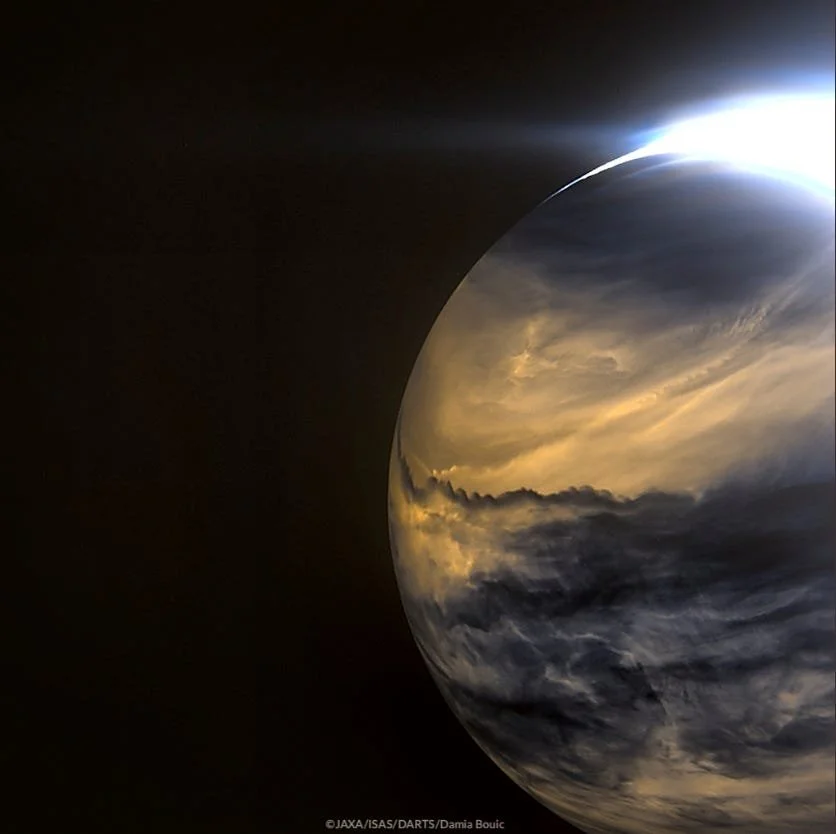
The cloud tops are swept by strong, perpetual winds that blow westward, parallel to the equator. They can reach speeds up to 60 times faster than the planet’s rotation, carrying the clouds around Venus in just four Earth days. This phenomenon is known as super-rotation. At the surface, however, winds range from a gentle breeze to nearly nonexistent, largely because of the immense density of the atmosphere. Winds are strongest near the equator and weaken toward the poles, producing a distinctive V-shaped pattern in images of the cloud layers. While carbon dioxide traps heat within the atmosphere, these powerful winds help distribute it around the planet, keeping the night side nearly as hot as the day side. Convection also carries heated air upward, where it emits infrared radiation. This light has been observed by Japan’s Akatsuki space probe (pictured), which orbited Venus before its mission ended.
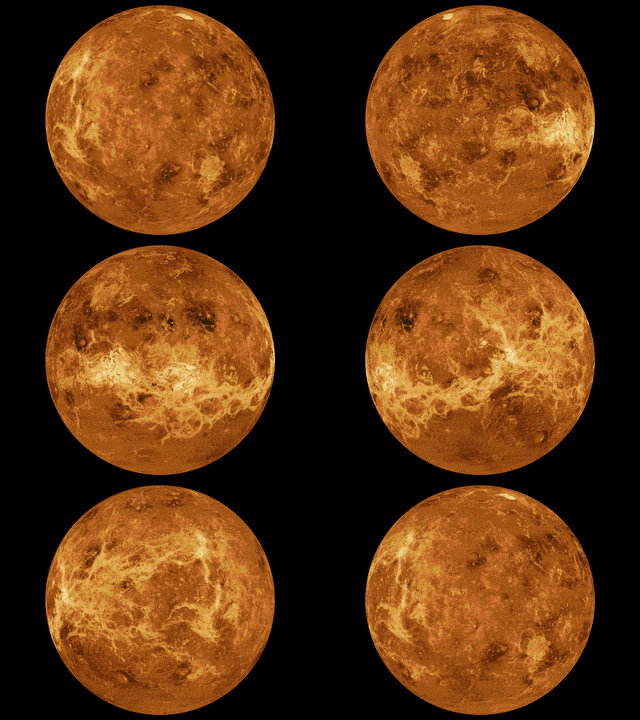
The opaque cloud tops of Venus make optical observation of the surface impossible from both Earth-based and orbital vantage points. Fortunately, probes like the Magellan spacecraft (1989-1994) have been able to use various forms of radar to cut through the cloud cover and map nearly the planet’s entire surface. Radar uses pulses of low frequency radio waves and higher frequency microwaves that reflect off distant objects, return back to the source, and record the time it took, revealing how far away the target object is. Radar mapping reveals a barren, rocky surface replete with volcanoes, great chasmic rifts, windswept erosion and large impact craters.
While Earth’s crust is divided into ever-shifting tectonic plates, Venus has a largely continuous outer shell of solid silicate rock. Despite this, the crust is not completely rigid. It can slowly deform as heat from the planet’s interior drives the circulation of material in the mantle. The crust resting atop this ocean of magma is pushed, pulled and squeezed from below. When the crust is squeezed by these stresses, it can buckle into folds, creating long ridges and wrinkles across the surface. Stronger compression can cause sections of crust to break and slide over one another, forming thrust faults. In other places, hot material rising from the mantle can push the crust upward into a broad dome. As the uplifted crust stretches and fractures, the center can eventually collapse, forming a distinctive circular or oval-shaped depression called a corona. Thousands of these features are scattered across Venus.
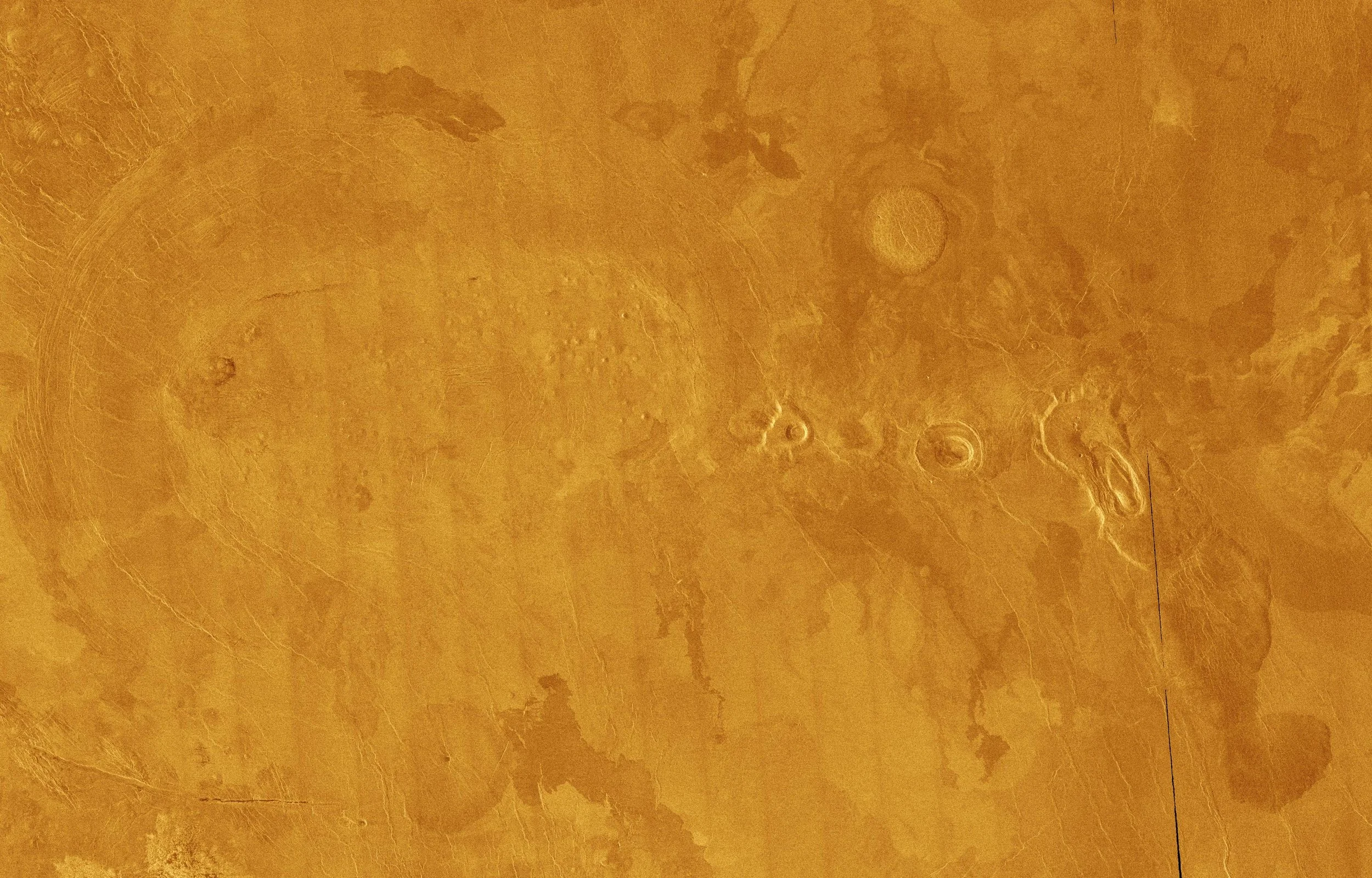
The vast majority of the Venusian surface consists of lowlands: broad, relatively smooth and flat plains of basaltic rock. These plains were formed by enormous outpourings of lava that flooded much of the planet’s surface hundreds of millions of years ago. Older terrain and the many impact craters that scarred it was buried beneath layer upon layer of volcanic rock. Any disturbances visible today are therefore largely a record of only what has occurred since. Scientists debate whether this happened in one catastrophic resurfacing event or a number of smaller ones across time. Either way, Venus has an unusually young surface.
As you can imagine, these plains are closely tied to Venus’ history of volcanism which played a major role in shaping its surface. Venus features the most volcanoes of any planet in the solar system, with over 80,000 known. While massive individual volcanoes do sit in highland-adjacent regions, the sheer volume of volcanic features and widespread plains volcanism heavily dominates the lowlands. About 99% of these are small shield volcanoes, less than 5 km (3 mi) wide. Larger volcanoes span diameters over 20 km (12 mi) to more than 100 km (60 mi). It’s common to find webs of dry lava channels of various lengths and widths that carve across the plains, concentrated around volcanic structures near the equator. For years, Venus was highly suspected to be still volcanically active today, but unconfirmed. In 2023, scientists comparing old Magellan probe radar data discovered that a volcanic vent had changed shape, expanding by nearly 2 km² over eight months. After ruling out other possibilities, scientists concluded that Venus is almost certainly still volcanically active.
Despite its fastest winds roaring high in the atmosphere, the slower winds near the surface of Venus can still exert substantial force on rock and regolith. When surface winds encounter obstacles such as rocky outcrops, they can pass loose sediment around them, leaving behind contrasting trails that extend downwind from the obstacle. These features are called wind streaks. Not only that, but that same wind over a very long time can sculpt the outcrops into sharp ridges called yardangs. The most surprising formations are windswept sand dunes scattered across low-lying plains. These mounds of sediment form under much higher pressure and appear more low-lying than those we find on Earth’s surface. In this way, they actually more resemble the sand dunes we find at the bottom of Earth’s oceans.
Some notable lowland regions across Venus are named after mythical or legendary women:
Guinevere Planitia is one of Venus’ largest and most extensive volcanic plains. Named after the legendary queen of Great Britain and wife of King Arthur. Features a trio of flat-topped volcanoes, with one having scalloped edges to give it a bottlecap appearance.
Atalanta Planitia is a huge northern lowland. Named after a Greek huntress who challenged potential suitors to a footrace. It is one of the largest, deepest, and most circular basins on the planet, like a giant sinkhole.
Lavinia Planitia is a major southern lowland characterized by extensive volcanic plains and tectonic deformation. Provides the best evidence that Venus has a “pack ice” geology, actively breaking and jostling around like frozen chunks of ice over a winter ocean.
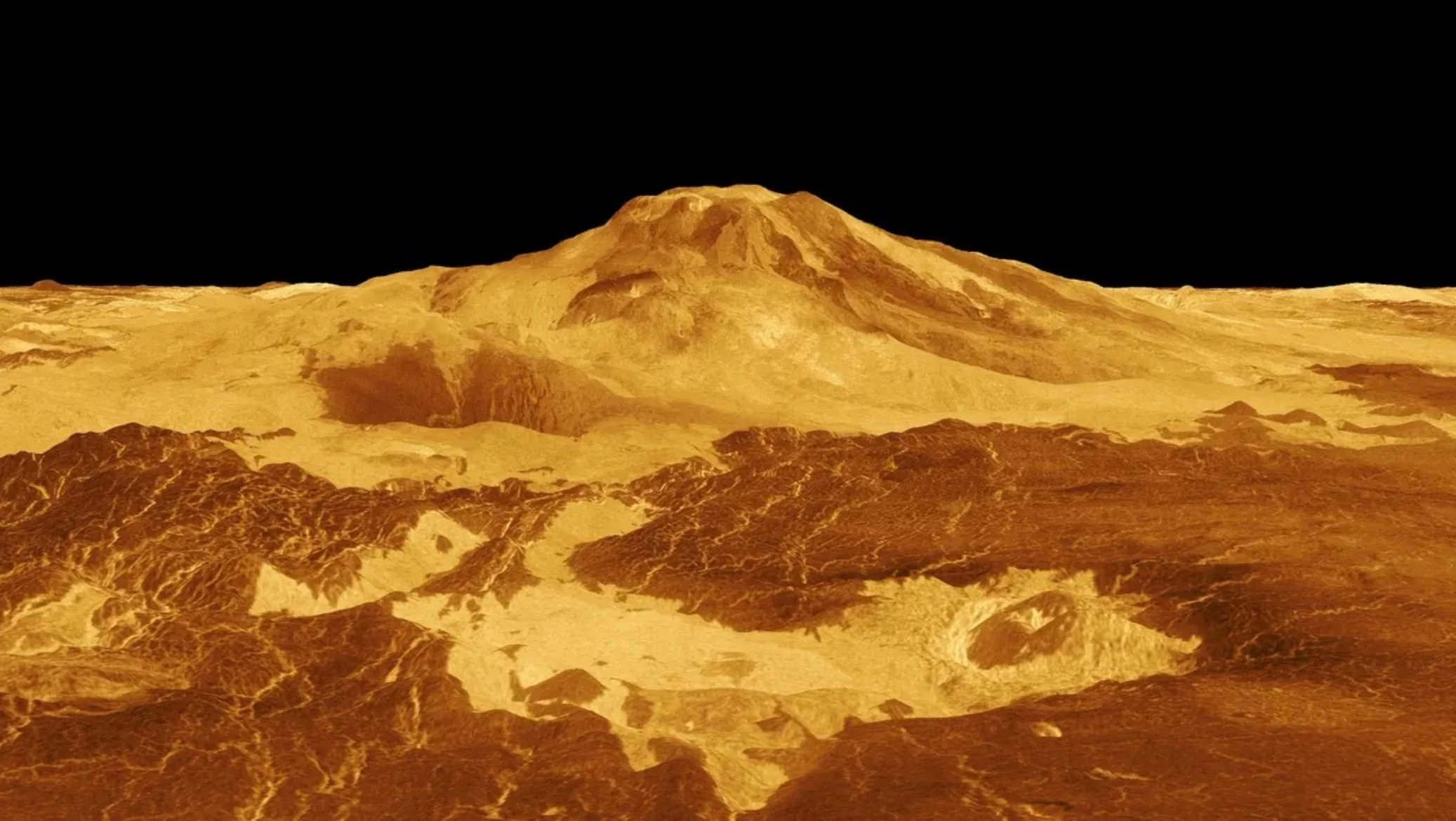
Like islands scattered across vast oceans, Venus’ mountainous highlands rise above its volcanic plains. They make up a relatively small portion of Venus’ surface (less than a tenth) but are among the oldest, most complex and distinctive landscapes the planet has. Their elevation has led scientists to sometimes describe them as “continents.” This is evocative of ideas some scientists have that Venus may have been more Earth-like in the past with a milder climate and oceans of liquid water. Geologically, these highlands are really more like calluses or scar tissue. The crust seems to have grown thick and rugged under a persistent regime of compression, folding and faulting. As a result, some have developed towering mountains, clustered into long, linear belts that resemble mountain ranges on Earth, like the Himalayas. The tallest mountain range on Venus is Maxwell Montes, whose highest peak reaches about 11.5 km above the mean planetary radius, much taller than Mount Everest.
The highlands appear as some of the brightest and most reflective regions on radar maps, also known as backscatter, owing to their rugged texture and unusual chemistry. As explained earlier, the highlands are regions of crust scarred by the stresses imposed by the restless, pulsating mantle below. Where the crust is compressed, enormous forces squeeze the rock together, buckling it into long rows of ridges and grooves. Elsewhere, the crust is stretched and pulled apart, fracturing the rock into blocks that may become tilted, uplifted, or sunken. This rugged, irregular terrain creates a multitude of surface orientations that can reflect radar waves strongly back toward their source. But texture may be only part of the story. The highlands also rise to greater elevations where the atmosphere is cooler, possibly allowing certain chemicals to form and remain stable. One of the oldest hypotheses proposes that iron-bearing rocks and sulfur-bearing gases interact to form pyrite, an electrically conductive mineral that strongly interacts with radar waves. More recent research has proposed competing or complementary explanations, including the presence of ferroelectric minerals, such as chlorapatite.
There three main highland regions across Venus, each named after a goddess of love:
Aphrodite Terra straddles the equator and is the largest and brightest highland (roughly the size of South America). It features colossal shield volcanoes like Maat Mons (pictured) and an extensive network of deep rifts.
Ishtar Terra is found in the northern hemisphere (roughly the size of Australia) and features a high, flat plateau bounded on most sides by the planet’s four main mountain ranges, including Maxwell Montes. Fun fact: This region is an explorable location in the 2014 video game, Destiny.
Lada Terra is found at the southern pole and is dominated by several oval-shaped bulges called coronae, surrounded by volcanic rifts and plains.
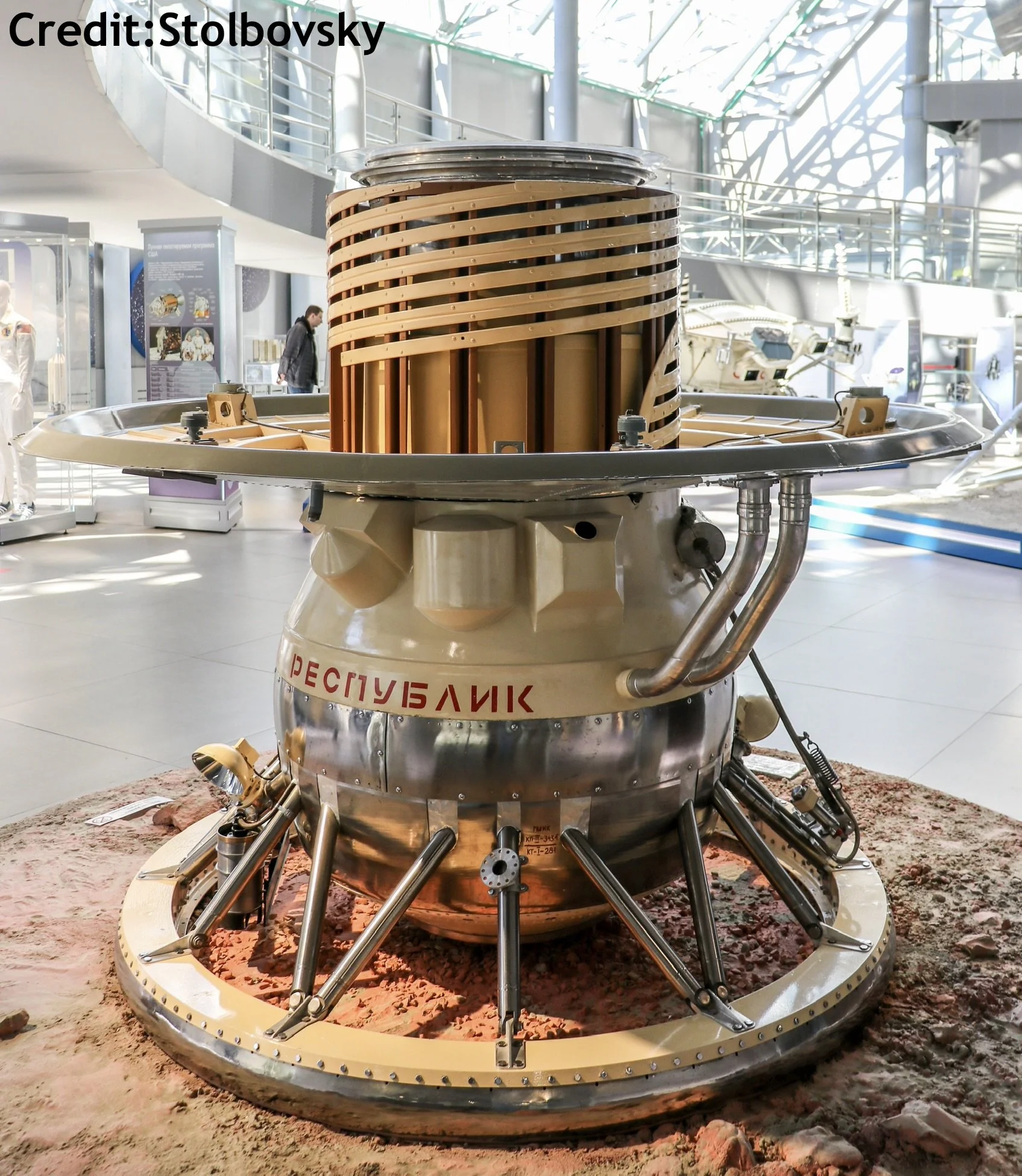
The surface and atmosphere of Venus together create a nightmarish environment and render unmanned-exploration difficult and manned-exploration improbable. That being said, humans have managed to put eight space probes in orbit around Venus and ten landers on the surface, with the Soviet Union being responsible for half of the former and all of the latter. Here is a brief history of the milestones achieved:
On December 14, 1962, NASA’s Mariner 2 space probe became the first spacecraft to successfully flyby another planet, passing within 35,000 km. While it did not enter orbit, nor did it have a camera, it was able to record the planet’s blistering temperature. This was the first time humans came to understand Venus for the hellish world it is.
On October 18, 1967, the Soviet Union’s Venera 4 space probe not only reached Venus but dove into the planet’s atmosphere which revealed its incredible thickness and carbon dioxide composition. The space probe was not built to survive to the surface and was destroyed.
On December 15, 1970, the Soviet Union’s Venera 7 space probe became the first spacecraft to make a successful soft landing on another planet and the first to transmit data from another planet’s surface. It sent back as much temperature and pressure data as it could before it succumbed to the scorching, crushing atmosphere. It only lasted 23 minutes. By this point, it became very clear that Venus was not remotely habitable.
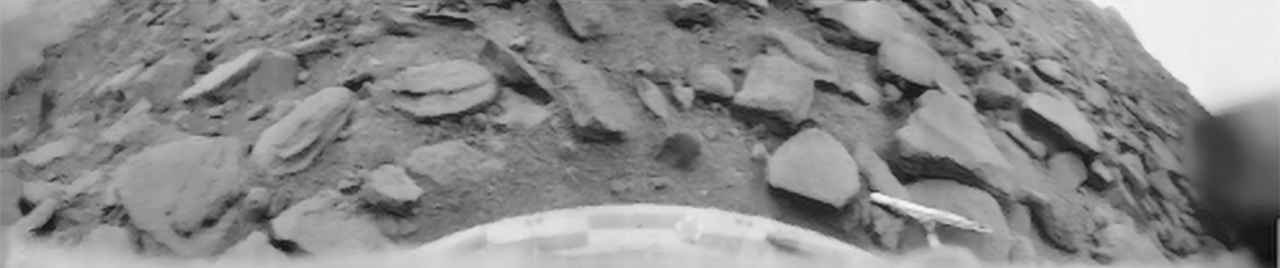
On October 22, 1975, the Soviet Union’s Venera 9 space probe (lander and black & white photo pictured), consisting of both an orbiter and a lander. The two components separated, with one remaining in space and the other descending into the atmosphere. The lander deployed its parachute and touched down on a steep slope covered with rocks. It became the first spacecraft to orbit another planet and transmitted the first photographs taken from the surface of another planet. The lander survived for about 53 minutes. Venera 10 arrived on the Venusian surface just three days later to transmit photos. The Venera 9 orbiter continued conducting surveys until it suffered a hardware failure in March 1976. It remains in a stable orbit around Venus to this day.
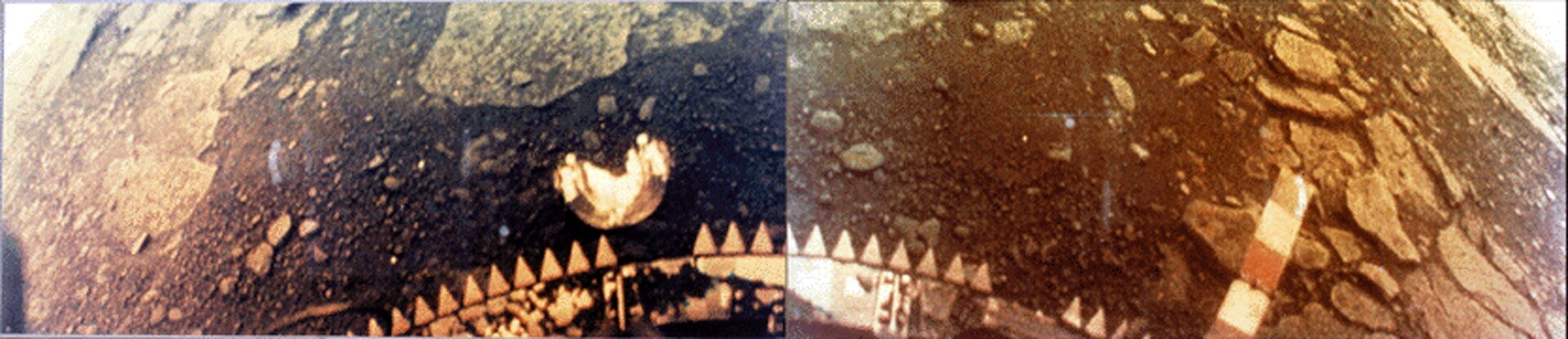
On March 1, 1982, the Soviet Union’s Venera 13 lander touched down in the Venusian surface where it captured color photographs (pictured). These are among the most famous photos ever returned from another planet. The lander was also equipped with a microphone to record the first sounds from another planet, specifically the wind. The lander was built to survive for only half an hour but ended up lasting over two hours! Venera 14 would soon follow up to become the fourth and, as of today, most recent lander to return images of the surface of Venus.
From 1989 to 1994, NASA’s Magellan orbiter used radar imaging to map 98% of the Venusian surface with remarkable detail. In some regions, resolution of 100-300 meters per pixel was achieved. It was only the latest in a series of efforts by both the U.S. and the Soviets to map the surface, but this was the first spacecraft to map virtually the entire planet. Upon completing its mapping mission, Magellan was directed to dive into the atmosphere where it was destroyed.
On April 11, 2006, the ESA’s Venus Express orbiter became the first European spacecraft to enter into orbit around Venus. By this point, we were no longer asking, “What is Venus like?” but asking “Why is its atmosphere so radically different from Earth?”
On December 7, 2015, JAXA’s Akatsuki orbiter became the first Japanese spacecraft to enter into orbit around Venus. Its primary mission was meteorological, studying the planet’s weather and climate.