
JUPITER
The king of the planets.
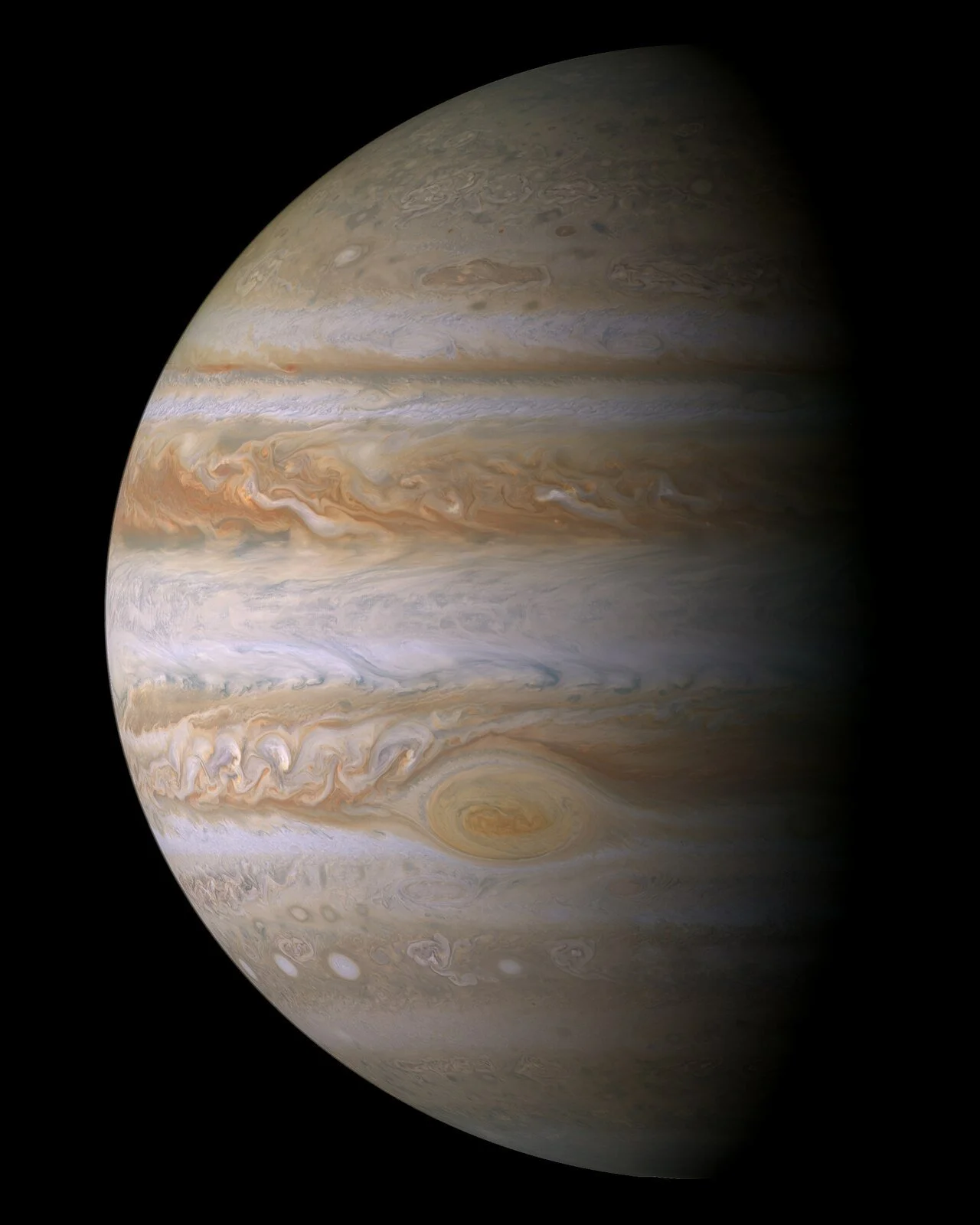
Distance from the Sun: 778 million km (5.2 AU or 43 light minutes)
Diameter: 143,000 km
Rotation period: 10 hours
Orbital period: 11.8 years
Beyond the small terrestrial worlds huddled closely around the Sun, just past the expansive fields of asteroids encircling them, looms a colossus. A monstrous world with unrelenting storms of planetary scale, crushing depths, and the gravitational might to hurl humongous rocks across space. Nothing in the solar system casts a larger shadow than the celestial behemoth, Jupiter. Being named after the Roman counterpart of Zeus, the king of the gods, is no overstatement. Jupiter is the largest and most massive planet in the solar system. Known to ancient civilizations long before the invention of the telescope, Jupiter can easily be seen with the naked eye. It is outshined only by the Sun, Moon and Venus (and occasionally Mars). This is certainly due to the planet’s immense size. From Earth, Jupiter can appear as large as 50 arcseconds across, about 1/36th the size that our Moon appears.
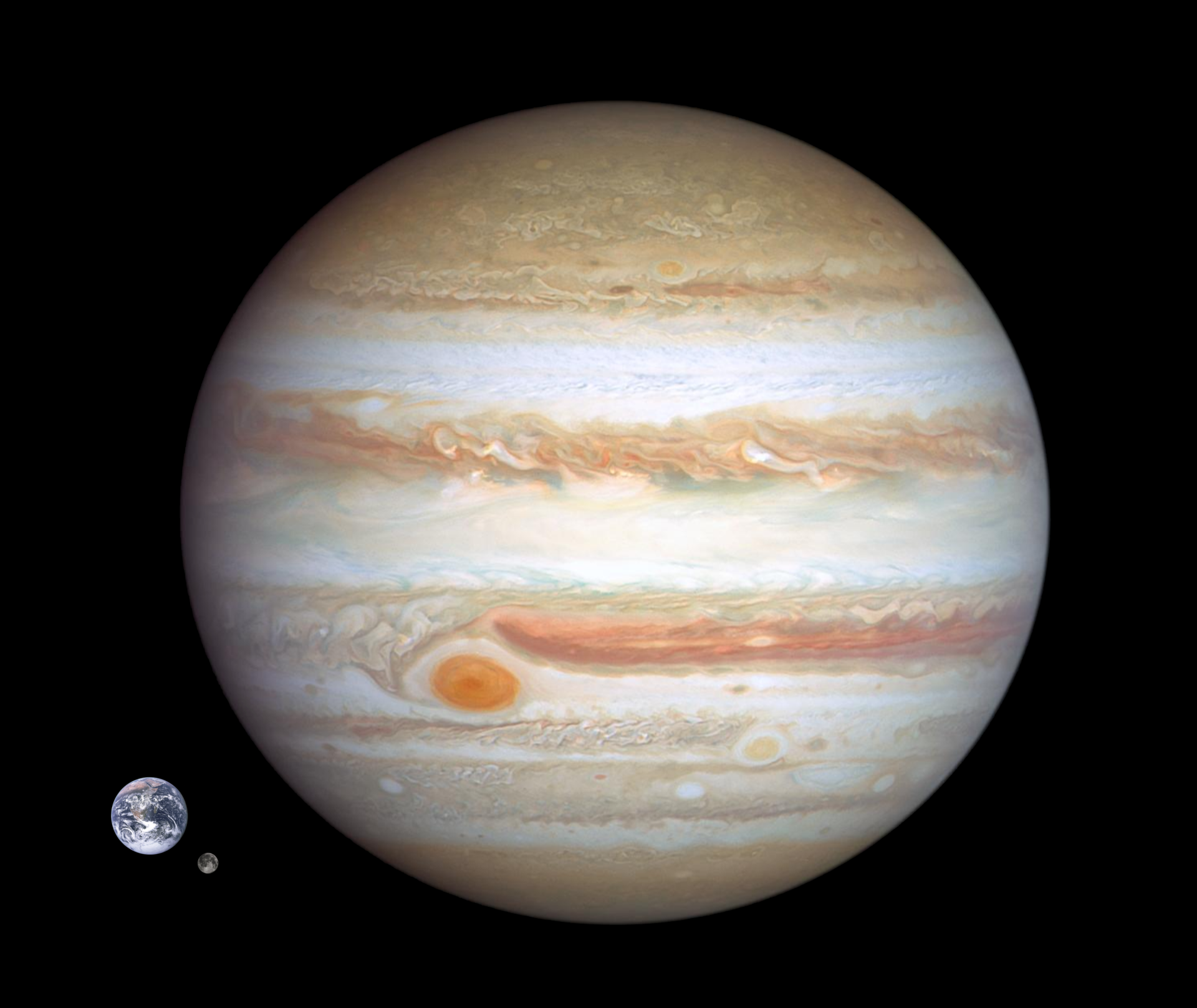
In reality, Jupiter’s diameter spans about 11 Earths across at the equator. You could fit more than 1,300 Earths inside its entire volume. That isn’t for show, either. Jupiter has a lot packed into that size. Truly a super heavyweight, Jupiter has 318 times the mass of Earth! Make no mistake, even Jupiter can’t hold a candle to the Sun, which is ten times wider and over a thousand times more massive. The Sun contains 99.85% of the entire solar system’s mass while Jupiter only accounts for 0.1%. However, take away the Sun and Jupiter shoots up to more than 70% of the remaining mass. That’s 2.5 times the mass of all the other planets combined! It is the only planet whose shared center of mass with the Sun, their common barycenter, lies outside the Sun’s surface.
Fun fact: If Earth was the size of a marble, Jupiter would be the size of a basketball, and the Sun would reach the height of a basketball hoop!
Closer look: It is a common sentiment that Jupiter is a ‘failed star’, but this isn’t really the case. Jupiter’s mass would need to be multiplied by at least 75-80 times to trigger thermonuclear fusion. It’s more accurate to say that Jupiter is a really successful planet. Actual failed stars would be brown dwarfs.
You’d think hauling all that weight around would make the planet sluggish but Jupiter in fact has the fastest spin in the solar system, making a full rotation in just 10 hours. This is so fast that the centrifugal force actually causes Jupiter to bulge at the equator. When you were a kid, did you ever try to ride a fast-spinning merry-go-round? Your body got pulled outward and you had to hold on, right? It’s the same idea. Jupiter is nearly 10,000 km wider at its equator than it is from pole to pole, giving it an oblate shape that’s noticeable with even a backyard telescope! It sounds counterintuitive but this rapid rotation is actually a product of the planet’s size. Astronomers highly suspect that Jupiter formed first among the planets, beginning to accumulate material from the protoplanetary disk of gas and dust surrounding our young Sun. As this swirling material fell inward, the conservation of angular momentum caused it to spin faster and faster. Naturally, the largest concentration of mass amongst the planets would generate gravity to pull material with the greatest force.
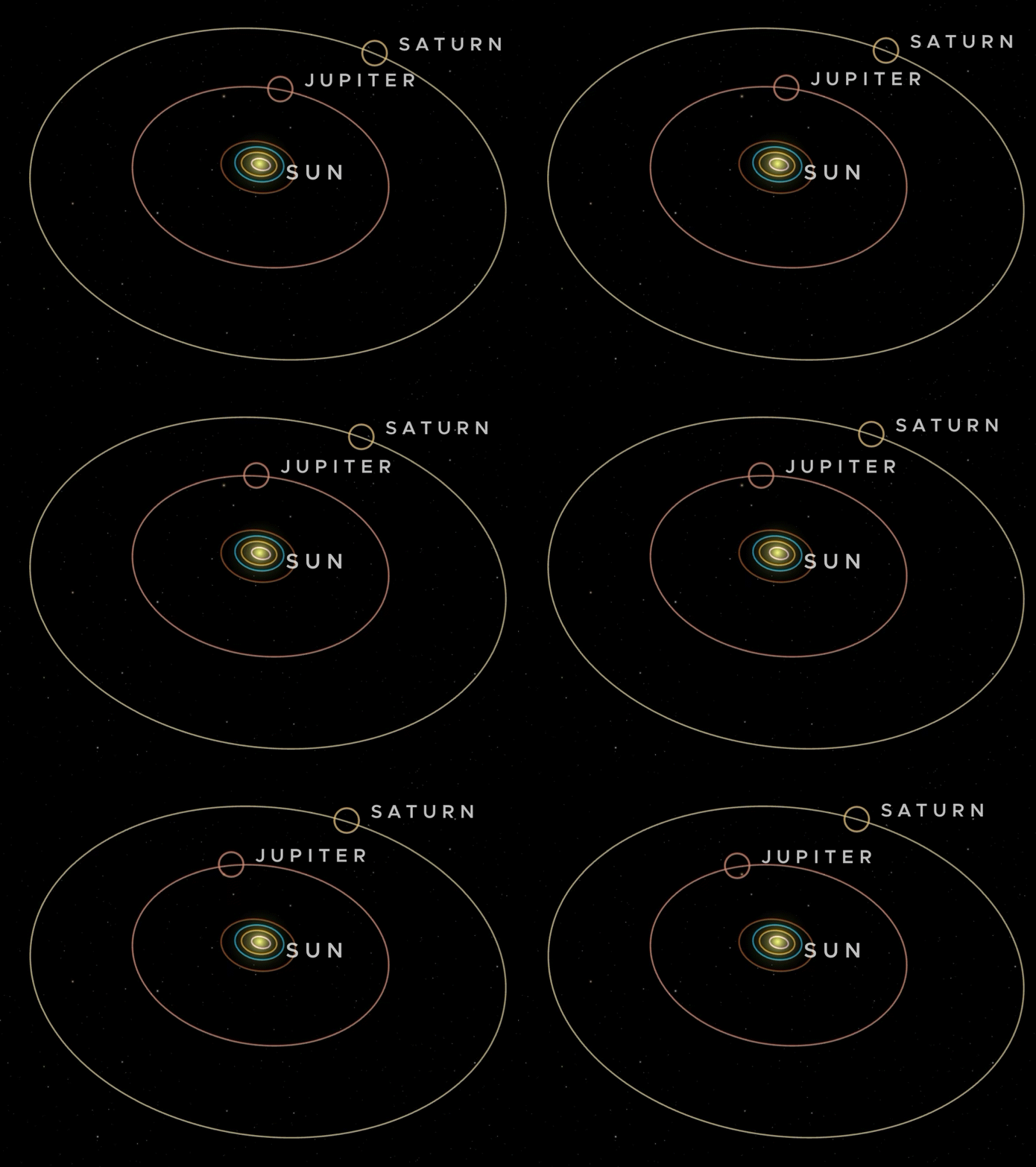
Jupiter orbits more than five times farther from the Sun than Earth, taking nearly 12 Earth years to complete one revolution. This is almost six times longer than Mars, but less than half as long as Saturn. Imagine Earth and Jupiter as hands on a clock, with both moving counterclockwise. While Earth completes a full revolution from midnight back to midnight, Jupiter advances only from midnight to about 11 o’clock. As a result, Jupiter takes roughly a year to cross each zodiac constellation along the ecliptic. After each opposition, Earth needs about 13 months to catch up with Jupiter at the same clock position again. This shifts Jupiter’s opposition, and its best viewing season, backward by roughly one month each year. A summer opposition, for example, becomes a winter opposition about six years later.
Its orbit is nearly circular, but it does have the highest eccentricity of any of the giant planets, meaning it’s the most stretched.