
MARS
The red planet.
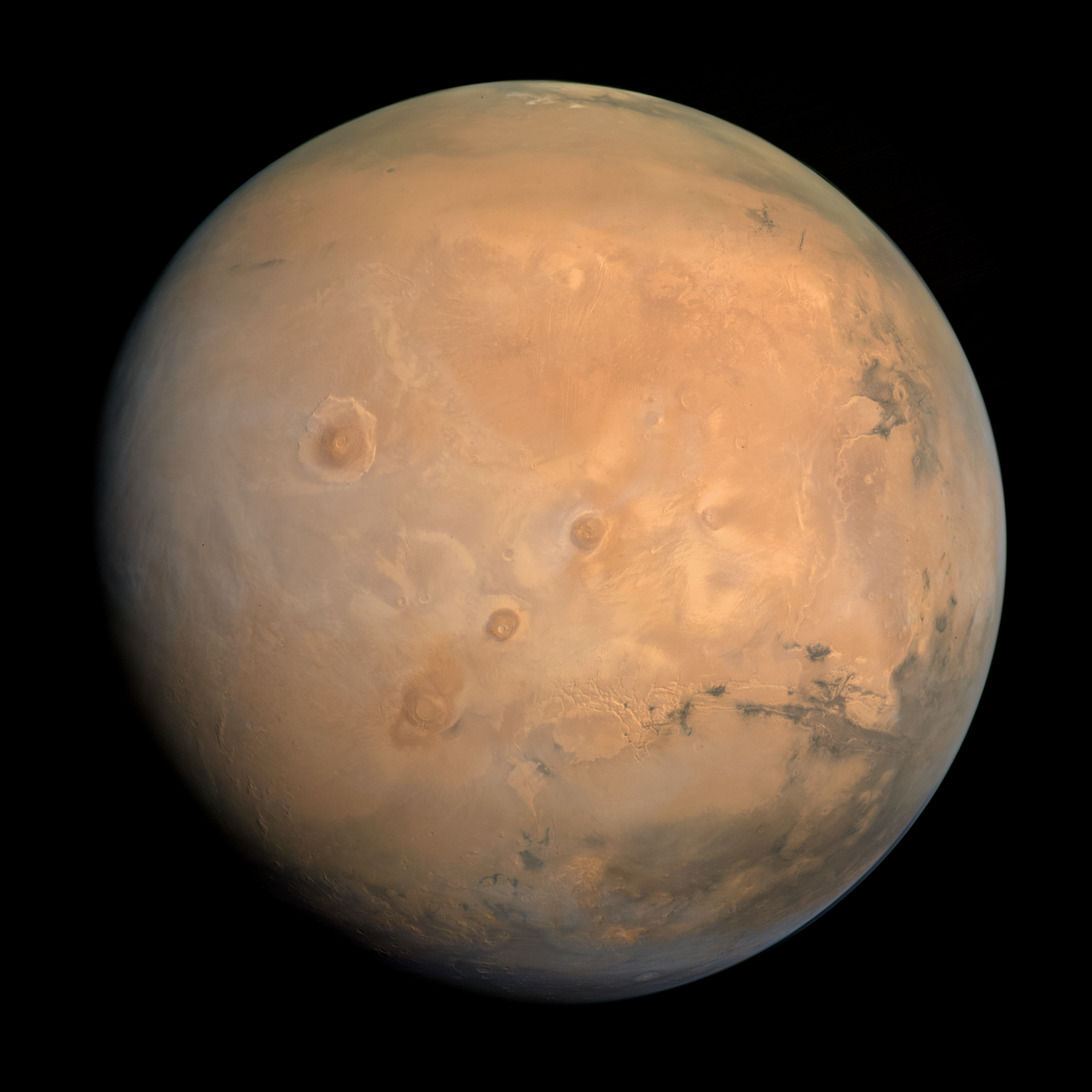
Distance from the Sun: 228 million km (1.5 AU or 12.6 light minutes)
Diameter: 6,800 km
Rotation period: 24.6 hours
Orbital period: 686 days
Beyond Earth is a strangely familiar world that has inspired countless pieces of art and storytelling since ancient times. Mars is the outermost of the terrestrial planets and the second smallest planet in the solar system, after Mercury. It has been wandering across our skies as a bright point of red light long since before the dawn of humanity. Its red color was often associated with blood, and its exaggerated retrograde motion resembled the advancing and retreating of a military force. The ancient Babylonians possibly gave Mars its first name as Nergal, after their deity of war and death. The Greeks had the same idea and called it Ares after their god of war. The Romans quickly followed suit and bestowed it with its modern moniker, Mars (the Roman counterpart to Ares).
Millennia later, Renaissance astronomers would uncover its true nature. It was a terrestrial world of crimson rock. Speculation about Mars having seas and lifeforms inspired many science fiction stories in the late 19th century centering Mars as either a hopeful frontier of human exploration or the staging ground for an extraterrestrial invasion, most famously the War of the Worlds (1897) by H.G. Wells. Today, we have a much deeper and intimate understanding of Mars that reveals that it’s not quite as alien as we once thought.
It could be argued that Mars shares more consequential traits with Earth than Earth does with its so-called sister planet, Venus. For one thing, Mars is the only other planet that orbits within the Sun’s Goldilocks zone. It has a comparable axial tilt of 25°, meaning it experiences similar seasons. Mars rotates on its axis about every 24 hours, similar to Earth. A year on Mars is nearly twice as long but that’s not that much more when compared to the decades to centuries-long orbital periods of the outer planetary mass objects. There are other interesting examples as well that illuminate what makes Mars such an important planet for the future of humanity’s ventures into space, but we’ll come back to that later.
Mars was long known to brighten and dim in about two-year intervals. This was suspected to be related to its retrograde motion, indicating Mars was getting closer and further away as Earth was regularly overtaking it in our faster orbit. However, the planet was too far to say for sure. It was Galileo Galilei who first observed Mars through a telescope in 1609. He confirmed everybody’s suspicions that Mars was advancing and receding from Earth as it orbited the Sun. This was yet more proof of the heliocentric model described by Nicolas Copernicus.
Because Mars is the closest planet outside Earth’s orbit, it exhibits the greatest range in apparent brightness and angular size. Its most dramatic changes occur between opposition, when Earth lies directly between the Sun and Mars, and superior conjunction, when Mars is on the far side of the Sun. Even from one opposition or conjunction to another, Mars can vary in size and brightness because its distance from the Sun also changes: near perihelion, Mars is closest to the Sun, while near aphelion, it is farthest from the Sun.
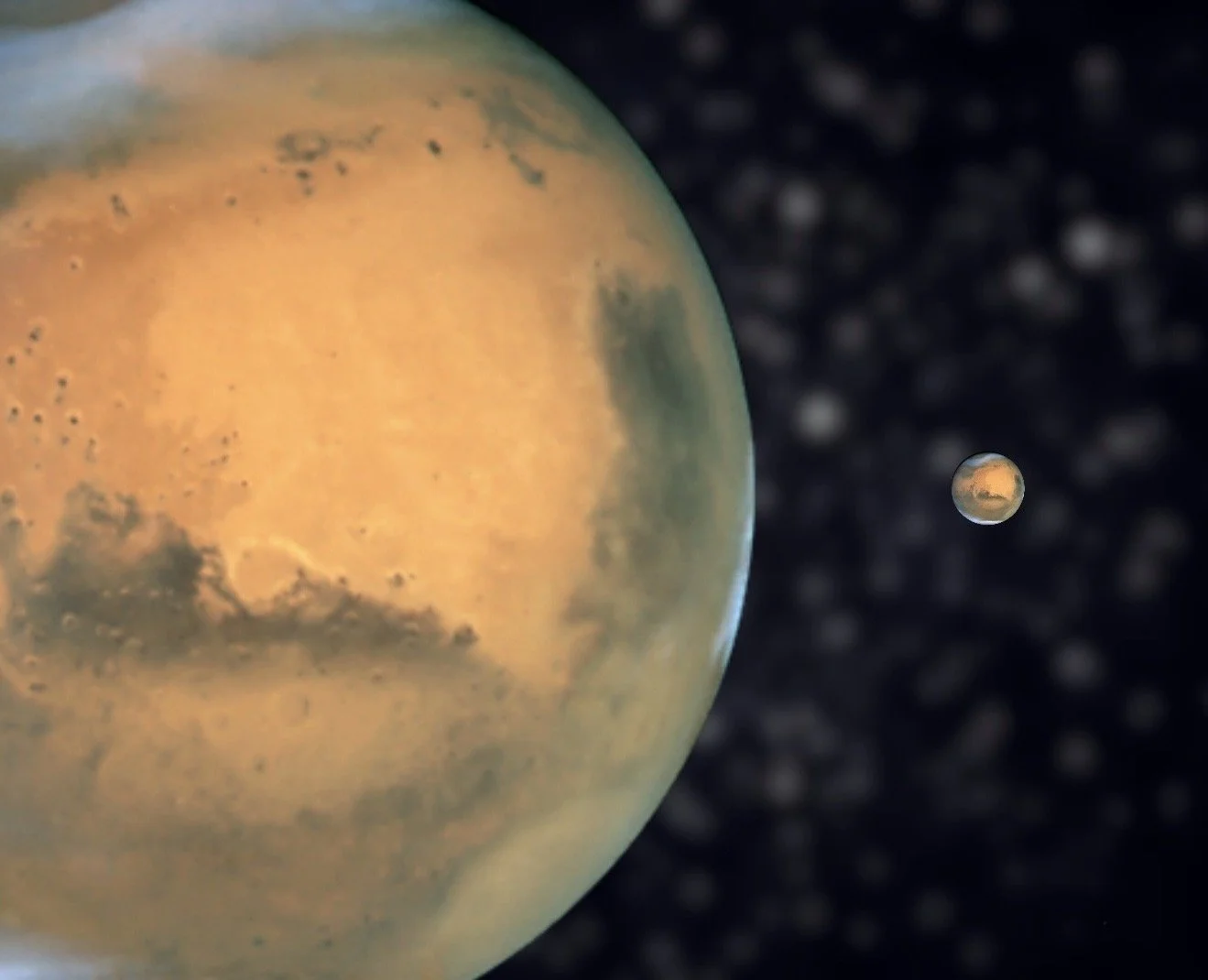
If Mars is at a favorable opposition, it can shine at a magnitude of -3, rivaling Jupiter. Through a telescope, Mars would appear 25 arcseconds across, about half the size that Jupiter appears while at opposition (pictured).
If Mars is at an unfavorable opposition, it can shine at a magnitude of -1.2, still brighter than every other distant star, with the exception of Sirius. Through a telescope, Mars would appear 14 arcseconds across, smaller than Saturn.
When Mars reaches superior conjunction, it’s too close to the Sun to be observed safely. However, if we could make the Sun vanish momentarily, we would find Mars to appear at a magnitude of +1.2 and 4 arcseconds across when at perihelion or appear at a magnitude of +1.8 and 3.5 arcseconds across when at aphelion (pictured). This magnitude is comparable to the star Alkaid at the tail end of the Big Dipper.
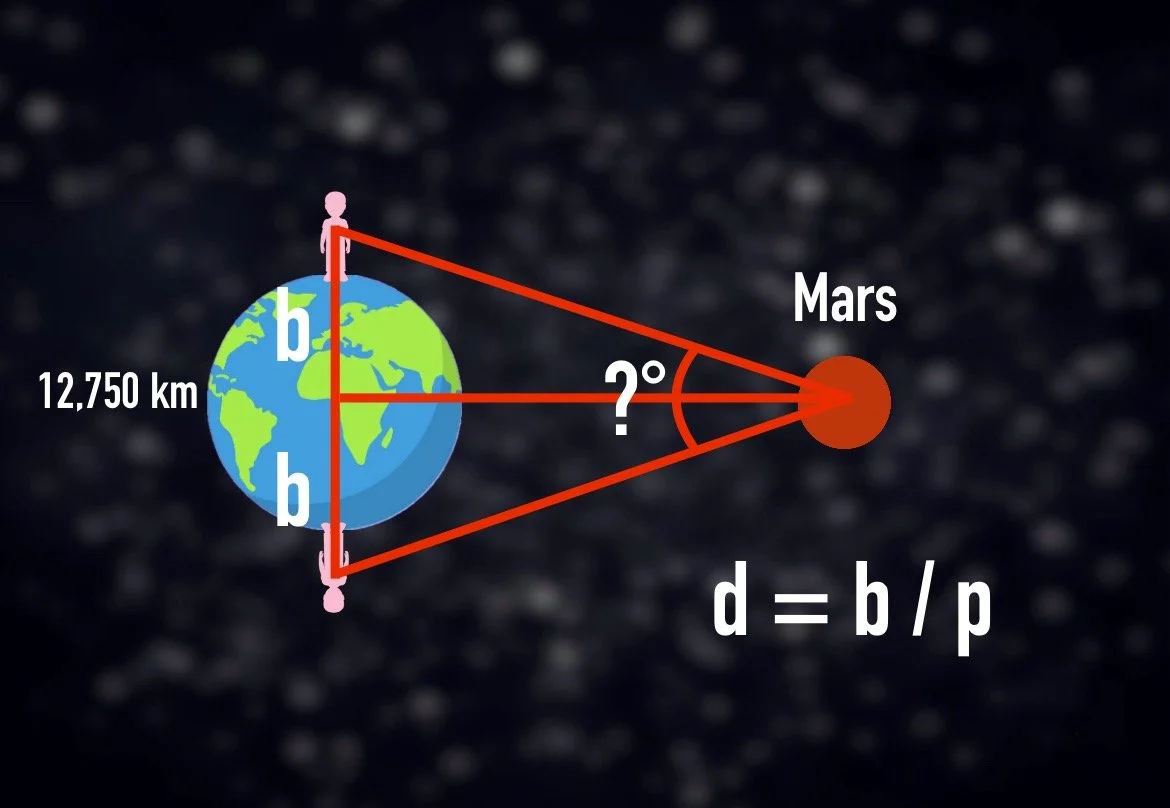
The true distance of Mars was determined in 1672. Giovanni Cassini observed Mars at opposition from Paris, France while his colleague Jean Richer travelled to Cayenne, French Guiana. From their different vantage points, Mars appeared in slightly different positions against the distant background stars. The angle of this apparent shift allowed them to triangulate how far away the planet was (pictured). This is known as the parallax method.
The distance they calculated allowed them to extrapolate that out to the broader solar system. Johannes Kepler’s laws of planetary motion had already provided astronomers with a good idea of the size of each planet’s orbit relative to one another. For example, the average distance between the Sun and Earth is defined as one astronomical unit (AU). At the time, astronomers didn’t really know what that distance actually was. What they did know, however, was that the time it took Mars to go around the Sun indicated that its average distance from the Sun was 1.52 times further than Earth’s. In other words, Mars was 1.52 astronomical units from the Sun.
Now that Cassini and Richer knew what the real distance of that extra 0.52 AU was, they were able to calculate the distance between the Sun and Earth. They determined that distance to be 140 million km. This figure was off by 7% of today’s measurement, which is honestly pretty accurate considering the limitations of 17th-century telescopes.
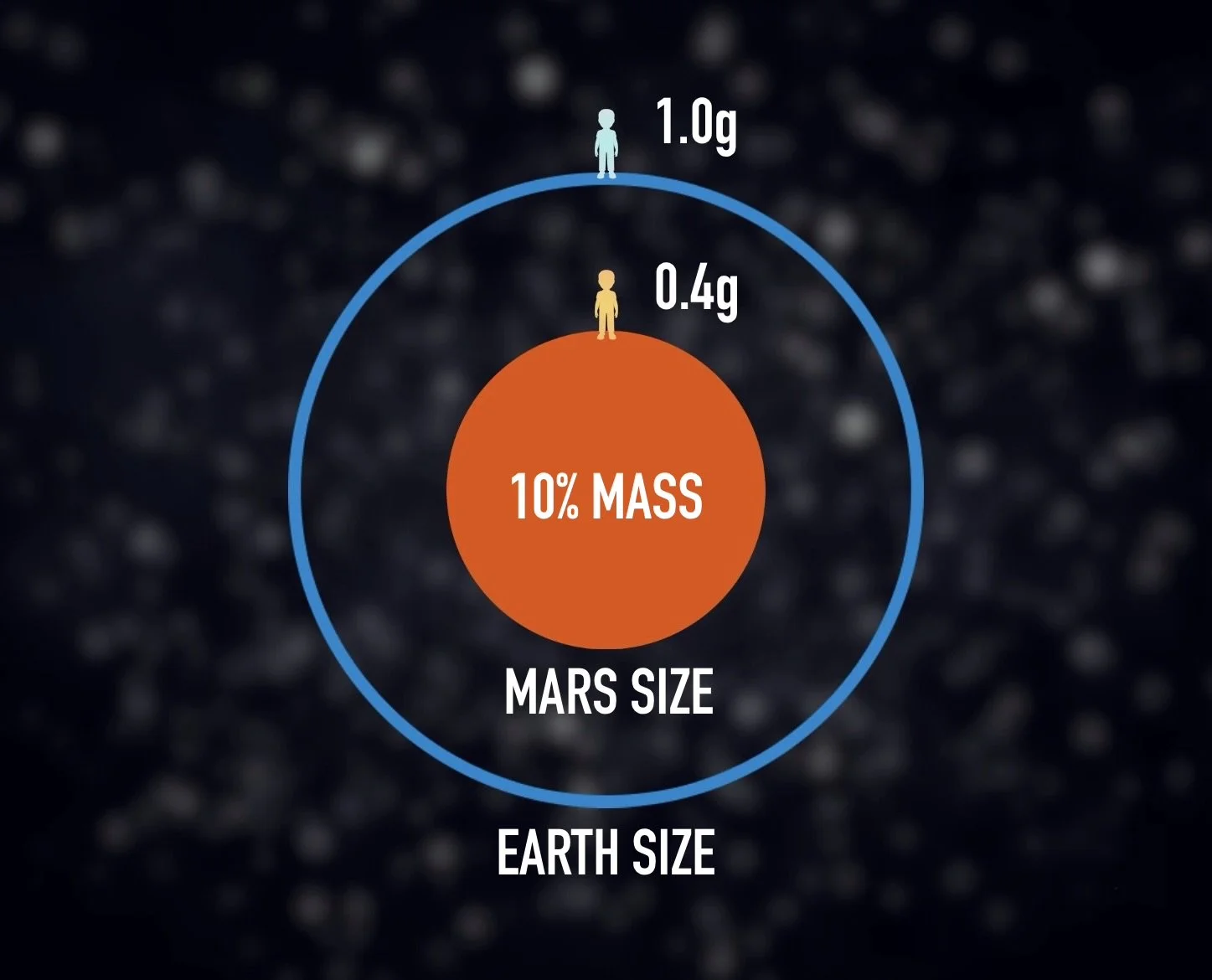
Mars only has about 10% of Earth’s mass and about 40% of Earth’s gravity. But wait… Shouldn’t a planet that has only 10% of the mass only have 10% of the gravity? As we know, the strength of gravity changes exponentially with a square of the distance. If you halve the distance, you quadruple the gravity. Well, Mars is about half the diameter of Earth so the 10% gravity at an Earth-like distance from the center becomes 40% on the surface of Mars.
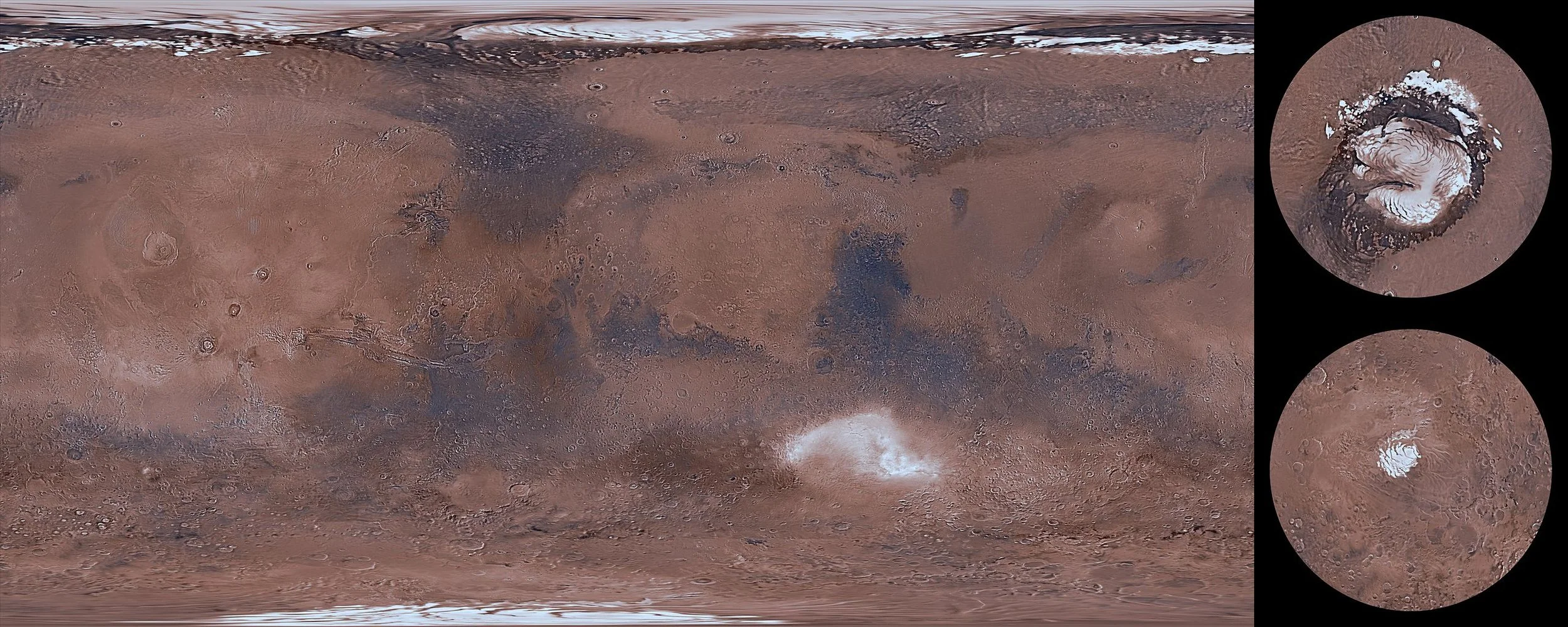
As observations of Mars continued throughout the 17th century, better telescopes resolved clearer images of the planet. The surface was revealed to be more than the simple red light it had always been known as. It had dark blemishes across its red surface near the equator and bright spots at the poles. These were surface features! By carefully watching how they moved across the planet’s disk, astronomers were able to determine the length of Mars’ day and the tilt of its rotational axis. As we mentioned earlier, these are both strikingly similar to Earth!
At first glance, the Martian surface as we know it today may seem like just a continuous desert. However, this really shortchanges how much fascinating history is written into its seemingly barren landscape.
The first question you may have is:
“Why is Mars red?”
While this is the most popular question, it’s also the easiest to answer. The surface of Mars is coated in a layer of dust that is as fine and rich in iron oxide, the main component of rust. This is the very same rust you find on old cars, bike chains and water pipes. How do we know that if we’ve never directly sampled the surface? When sunlight reaches the surface of Mars, its minerals absorb and reflect specific wavelengths, creating a unique spectral “fingerprint.” Spectrometers analyze the reflected light to identify which wavelengths are present or missing, allowing us to match those fingerprints to known minerals and chemical elements.
“What about the dark regions?”
The Martian surface itself is composed of dark volcanic rock, called basalt. This is the solidified remnant of ancient lava flows from volcanic eruptions. It’s the same mineral we find on Earth’s ocean floors and on the Moon’s darker maria. It is packed with heavy metals like iron and magnesium that are tightly locked inside so they don’t oxidize like the dust does. Sometimes windstorms will sweep up the rusty dust from an area and deposit it elsewhere, leaving the original basaltic surface exposed. Regions of high elevation and steep slopes are more likely to lose their dust and less likely to be recovered. Additionally, the exposed dark surfaces absorb more sunlight and get hotter.
“And the white regions?”
Those are Mars’ polar ice caps. We’ll get more into them a bit later.
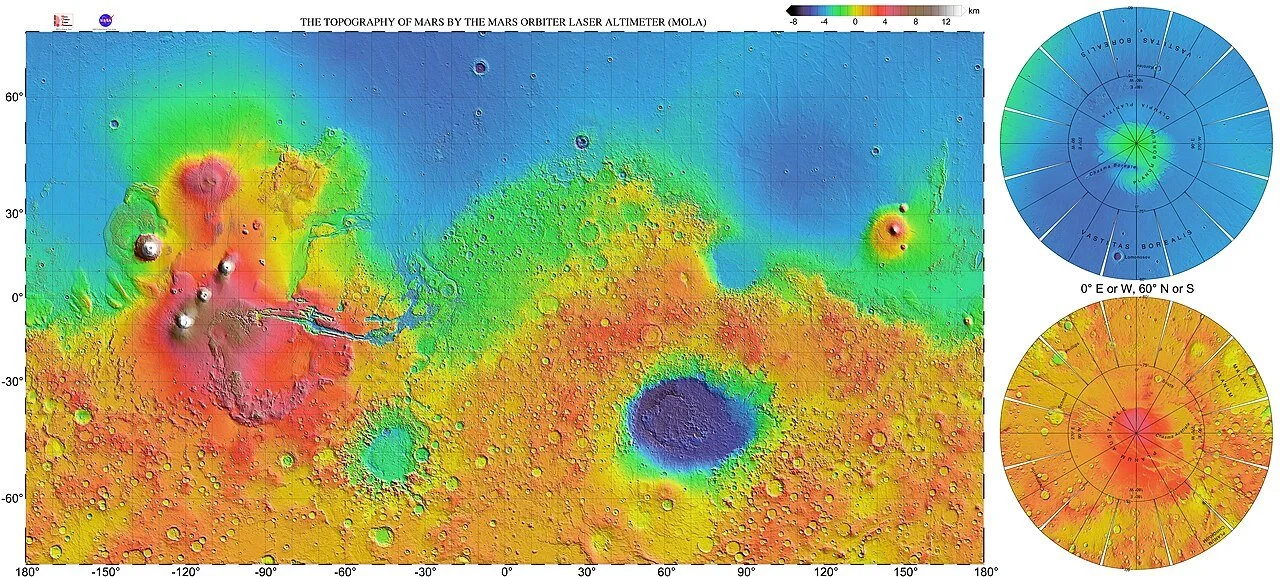
The topography of Mars shows a clear delineation between the northern hemisphere and southern hemisphere, separated by a complex boundary. The northern hemisphere is dominated by vast plains flattened by solidified lava flows and feature very few impact craters. These lowland regions make up about a third of the Martian surface. The southern hemisphere is dominated by highlands, pitted and cratered by ancient impacts. On average the highlands lie 3 km above the lowlands. The sharp contrast between these two halves is known as the Martian dichotomy.
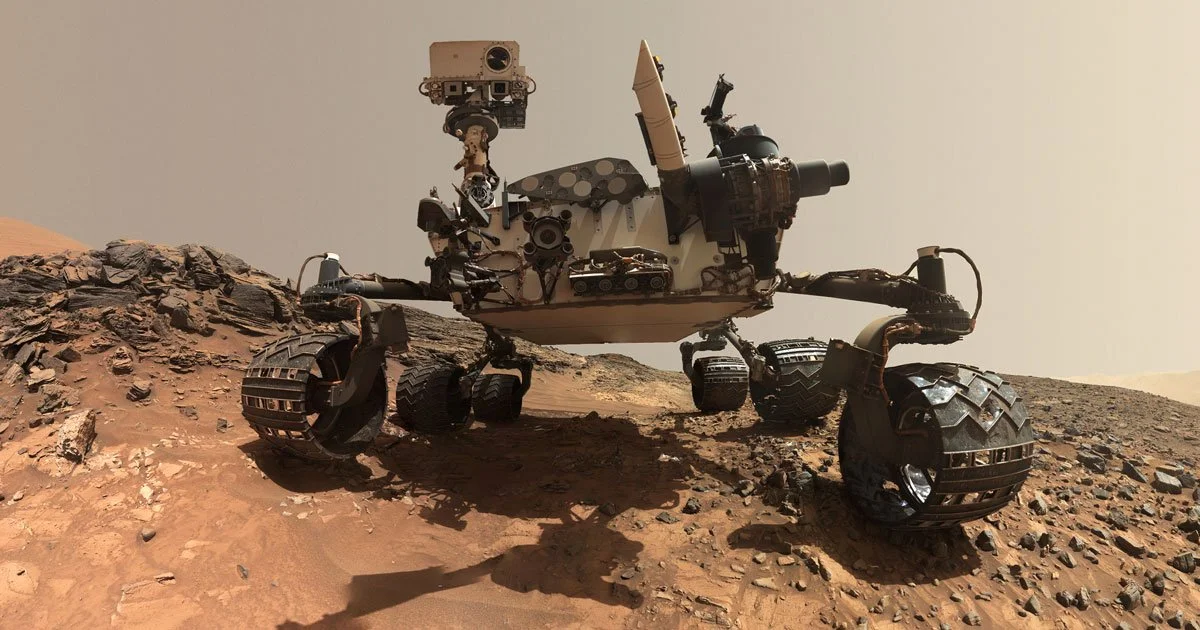
Despite serious considerations of sending astronauts to Mars, exploration of the red planet up to this point has been exclusively unmanned. What began with brief encounters has gradually developed into a sustained presence on the Martian surface.
NASA’s Mariner 4 conducted the first successful flyby in 1965, followed by Mariner 9 in 1971, which became the first spacecraft to orbit around another planet. That same year, the Soviet Mars 3 became the first spacecraft to successfully land on the surface. In 1976, NASA’s Viking 1 transmitted the first clear images from the surface, and in 1997, Sojourner became the first wheeled vehicle to operate on another planet. NASA’s twin rovers, Spirit and Opportunity, landed in 2004 for a planned 90-day mission. They far exceeded expectations, lasting several years. Opportunity was especially tenacious. It remained operational until 2018 and travelled 45 km (28 mi), longer than a marathon run and remains the record for now. Since their arrival, humans have maintained an unbroken robotic presence on the red planet’s surface. All the while, the Mars Reconnaissance Orbiter has watched from the skies, providing countless high-resolution satellite images to see how the geology changes over time and acting as a communications relay for the rovers. China’s Zhurong rover, which landed in 2021, expanded exploration of the Martian surface beyond NASA. It has thus far been the only successful non-American rover. Unfortunately, it lost power a year after landing, following a sandstorm.
There are two rovers currently active on Mars:
Curiosity rover (pictured) landed at Gale Crater in 2012. In 2026, it will surpass Opportunity as the longest active rover in Mars history.
Perseverance rover landed at Jezero Crater in 2021. It was accompanied by the compact Ingenuity helicopter, which performed the first powered flight on another world.
Mars rovers are not manually controlled because radio signals can take as much as twenty-two minutes to travel to and from Earth each way. Instead, they are sent daily sequences of commands to travel to waypoints or interact with the environment. More advanced rovers use stereo cameras to build 3D maps of their surroundings and identify obstacles. Repairing damage is impossible, so all actions taken by a rover are the result of meticulous deliberation and planning.
Over the span of three decades, these remote-controlled vehicles have captured and transmitted more than two million images of the Martian surface. This has given us an unprecedented view of another world and has made Mars one of the most thoroughly explored and visually documented planets in the solar system. They have also gathered dozens of rock samples into small capsules with the hope that future missions will enable us to retrieve them and study them in laboratories on Earth.
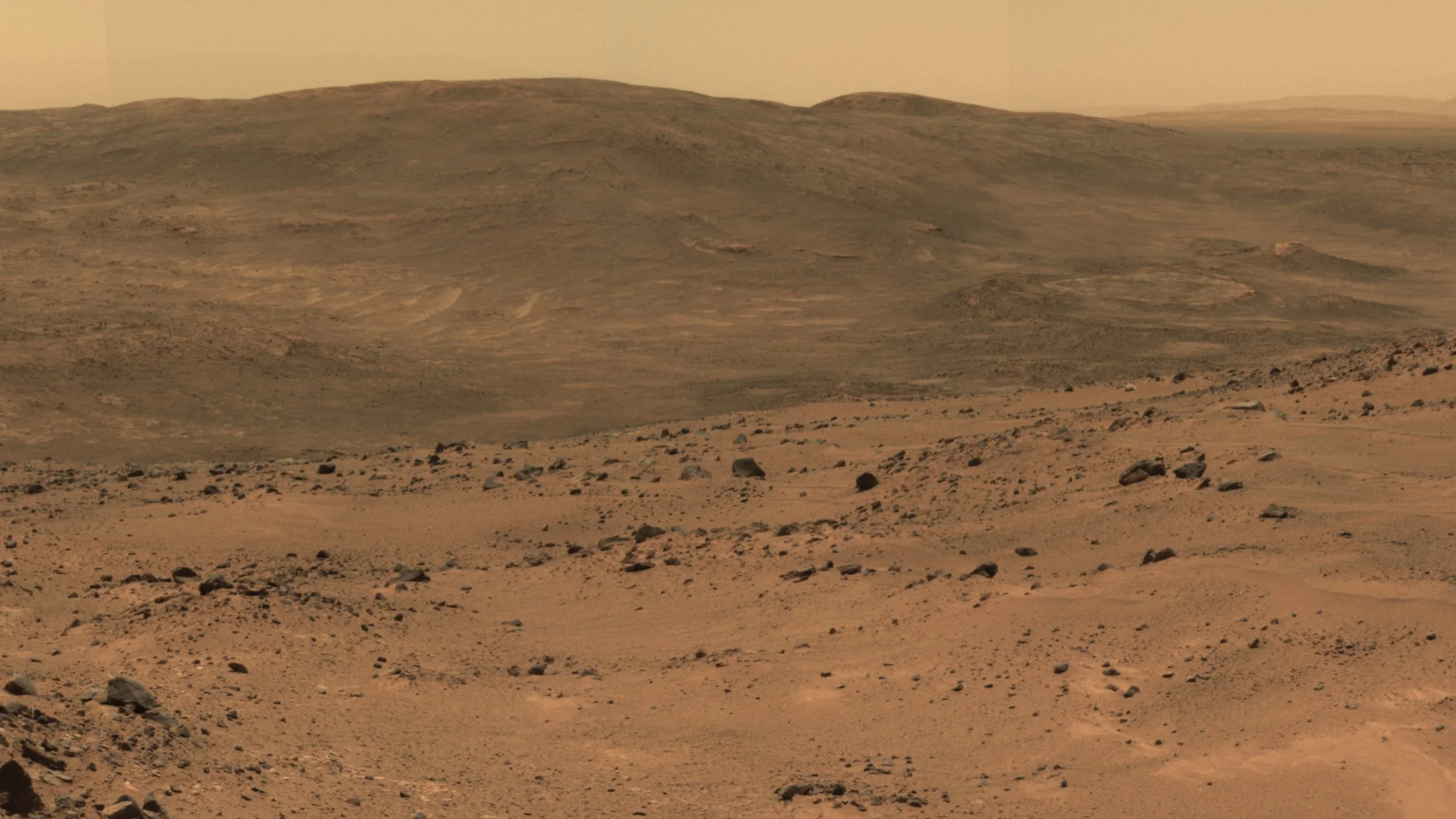
If you were to choose a random location on Mars to drop down to, you’d most likely find yourself surrounded by barren, gently rolling plains covered in dust and rocks. Up close, the Martian soil reveals more nuance in its coloration than the red-orange hues seen from space, taking on brown, ochre, and butterscotch hues. Your boots would probably sink into a few centimeters of regolith. You squat down to grab a handful. Much of it has the consistency of talcum powder while some more closely resembles gritty sand grains. Buried amongst the dust are countless rock fragments scattered across the landscape. If you scoop one up, you’ll find it is granular in texture, maybe even pitted, with edges smoothed by prolonged weathering. The Martian gravity makes even larger rocks surprisingly easy to hold up. You stand back up and look toward the horizon. The landscape stretches for miles, broken only by low hills, shallow depressions, and occasional rocky outcrops. The Sun is noticeably smaller here than what we see on Earth. It shines less than half as bright against the golden pink sky.
Pictured: Husband Hill in Gusev crater, imaged by Spirit rover in October 2005.
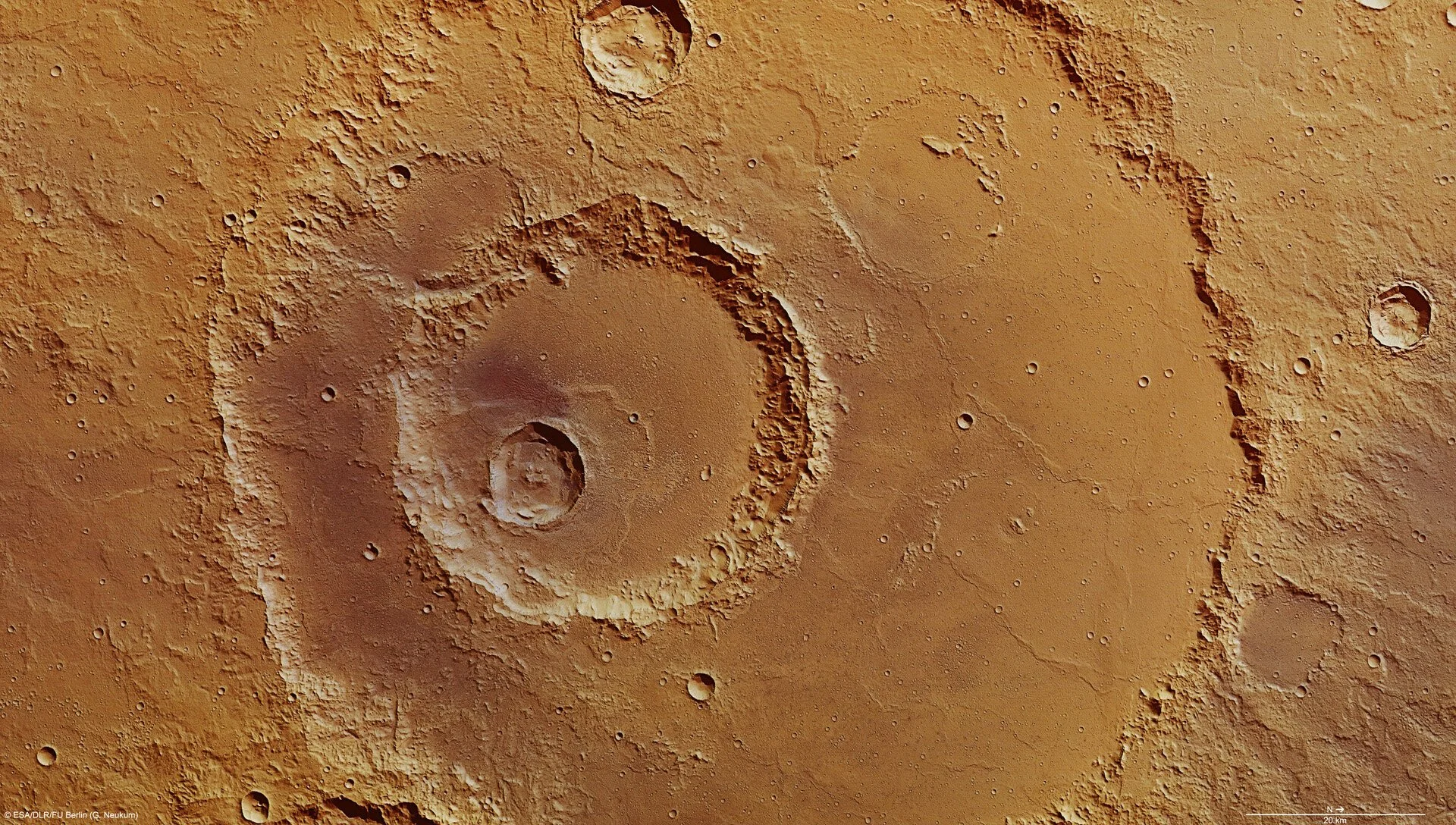
Much of the surface of Mars is absolutely riddled with impact craters. It is the second most cratered planet in the solar system, after Mercury. This is enabled by its thinner atmosphere being unable to burn up as many meteors as Venus or Earth can. There are probably hundreds of thousands of craters exceeding a kilometer in diameter. About a thousand of these are named, with Mars accounting for around a fifth of all named craters in the solar system. There are likely tens of millions of smaller craters. They are especially prevalent within the southern highland regions where they hadn’t been paved over by geologically recent lava flows.
Pictured: Hadley Crater is overlapped by new craters.
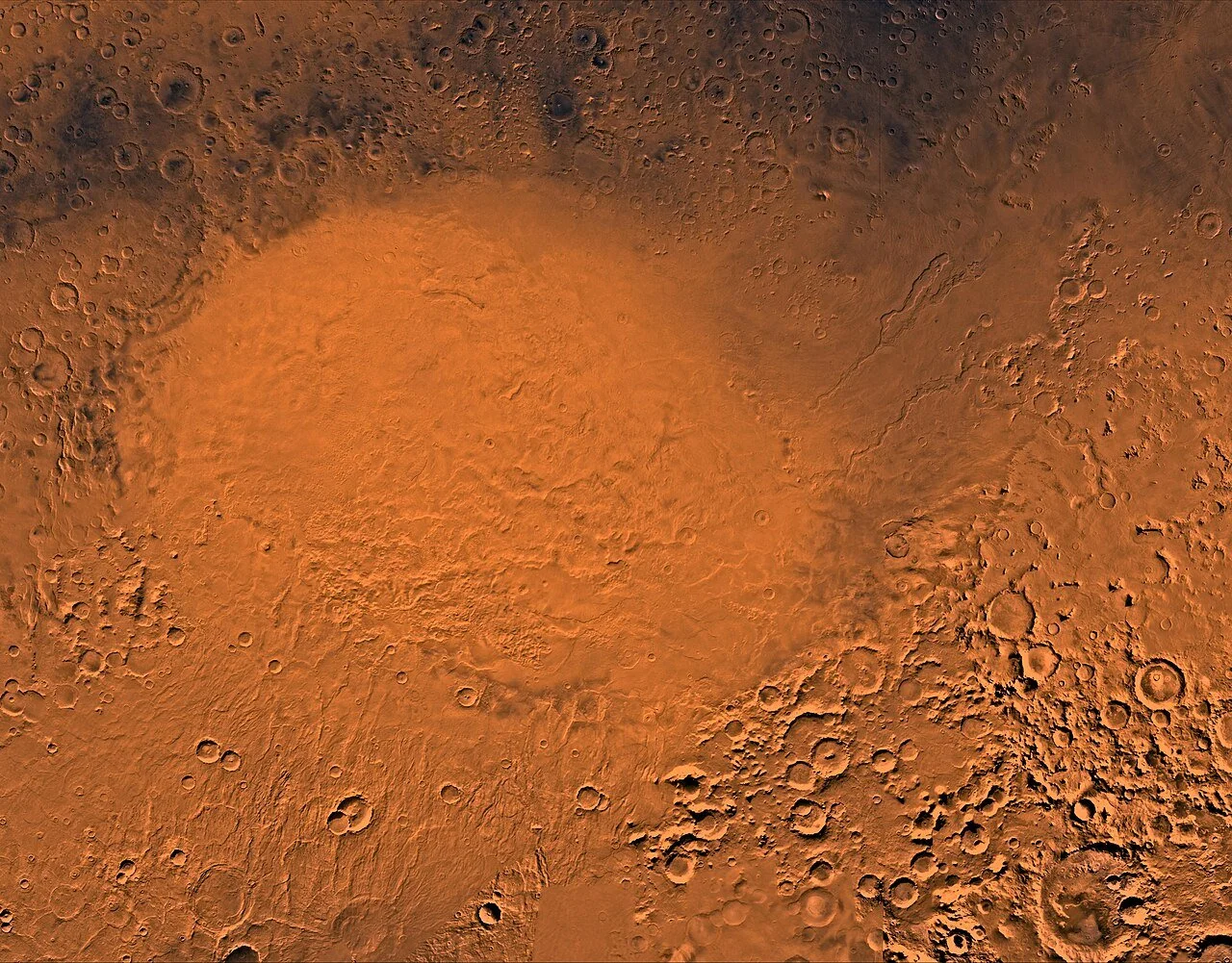
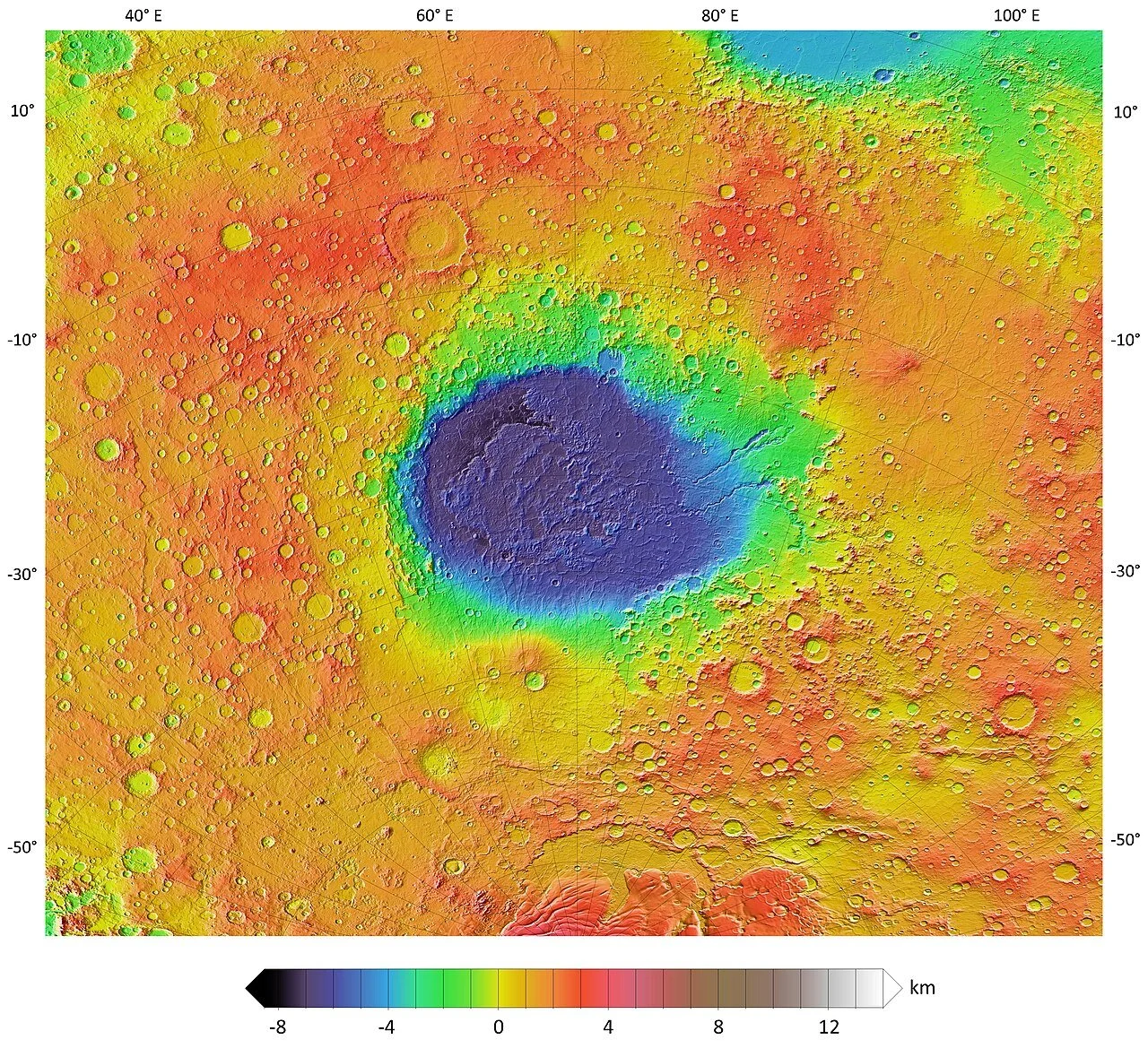
Hellas Planitia is a gargantuan impact basin, about half the width of the mainland United States, that scars the southern hemisphere of Mars. It is thought to have been caused by a collision with a protoplanet during the Late Heavy Bombardment way back in the early solar system. Because of its size and light coloring, it was one of the first surface features identified with a telescope. It is the deepest recess on the planet's surface, with the center sinking 9 km below the surrounding rim.
Fun fact: Hellas Planitia has been the setting in several sci-fi video games, such as Doom and Destiny 2.
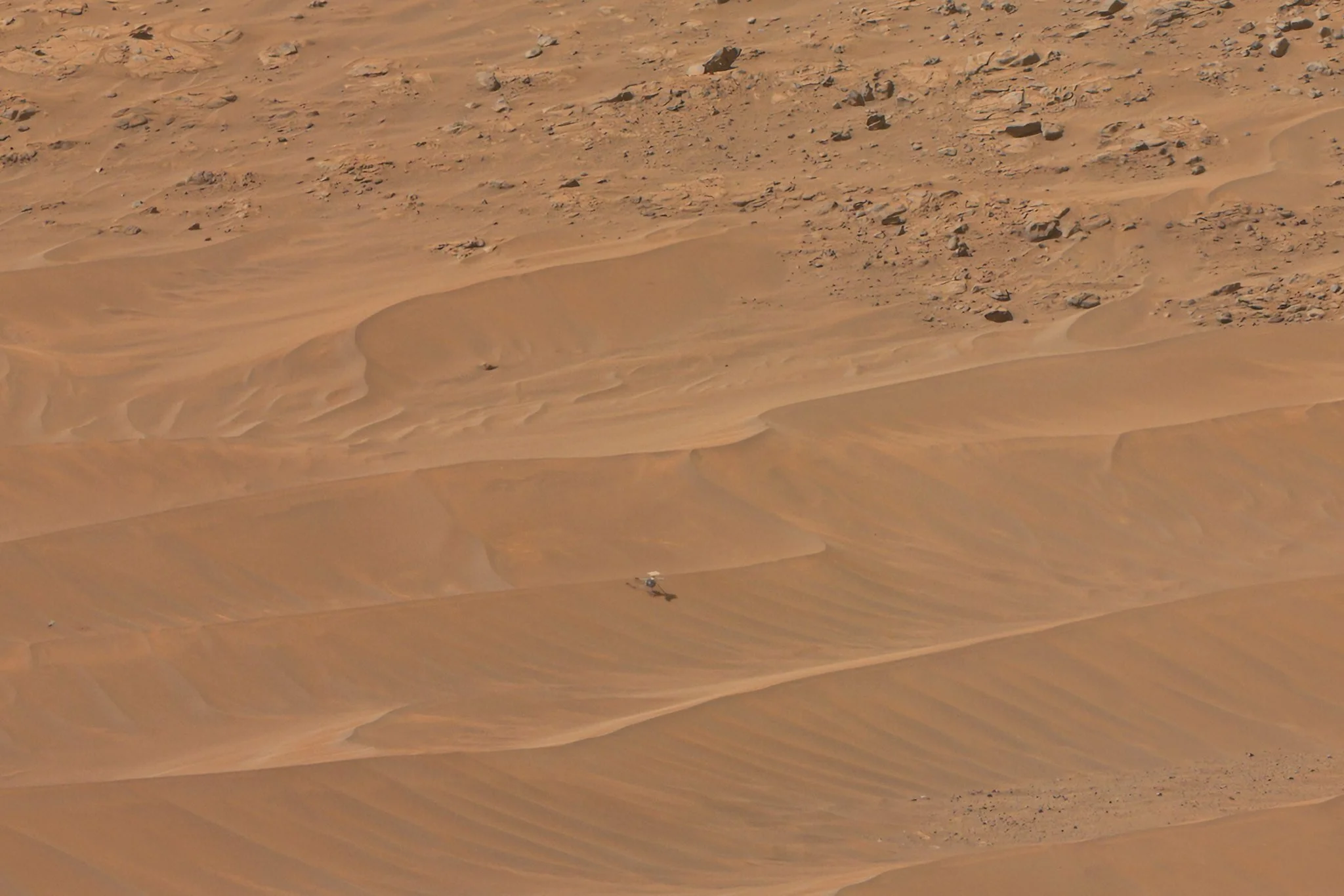
While Martian winds are not typically as strong as winds on Earth, they are fighting against weaker surface gravity and are capable of shaping the terrain over really long time periods. One of the most visually striking surface features that demonstrate this effect are sand dunes, which are found all over the planet. These are mounds of grains that have been blown across the ground and gradually sculpted by steady streams and powerful gusts, forming a variety of differently shaped ridges. The largest concentration is the Circumpolar Dune Field surrounding most of the planet’s north pole like a great low-lying sea of sand.
A regular goal of the Mars Reconnaissance Orbiter is to observe how these dunes evolve over time, which will give scientists a better idea of how Mars’ atmosphere ebbs and flows. The shape of a dune’s ridges can hint at the direction of the wind while the rate of change can hint at the speed of the wind. Star dunes have a central peak with multiple ridges forming from wind blowing in multiple directions. Linear dunes are formed by wind blowing in one or two slightly different directions. Barchans are crescent-shaped dunes that form from wind blowing in one direction.
Pictured: Following damage to one of its rotors, Ingenuity found its final resting place atop the ridge of a sand dune in Jezero Crater. Image captured by Perseverance in 2024.
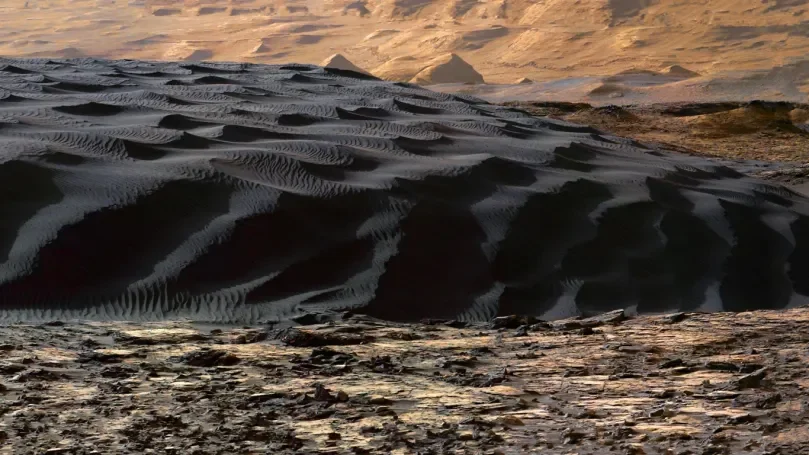
Fun fact: Many sand dunes on Mars are dark in color, sometimes even black! They are made of mostly basalt which is pulverized by meteorite impacts or stripped from the crust by wind erosion.
Pictured: Black sands of Namib Dune, near Mount Sharp, imaged by Curiosity rover in 2016.
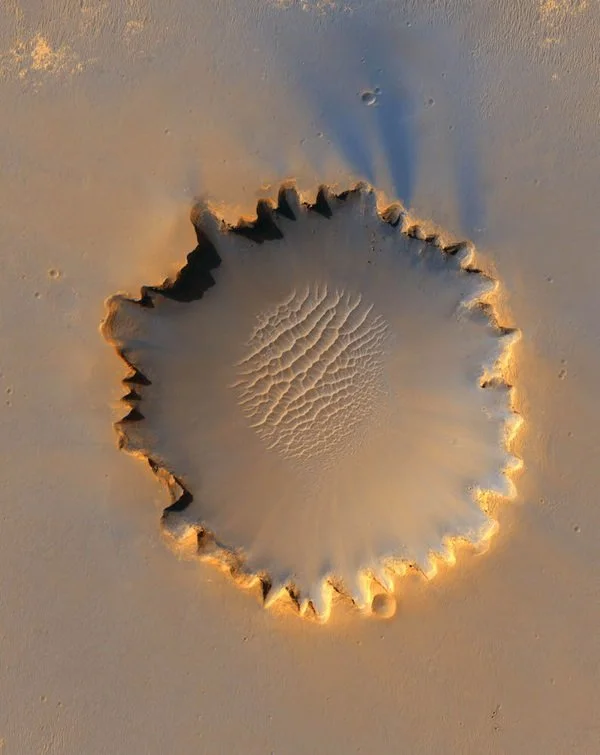
Fun fact: We commonly find sand dunes forming as wrinkled pools collecting at the center of craters. Their depressed interiors form a sand trap, making it easy for sand to enter and difficult to escape. As winds rush over the high, scalloped rims of craters, they are forced into chaotic and intersecting flows. This can form striking polygonal patterns atop the sand dunes that we don’t find on Earth.
Pictured: Star dunes within Victoria Crater (800 m across), which was visited in the early months of Opportunity rover’s long journey.
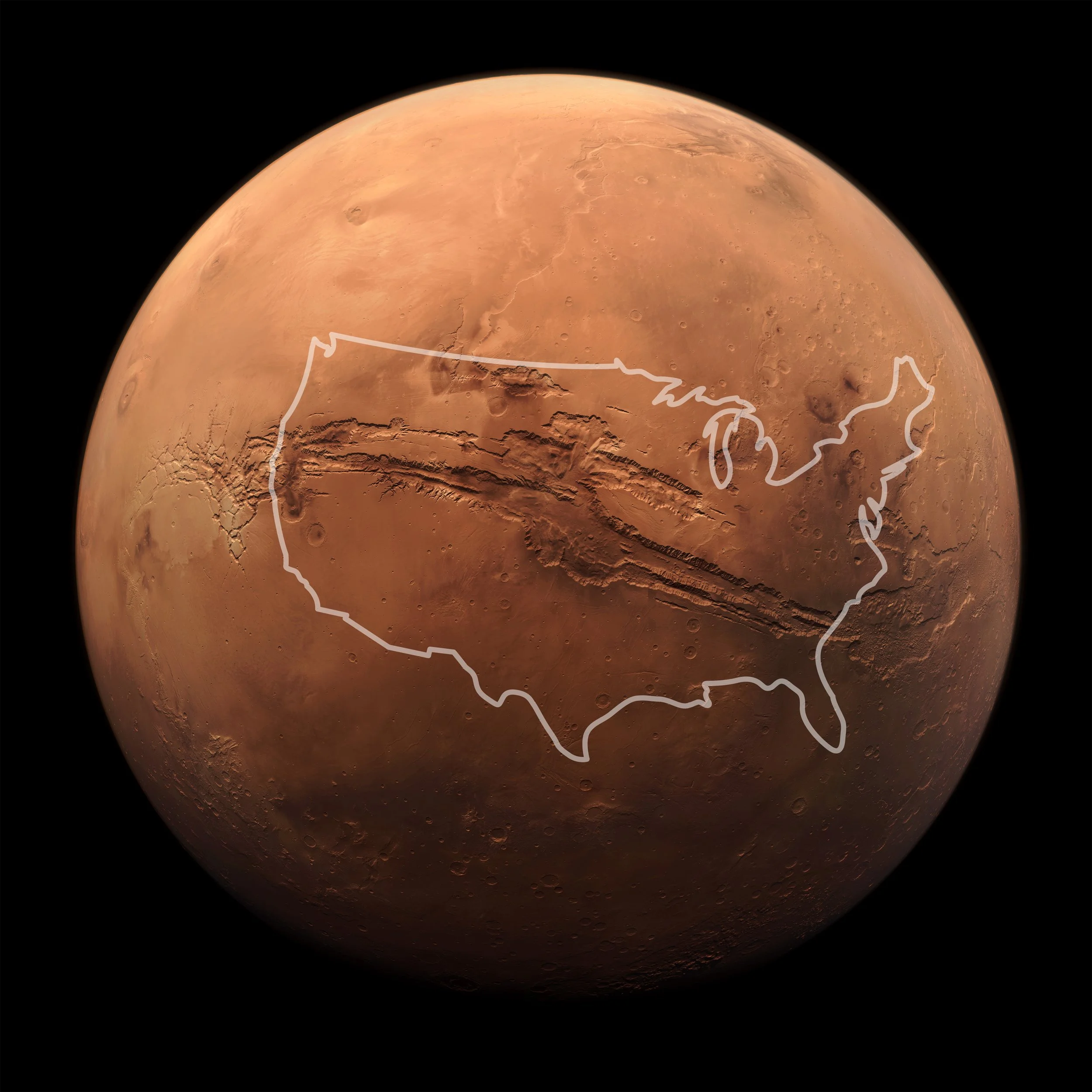
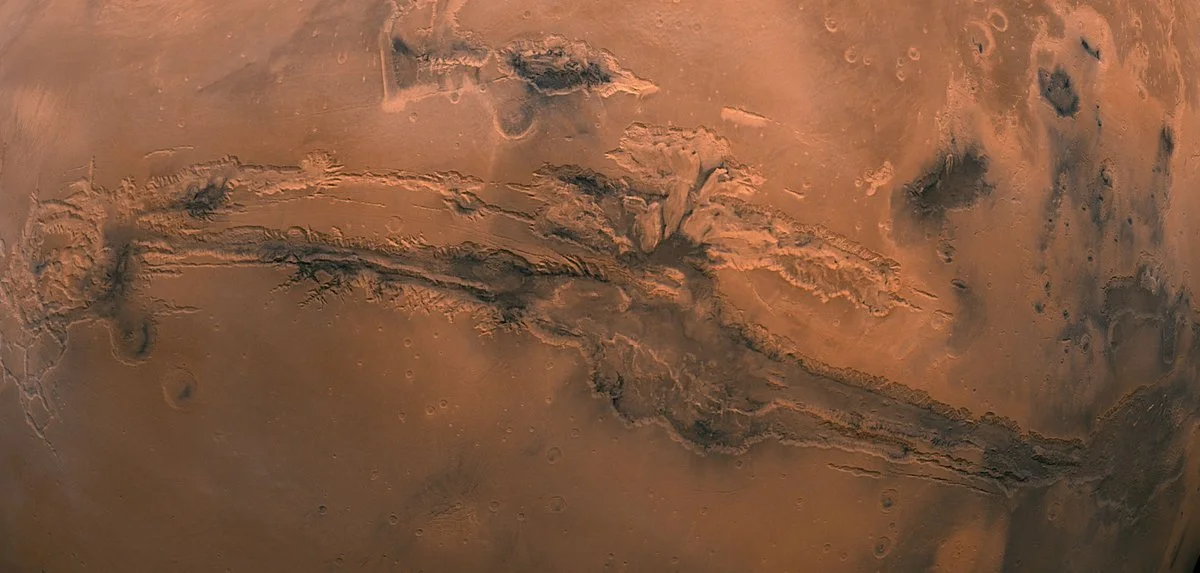
The grandest surface feature on Mars is easily Valles Marineris. Named after the Mariner 9 orbiter that first discovered it in 1972, this gargantuan system of canyons carves a colossal gash across the belly of Mars, east of the Tharsis region. Valles Marineris is the largest canyon system in the solar system. At 4,000 km (2,500 mi) long, 200 km (120 mi) wide and 7 km (4.35 mi) deep, Valles Marineris is ten times longer and wider than the Grand Canyon. Its length alone would stretch across the entire continental United States, from the Atlantic coast to the Pacific. On Mars, this covers nearly a quarter of the planet’s entire circumference.
Just looking at it, you can tell Valles Marineris is not simply just a bigger version of one of Earth’s premiere natural attractions. Rather, it is an extensive network of canyons, valleys, cliffs, and plateaus. At the westernmost end is a shattered web of interconnected valleys and isolated mesas, called Noctis Labyrinthis. Its Latin name translates to "Labyrinth of the Night,” referencing its maze-like structure. It is believed the swelling of Tharsis caused this patch of crust at its perimeter to rupture under the stress. This feature blends eastward into the main canyon system of Valles Marineras. Across the majority of its length are three attached chasmata, each one running roughly parallel to each other. From north to south is Ophir Chasma, the sprouting depression, Candor Chasma, the extended trough, and Melas Chasma, the southernmost and widest canyon in all of Valles Marineris. Chunks of the immense canyon walls occasionally break off and smash into the bed, forming fans of debris below. At the easternmost end, the canyons give way to a series of winding outflow channels before emptying into the vast northern expanse of Chryse Planitia.
The origins of this dramatic and complex rift are believed to be closely tied to the neighboring Tharsis bulge. When hot material in the mantle swelled and lifted Tharsis up, this put considerable stress on the surrounding crust. The surface split open, creating Valles Marineras. It is also possible that the carving out of the canyons was later assisted by various other factors such as subsurface water flooding, lava flows, and acidic glaciers.
Pictured: Viking 1 orbiter mosaic image of Valles Marineris.
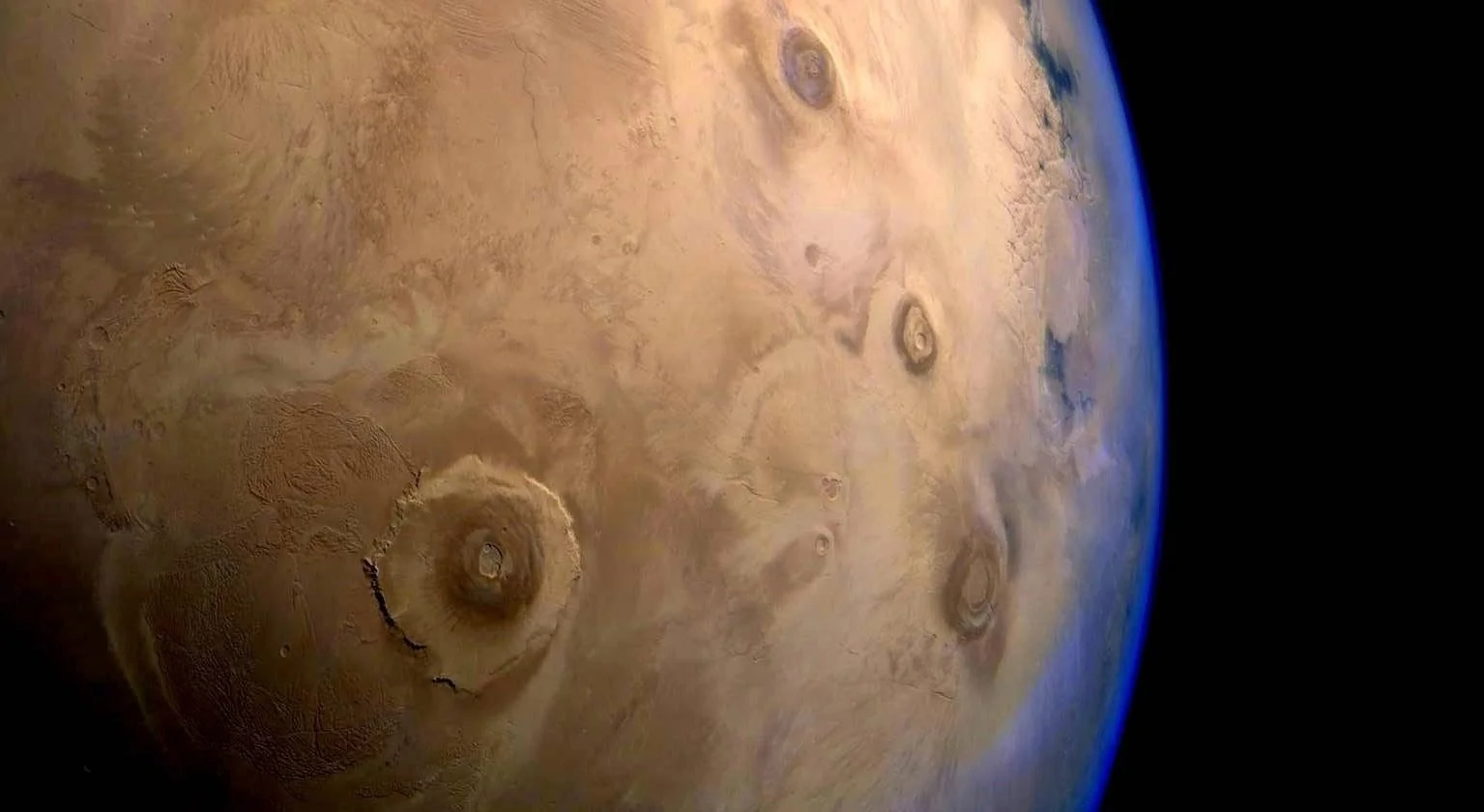
We first observed and imaged volcanoes like Ascraeus Mons on the planet's surface back in 1972 with the Mariner 9 orbiter. Volcanism is quite important to Mars’ history. Magma and gas rise up through the mantle and are forced through these crustal vents. Sometimes lava spills across the land which cools and solidifies, becoming the basalt rock we see across the surface today. This is quite similar to how volcanism works on Earth as well! However, Mars has weaker gravity and a thinner atmosphere. As magma rises up and the surrounding pressure drops, the bubbles of gas dissolved within the magma expand into much larger bubbles than they do on Earth. These bubbles can even burst and release tons of sulfur and ash. The ages of Martian volcanoes range widely, from over 3.7 billion years ago to less than 500 million years ago, indicating that Mars has been volcanically active through its history (and might still be today).
Dominating Mars’ western hemisphere is Tharsis, a vast plateau encompassing the most intensely and most recently volcanic region of the planet. This uplifted bulge is roughly the size of North America. Appropriately, it’s home to the four biggest volcanoes on Mars, including the largest volcano in the solar system: Olympus Mons. This gargantuan shield volcano is about 22 km tall and 600 km wide. It is almost three times taller than Mount Everest and its surface area is roughly equivalent to the state of Arizona. It last erupted about 25 million years ago. This is based on the age of the uppermost layer of hardened lava, determined to be relatively young by the low presence of impact craters.
Note: Okay, technically, Olympus Mons is not located on Tharsis but just off its western perimeter. However, it is commonly associated with the region for obvious reasons.
When you look at topographical maps of Mars (like the one shown earlier in this primer), you’ll notice that the Tharsis region is completely unique in its altitude. The surface here lies as much as 10 km higher than the northern lowlands. A popular hypothesis suggests that this is a product of ancient upwelling of hot material in the planet’s mantle. This lifted up the crust from below, creating a broad, elevated region of terrain.
Pictured: Tharsis region with Olympus Mons (bottom left), Ascraeus Mons (upper right), Pavonis Mons (middle right), and Arsia Mons (lower right).
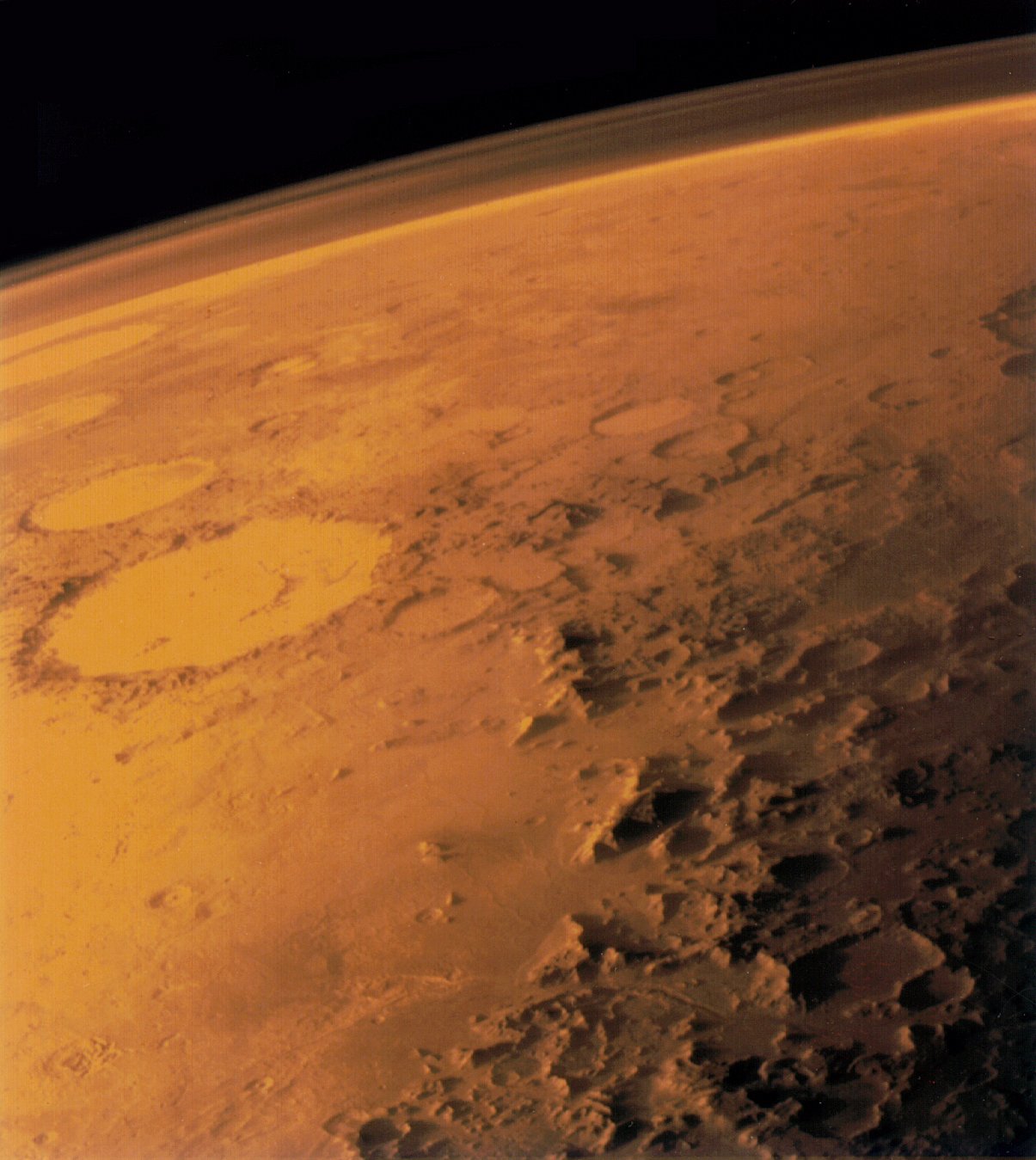
While its red-orange color may bring about associations with heat, Mars is indeed a very cold planet. Near the equator, in the summertime, at noon, temperatures usually reach as high as 20°C (68°F), sometimes higher, which is admittedly pretty comfortable for humans. However, after sunset, temperatures there drop rapidly, often reaching as low as -100°C (-148°F). That’s pretty freezing but it’s not too much colder than the coldest temperature ever recorded in Antarctica. Things are much less hospitable at the Martian poles. Even with constant sunlight and the high albedo of the ice caps, you can still expect -45°C (-50°F) at the hottest during summer days. We see a significant drop during prolonged winter nights, reaching as low as -153°C (-243°F) at polar latitudes.
These temperatures are achieved in spite of Mars’ atmosphere being composed almost entirely of carbon dioxide. On Venus, this results in a runaway greenhouse effect that traps heat and keeps the temperature incredibly high. This is not the case on Mars because, unlike Venus, its atmosphere lacks the sufficient density to trap heat. Mars’ atmosphere is only 1% as thick as Earth’s so it is unable to store heat as well and its winds are generally weaker. This can work the other way though. The temperature variations on Mars are much wider than on Earth which can create really strong winds (topping out at 100 km per hour or 60 miles per hour), especially in the morning and evening.
Pictured: The thin atmosphere of Mars imaged by the Viking 1 orbiter in 1976.
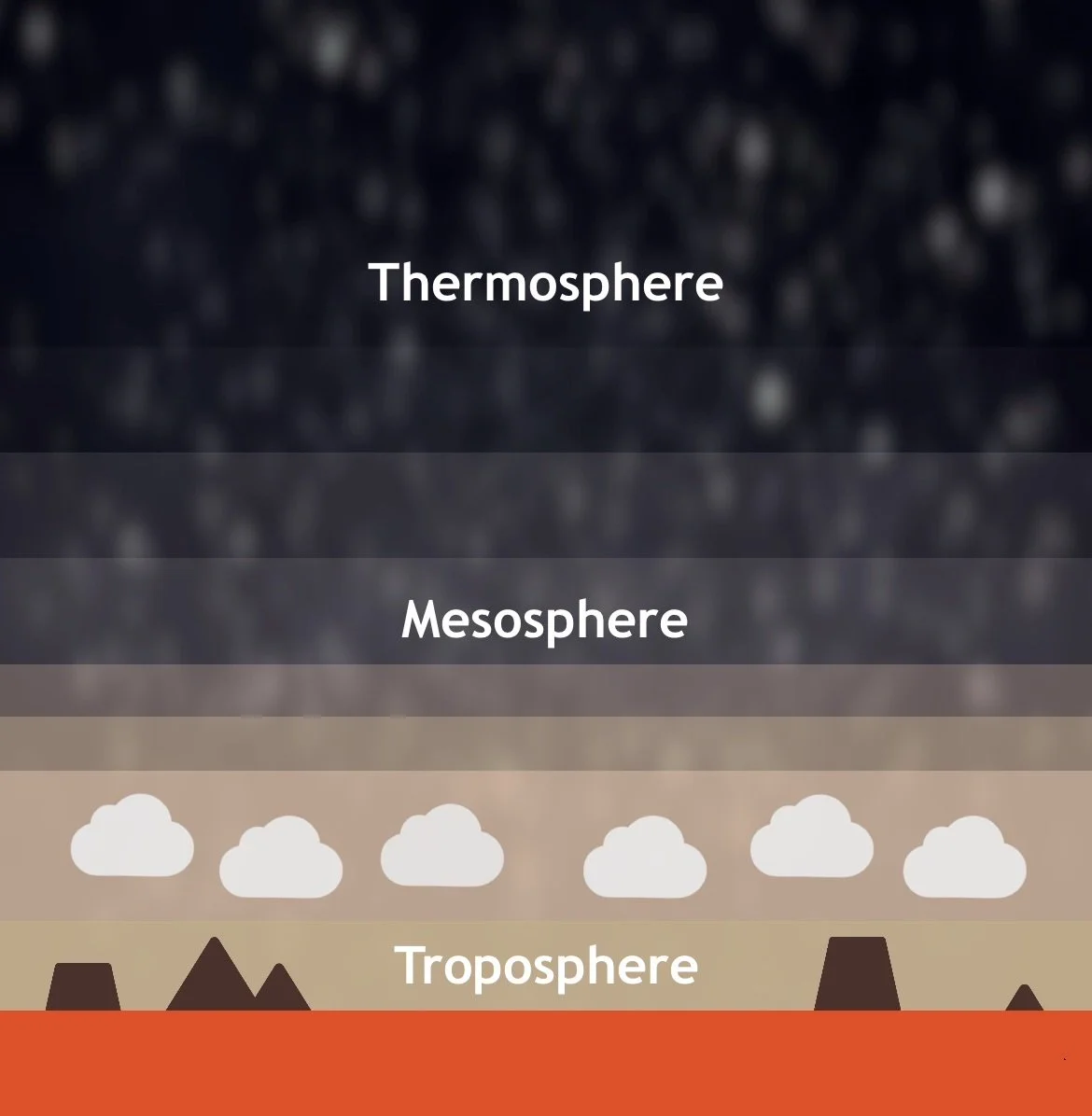
The Martian atmosphere, while much thinner than those of Earth and Venus, has a layered structure of its own. However, there are some important differences. These layers are not simply arbitrary divisions based on altitude. Instead, they are defined primarily by how atmospheric temperature changes with altitude. As you travel upward through the atmosphere, temperature may decrease, increase, or change at different rates. These transitions are what separate the major atmospheric layers.
The troposphere makes up the lowest and densest layer of Mars’ atmosphere. It extends from the surface to roughly 40-50 km (25-30 mi) above it. Like Earth’s troposphere, it is the region where most of the atmosphere’s weather takes place. It contains enormous quantities of suspended dust, particularly during the planet’s frequent dust storms. This is what produces the variety of unusual colors in the sky (beige, ochre, salmon, etc.). Because the Martian atmosphere is so thin, however, its ability to retain and transport heat is very different from Earth’s.
Temperature generally drops as you rise into the thinner layers of the atmosphere. On Earth, the stratosphere marks the point where the temperature reverses. The air starts to heat up as it approaches the ozone layer which absorbs much of the Sun’s harmful ultraviolet radiation. Mars has ozone too, but only in trace amounts, so it does not produce a comparable temperature inversion. Instead of a stratosphere, Mars’ troposphere blends into the mesosphere. Here, atmospheric density and temperature falls dramatically. In fact, this is the coldest layer in Mars’ atmosphere.
Farther upward, the thermosphere begins. Here, the temperature trend actually does reverse, and temperatures rise with increasing altitude. The extremely thin upper atmosphere absorbs incoming solar ultraviolet and X-ray radiation. Despite these high temperatures, the Martian thermosphere contains so few molecules that it would not feel remotely as hot as the temperature number might suggest. There simply are not enough particles to transfer much heat.
Beyond the thermosphere, the atmosphere gradually fades into the exosphere and ultimately into space. At these extreme altitudes, individual particles are so widely separated that collisions become increasingly rare, and some particles can even escape Mars’ gravity altogether.
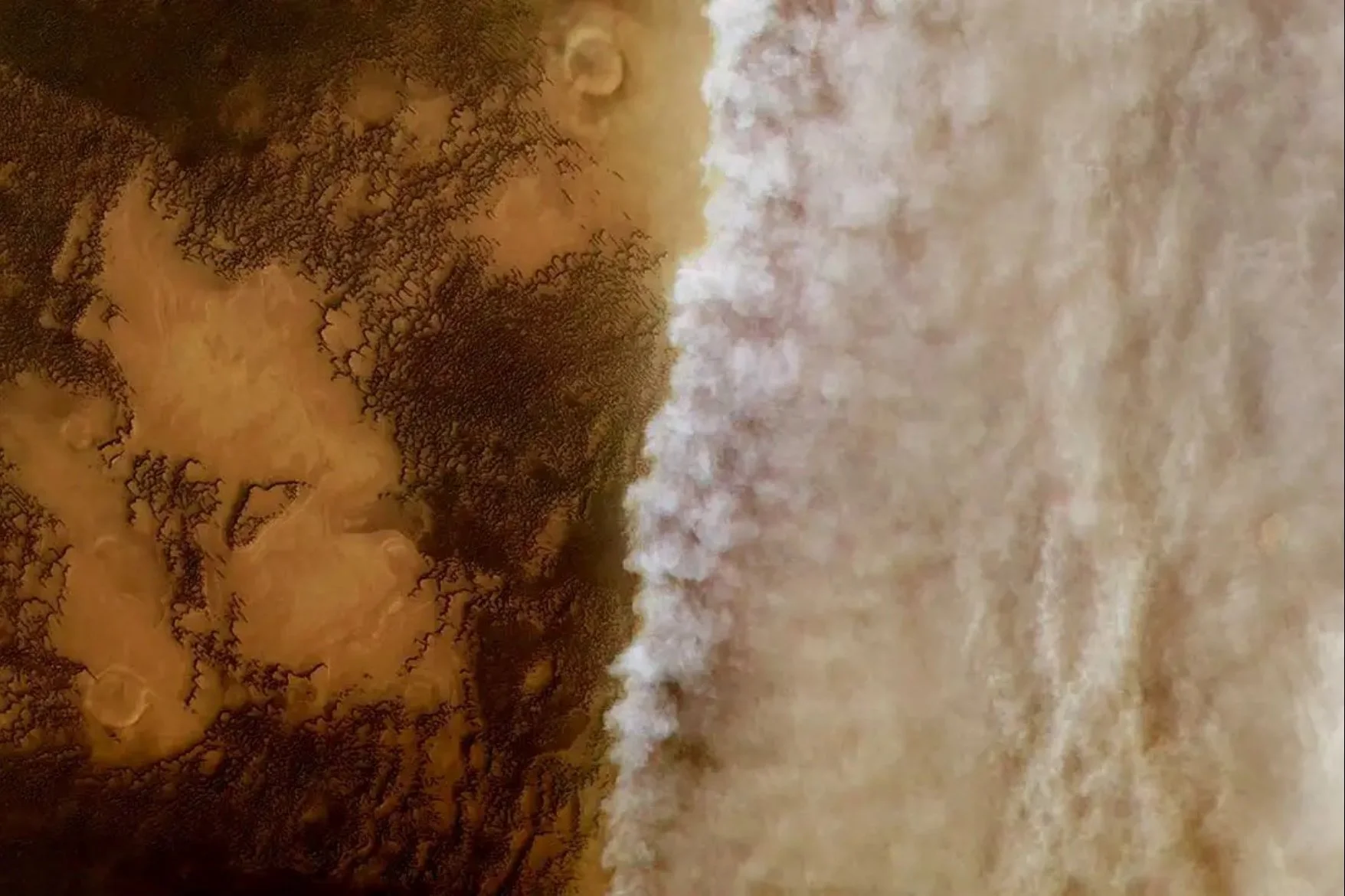
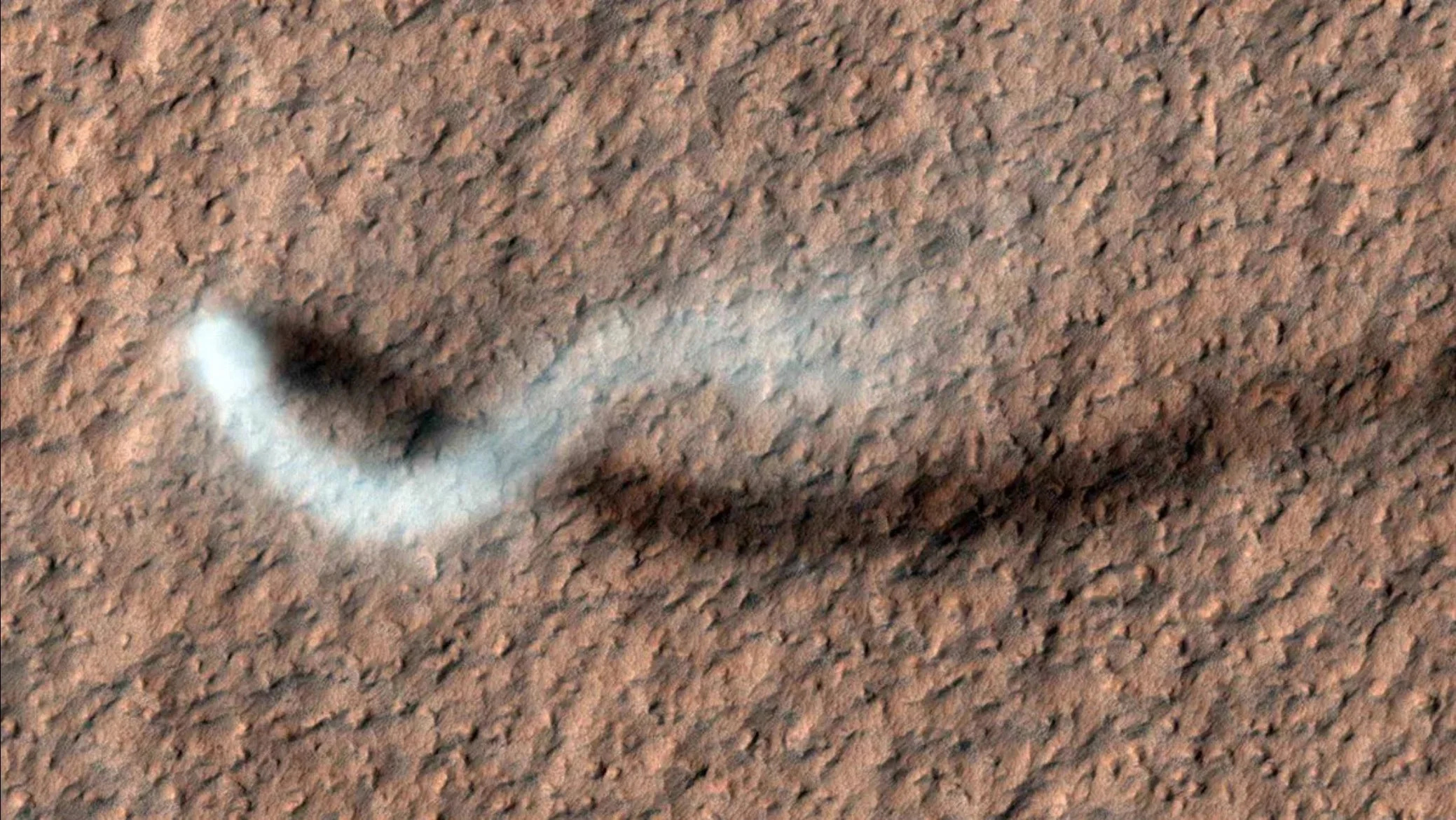
Mars has the greatest wind erosion effects in the solar system and can be observed across its various sand dunes. Sometimes these strong wind currents can kick up iron oxide dust forming massive dust storms, some of the largest in the solar system covering continent-sized areas and lasting weeks at a time. Every three Martian years or so, these dust storms can even grow to planet-spanning scales. These dust storms present a significant challenge for engineers of the Mars rovers as the fine dust particles are very sticky and get inside the various nooks and crannies and can obstruct vital solar panels. Convective vortices known as dust devils have also been directly observed, as well as the trails they leave behind in the soil. They form when the warming surface lifts up nearby air and then horizontal winds cause rotation. They are usually many times larger than ones found on Earth with some reaching several kilometers into the sky.
Ice can be prevalent in the Martian atmosphere when much of the polar ice caps evaporate into the spring air. Clouds on Mars consist of water ice and CO2 ice condensed on reddish dust particles suspended in the atmosphere. It occasionally even snows where the snowflakes are made of frozen carbon dioxide cubes.
Pictured: Dust storm imaged by ESA’s Mars Express orbiter in 2018.
Pictured: A dust devil and its shadow imaged by NASA’s Mars Reconnaissance Orbiter in 2012. This one is 800 meters tall and 30 meters wide.
While Earth’s sky is blue in the day and red at sunset, Mars is reversed, having a red sky in the day and blue at sunset. Why is this? The effects of Rayleigh scattering on Mars is relatively weak because Mars has such a thin atmosphere compared to Earth. The sky’s reddish color in the daytime is more attributed to the iron oxide suspended in the air. There is however a phenomenon called Mie scattering which more effectively scatters red wavelengths of light when colliding with the larger dust particles of Mars’ atmosphere. As the Sun sets and the light passes through the atmosphere at a lower and lower angle, so much red gets scattered that it disappears completely, leaving only blue to be scattered.
Many images from Mars rovers like Curiosity and Perseverance show the Red Planet to a barren, lifeless world; an endless, frozen expanse of dirt and rock. However, evidence gathered over many years of exploration has mounted and mounted that this is a far cry from what Mars once was. Billions of years ago, when it was relatively young, the surface of Mars is believed to have been covered in liquid water, just like Earth is today.
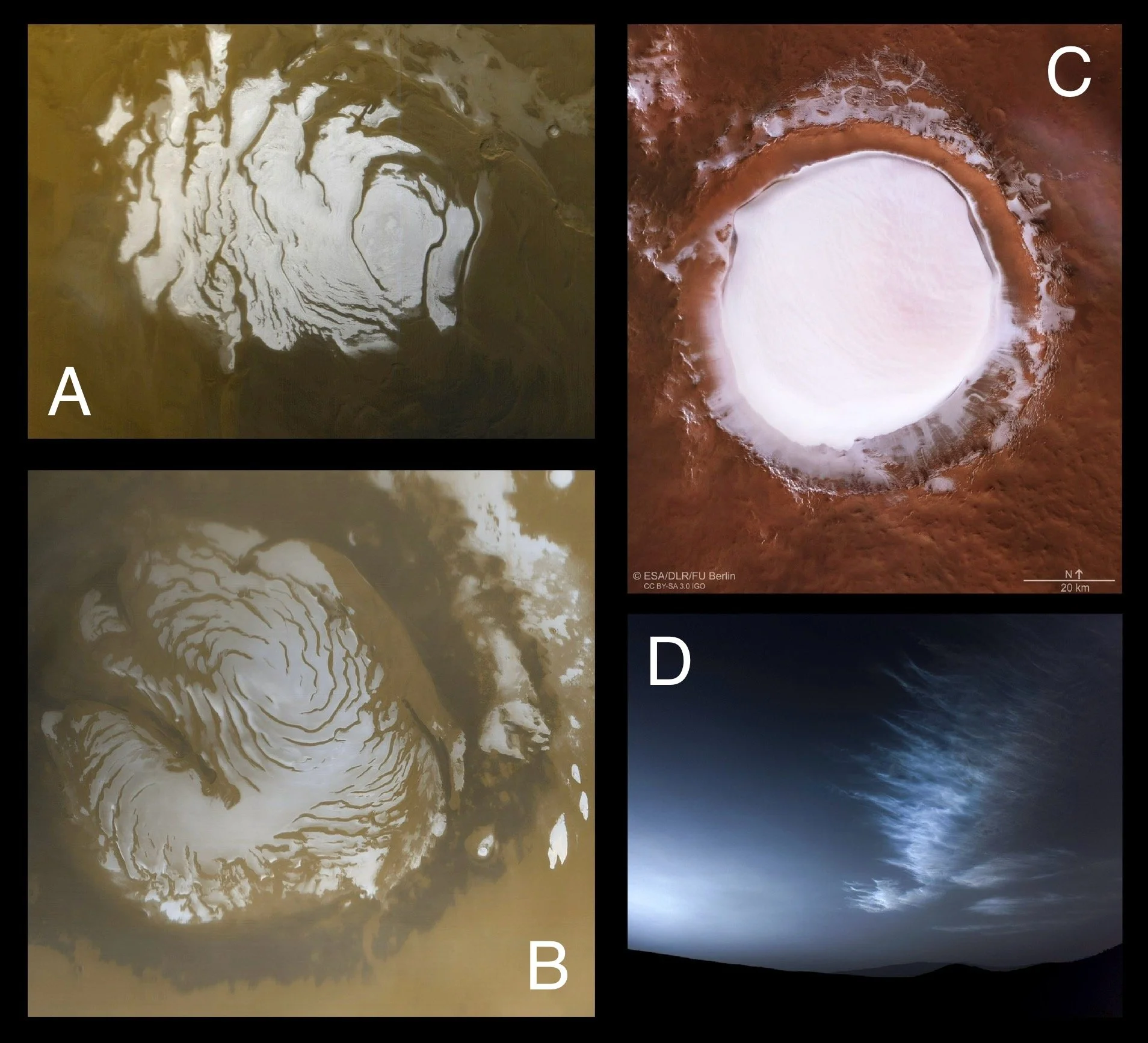
Even before we ever visited Mars with orbiters and rovers, we saw evidence of water. Like Earth, Mars has polar ice caps. Humans have been aware of them for 350 years as they are visible from Earth with moderately sized telescopes. Both have two main layers: a lower residual layer and an upper seasonal layer. The residual layer exists year-round and is mostly made of water ice, several km thick, and mixed with dust and sand particles. The polar caps get seasonal coatings of dry ice, frozen carbon dioxide, that covers them from 1 to 8m thick. This happens in their respective winters; in the summer, sunlight thaws the CO2, causing avalanches and sublimates (turning it directly from solid into a gas) which then blows away from the pole, generating fierce winds. Ice largely can’t survive the sunlight’s warmth outside of Mars’ polar regions. Ground-penetrating radar and other orbiting detectors have revealed significant subsurface water ice deposits. More than 5 million cubic kilometers (1.2 million cubic miles) of ice has been identified at or near the Martian surface.
Also present on the surface are ice-filled impact craters (C). This is the result of something called a ‘cold trap’ in which air passes over the ice collecting at the deepest recess of the crater is cooled, causing it to sink down and shield the ice from future heating.
Ice isn’t only found on the surface. Ground-penetrating radar from the Mars Reconnaissance Orbiter shows that Mars features extensive underground ice deposits, particularly around the mid-latitudes. In some cases, there are even ice glaciers. If a manned mission to Mars ever happens, these ice deposits will be an important resource for sustaining a base camp on the planet.
Granted, none of this surface water on Mars is liquid as it’s too cold and the atmospheric pressure is too low. The only liquid water found on Mars today is in the form of small water vapor molecules floating in the atmosphere that can condense to form transient clouds (D) and sometimes precipitate as snow or frost.
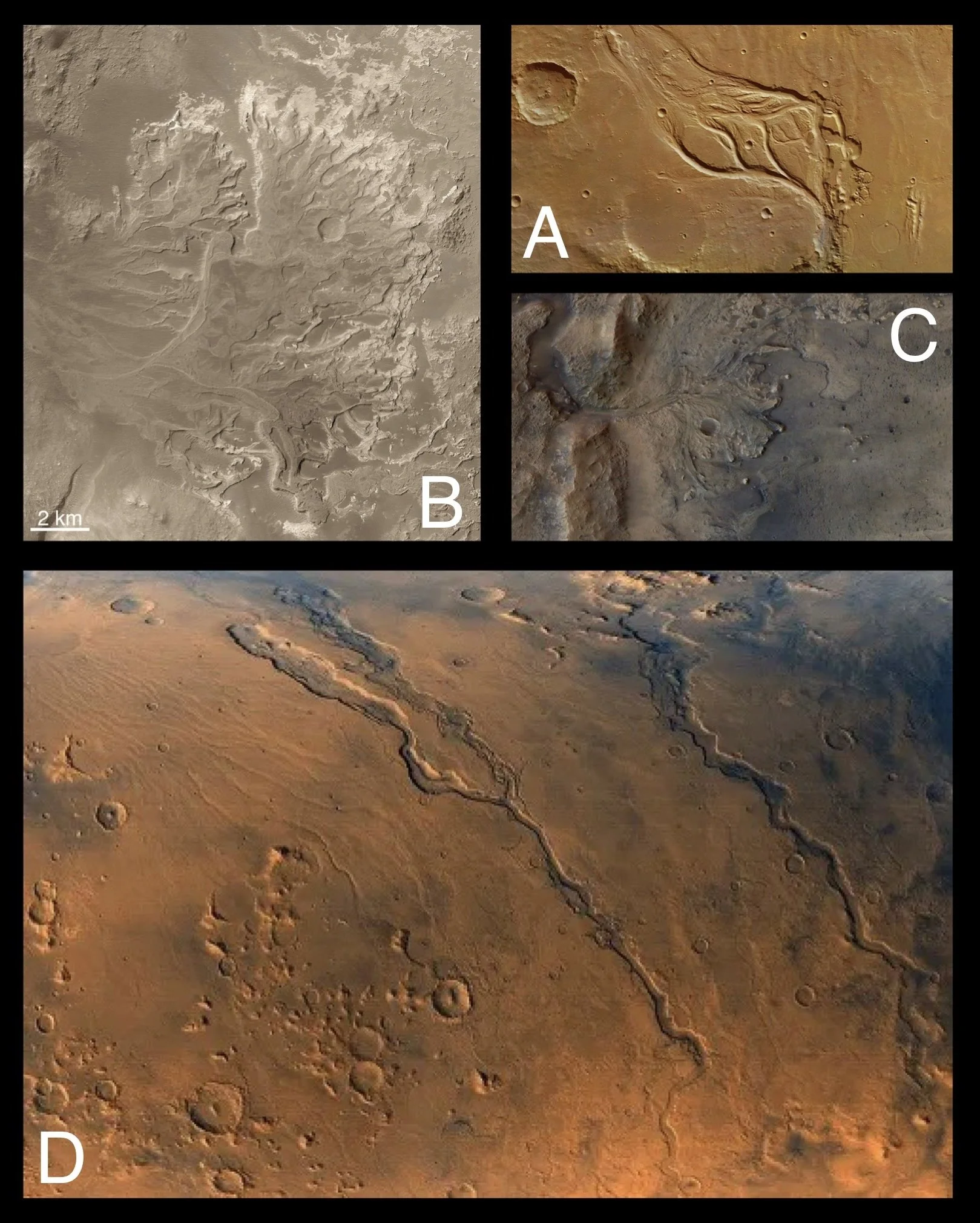
The surface of Mars is covered by many ancient riverbeds (A & D) and lake deltas (B & C) visible to orbiting space probes that greatly resemble those found on Earth.
These geological features suggest that liquid water once flowed across the landscape and carved a complex series of channels through a mix of fluvial erosion and catastrophic flooding. Even the most eye-catching formation on Mars, Valles Marineras, is believed to have been formed in part through erosion by water. Many of these riverbeds are still very well preserved due to Mars’ low atmospheric pressure being unable to reshape them through wind erosion. They exhibit many features seen on Earth’s rivers such as terraces, meanders, cut banks and branching networks.
Many can be seen flowing into various impact craters, sometimes through delta formations, where water would have pooled inside and created lakes (as we saw early). The Mars Perseverance rover is currently exploring a delta (C) cutting through the rim of one such impact crater called Jezero Crater while Mars Curiosity rover is investigating riverbeds around Gale Crater. Both are searching for signs of ancient life that may have inhabited these areas long ago.
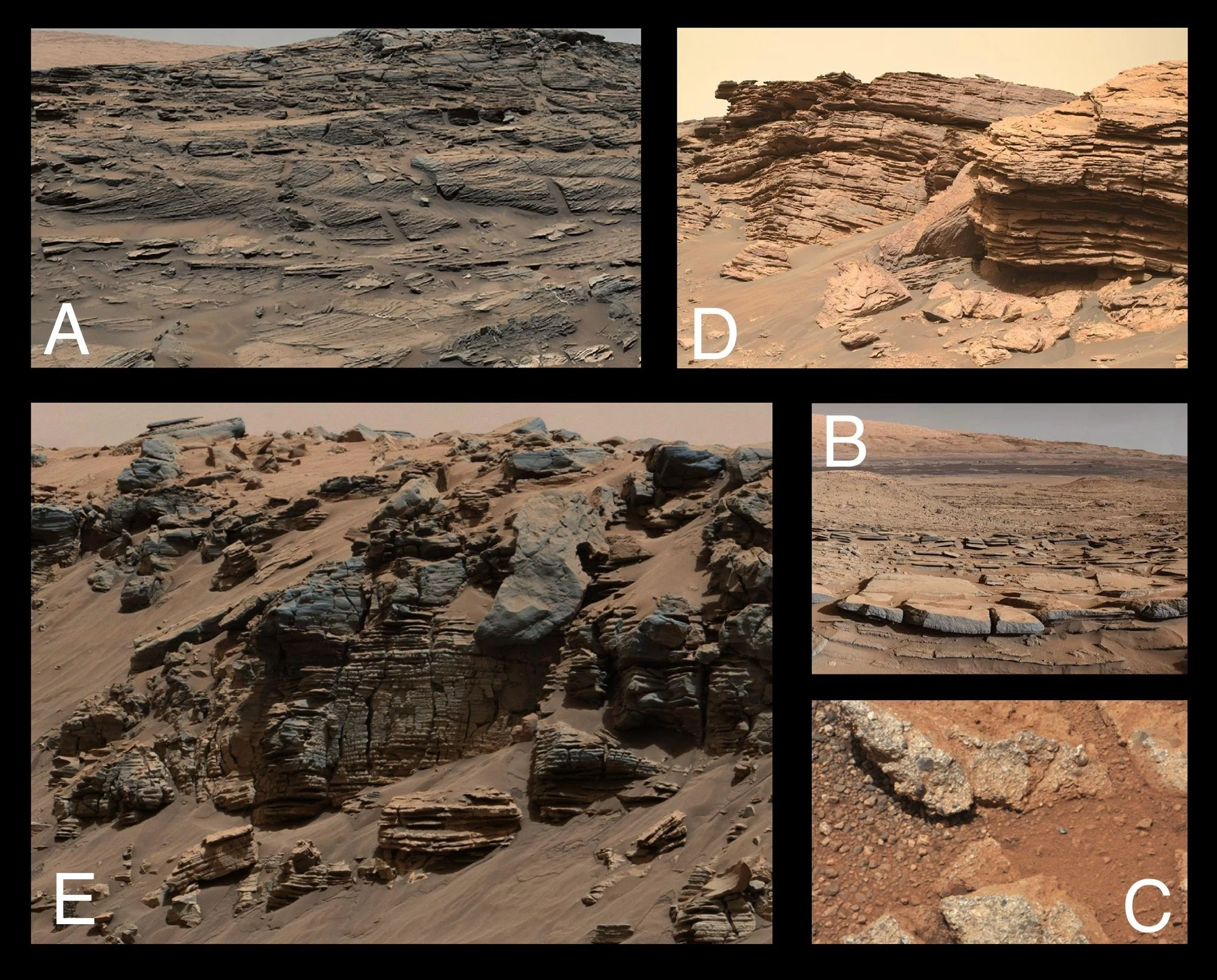
When we look closer at these regions, such as in lake basins, the soil and rocks also tell a very interesting story.
Water flowing along a river glides along and weathers the rocks lying at the bottom, gradually peeling off small particles over time. These particles are called sediments which get carried down the river where they settle and accumulate. After a while they can form different kinds of sedimentary rock, such as sandstone (A), mudstone (B) and pebble-rich conglomerates (C). Significant amounts of these sedimentary rocks are found in channels and lakes all across Mars. We also see layered deposits of sedimentary strata (D & E) found within outcrops of lake basins, river deltas and gullies.
The actual minerals found within the Martian soil point heavily towards water. Remote spectrometers from orbiters have detected clay minerals which form in water over time. Mars rovers have discovered extensive sulfate deposits, which form when water interacts with volcanic rocks. Many regions on Mars contain hydrated minerals which host water molecules within their crystalline structures as found through spectral analysis. The iron oxide mineral, hematite, has been found around sedimentary deposits. Orbital observations have identified deposits of opaline silica which are associated with hot springs and hydrothermal systems where water interacts with volcanic rock. The presence of various kinds of salts such as perchlorates and brine is significant because they can lower the freezing point of water, providing more opportunities for liquid water to exist on the surface. These are closely linked to the seasonal formation of recurring slope lineae (RSL), which are narrow, dark streaks seen extending down slopes of hills and crater walls.
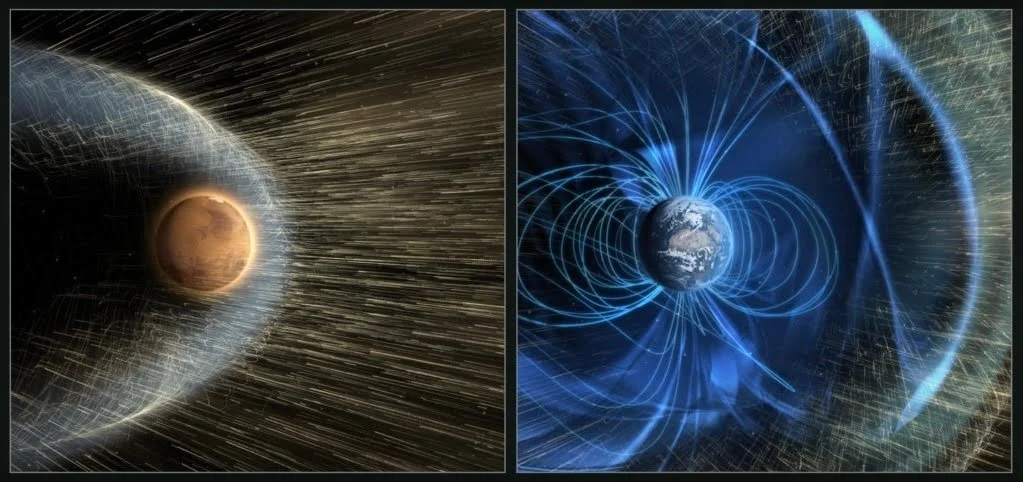
But if all this liquid water existed, where did it all go?
Billions of years ago, Mars was warmer and had a thicker atmosphere. Water flowed across rivers, lakes and oceans. Deep within, the churning of the planet’s inner iron core produced a magnetic field which shielded Mars from the punishing solar winds. This process is known as a dynamo and is found within our own planet and others. At some point, this churning ceased in Mars. Its internal dynamo shut down and its magnetic field all but disappeared. This left it vulnerable to the solar wind and over billions of years the Martian atmosphere was eroded away and the oceans and rivers dissolved with it. The only water that exists on Mars today, beyond fleeting traces of dissolved moisture, is the water ice in the polar ice caps and below the surface. Having liquid water in the past leaves the possibility (though not the guarantee) that Mars once hosted life. These are currently the most burning questions that scientists are trying to answer. A lot of these questions can possibly be answered through chance discoveries of evidence via rovers and orbiters. However, many questions likely require a human touch.
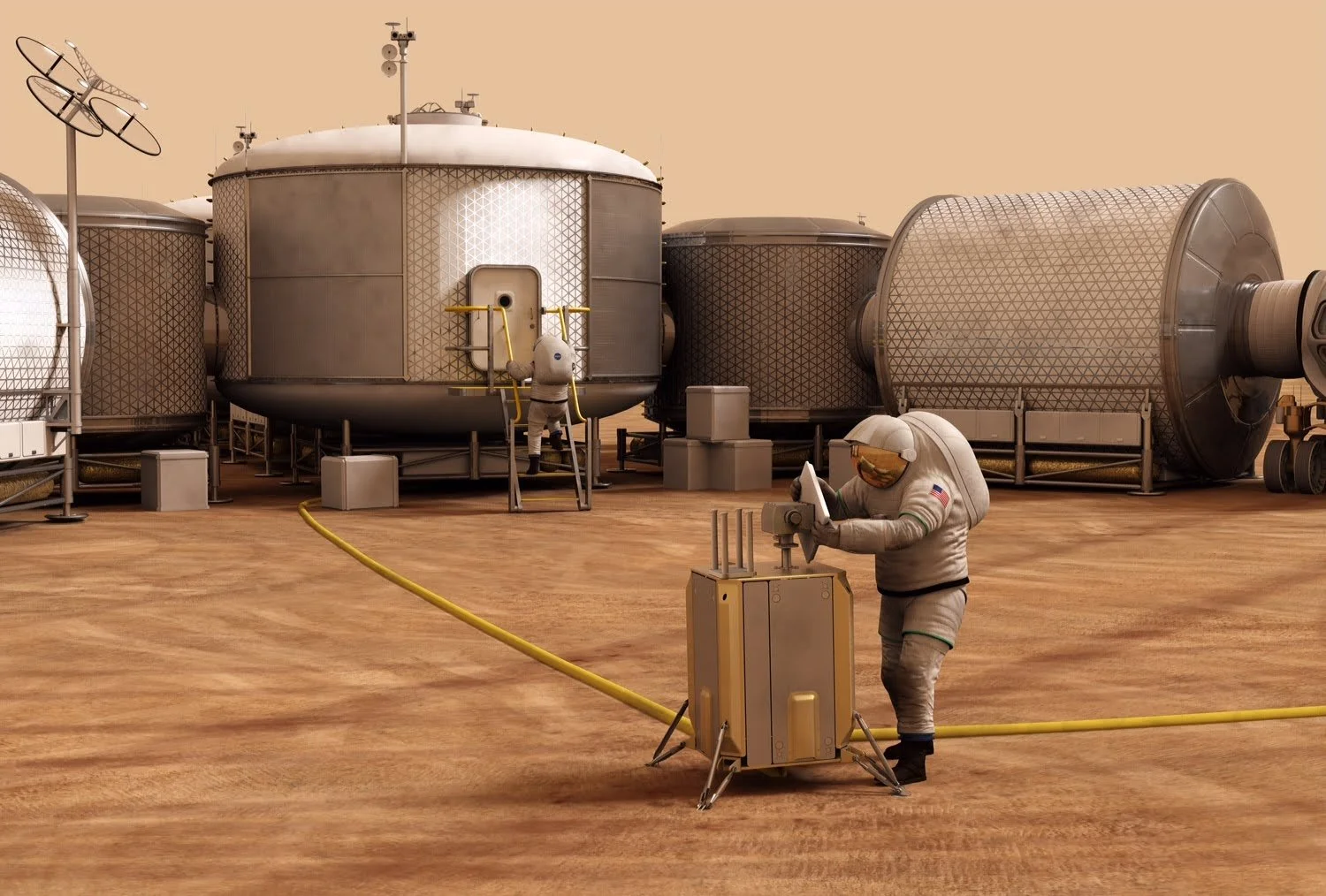
Mars is undoubtedly the next frontier in manned space exploration. It is the only other planet in the solar system that could realistically be settled by humans long-term. After all, Mercury and Venus are way too hot and all the giant planets beyond Mars have no surface.
The various orbiters and rovers deployed over the years have been instrumental in learning about the planet. They are cheaper to deploy, more resilient to hostile environments and can operate for long periods of time without many needs. However, there are certain things that just can’t replace direct observation and laboratory study. Humans can make immediate autonomous decisions whereas long-distance robots require deliberated consensus and cautious speed. An on-site geologist can quickly identify and compare rocks or complex formations whereas a robot can only take a picture which must be transmitted millions of kilometers where geologists can eventually make sense of the image. Robots designed for specific purposes can’t be modified to meet unexpected challenges while so far away.
There are still many challenges that must be overcome to make a manned mission to Mars not only possible, but fruitful. Considerations must be made regarding a wide variety of aspects of a potential mission.
Any journey to Mars would require astronauts to endure microgravity in cramped quarters for a months-long voyage that will likely last months. All their physiological needs would need to be provided for the entire duration of the mission from leaving Earth to returning to Earth. This would include breathable oxygen, as well as sufficient food and water for the journey both ways and while they are conducting surface operations. Regular exercise is required to stave off muscular atrophy and bone loss. They would also need proper environmental protection from dangerous cosmic radiation, extreme temperatures, toxic soil and adverse weather like dust storms.
Entry into Mars’ thinner atmosphere would be much faster, so the spacecraft would need a way to achieve additional deceleration to safely reach the surface. Not only would the spacecraft need to be able to land, but it would also need to be able to take off again so the astronauts could eventually return home. Luckily, leaving Mars is generally easier than landing because of the lower gravity and reduced atmospheric drag.
Once they arrive on the surface, astronauts would require domiciles consisting of living quarters and research stations. Scientists favor subsurface caves and lava tubes as suitable places for future human research and habitat modules where they will be protected from the harsher elements of the Martian surface.
MARTIAN MOONS
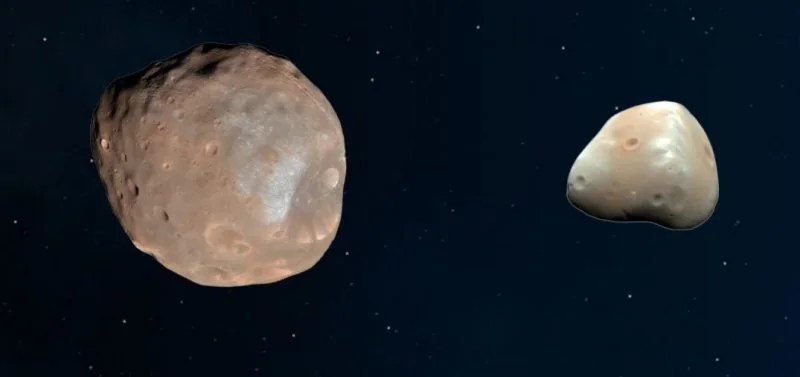
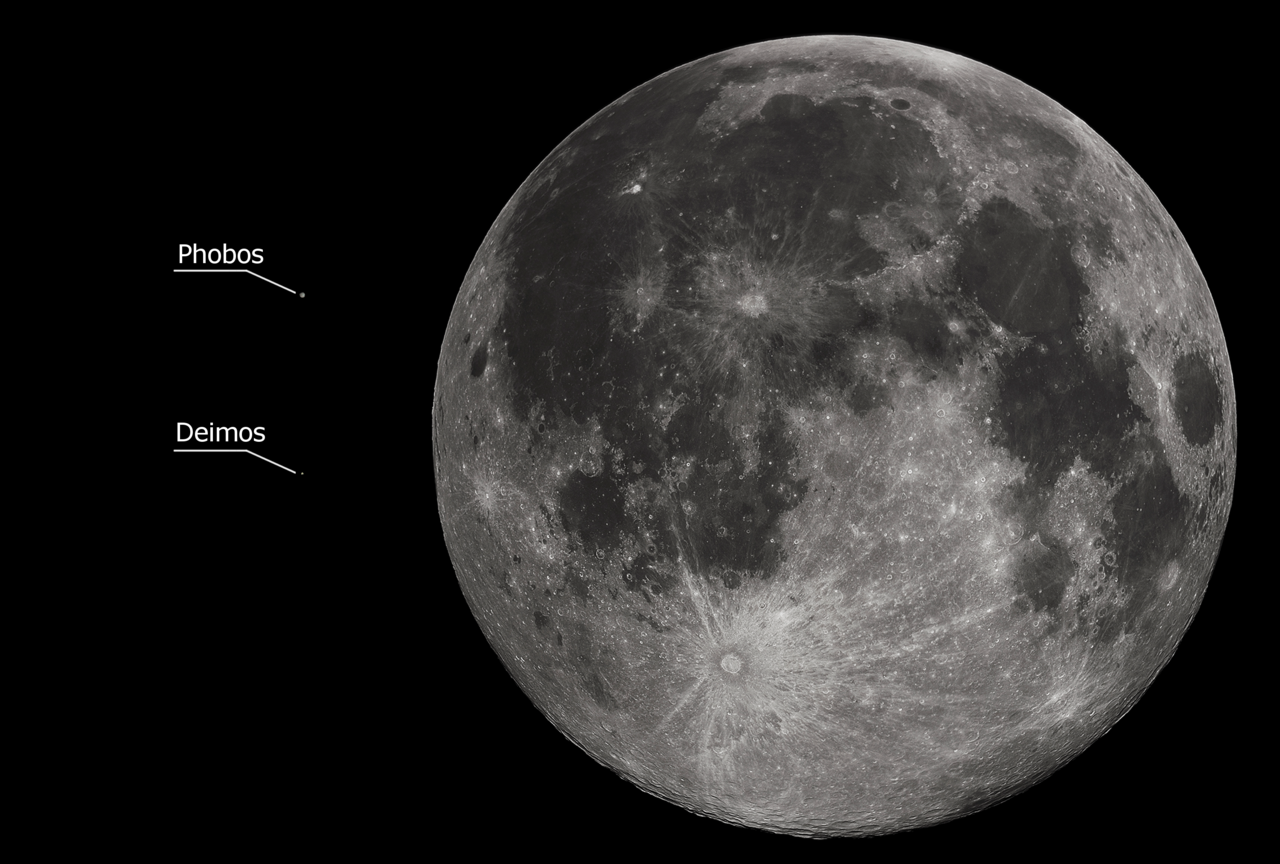
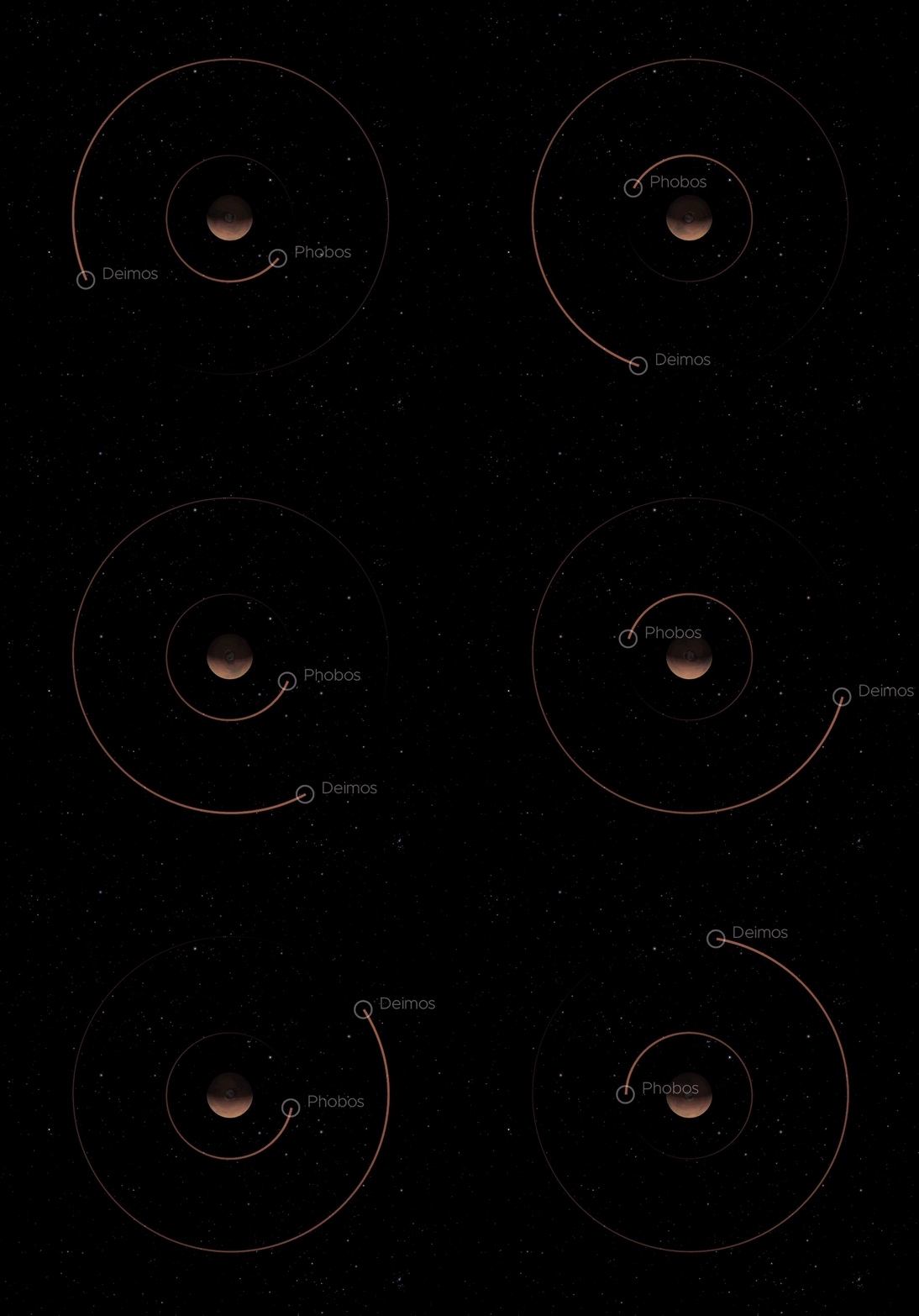
One final similarity between Mars and Earth is that they both have a moon. In fact, Mars is the only planet in the inner solar system that has more than one moon. It has two: Phobos and Deimos. While they were suspected to exist as far back as Galileo’s time, it wasn’t until 1877 that they were discovered by American astronomer Asaph Hall in 1877. He subsequently named them after the twin sons of Ares (Mars’ Greek counterpart), who personified fear and dread, respectively. Where Earth’s moon is large, round and bright, the Martian moons are very small, irregularly shaped and dark. They are almost indistinguishable in appearance from any typical large asteroid; lumpy, cratered and with no atmosphere. In fact, many scientists think that’s what they are: rogue asteroids that were captured by Mars’ gravity. However, this idea is very much in dispute as scientists have pointed out their circular, equatorial orbits and low density aren’t what we’d expected from such an encounter. Instead, they posit the moons accreted from ejected debris following a giant collision with Mars long ago.
Fun fact: Both moons are tidally locked, always showing the same face to Mars as they orbit, just like Earth’s moon!
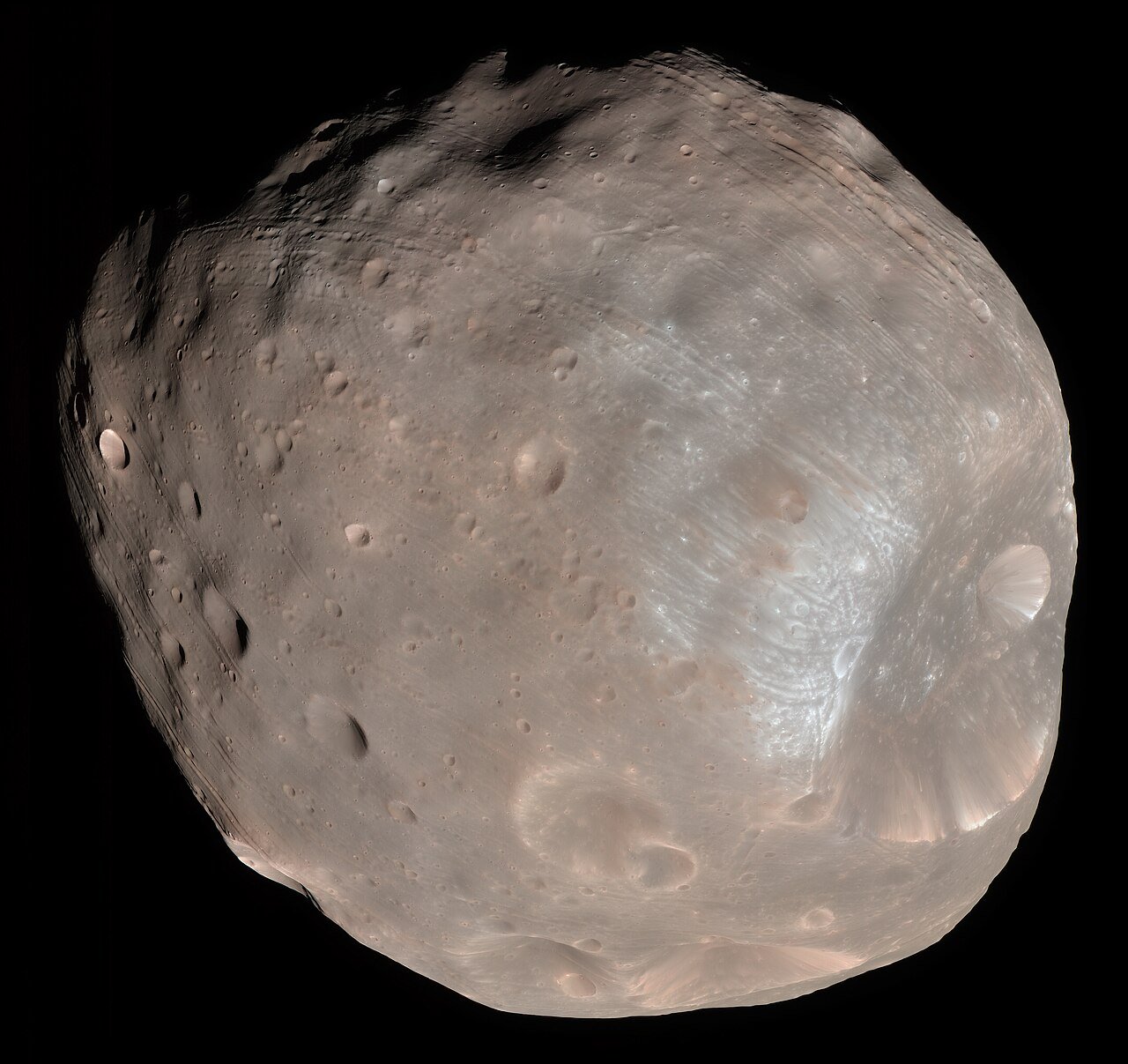
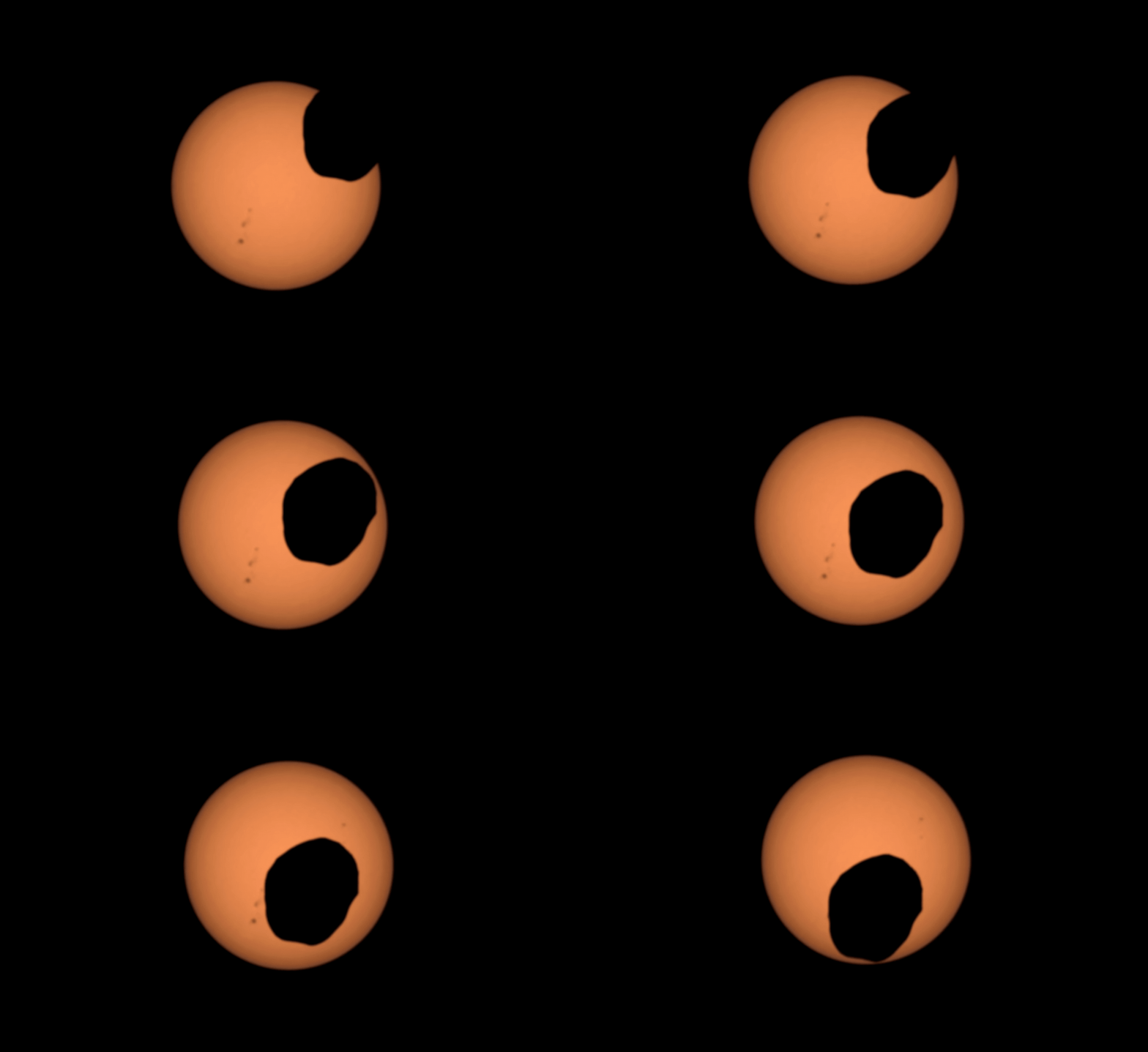
The larger and closer of Mars’ two moons, Phobos comes in at a max diameter of 26 km (16 mi). That’s smaller than Harford County! Phobos orbits just 6,000 km from the surface of Mars, closer than any other moon to its planet in the solar system. Because it’s so close, it must travel really fast around Mars in its orbit. It can do a full revolution around the planet in less than eight hours. This means it can orbit Mars over three times faster than Mars can rotate on its axis. From the equator, it would appear to rise in the west and travel across the entire sky in just four hours. You’d actually be able to notice a change in its apparent size as it travels from horizon to zenith. When directly overhead, it appears a third of the diameter that Earth’s moon appears in our sky. However, it wouldn’t be visible at all if you were standing near the planet’s polar regions.
Phobos has some hallmarks of an asteroid. Spectral analysis shows it to be composed primarily of carbonaceous rock, similar to C-type asteroids. It’s also covered in a thick layer of dark regolith from eons of meteorite impacts. These make it one of the least reflective objects in the solar system. It’s large enough to be covered in craters. In fact, Phobos’ most striking feature is a huge crater crushing in its leading side, called Stickney, after the maiden name of its discoverer’s wife. She was a mathematician who encouraged Hall to persevere in finding the moons. The crater is immense relative to the moon's size, spanning 9.5 km across. That’s nearly half the moon’s diameter! It is believed that the impact would have nearly destroyed Phobos were it not for the moon’s interior being so porous. Radiating out from the creator you can see a series of closely spaced grooves. These were previously thought to be stress fractures from the impact but have since been found to instead line up with the leading apex, the point facing Phobos’ direction of orbit (which is not far from the crater’s center).
While Earth’s moon is gradually drifting away, Phobos is falling towards Mars at about 2 cm per year. In 100 million years or less, Phobos will eventually get close enough to Mars that it’s expected to crumble under the planet's tidal forces. This is why it is often called the “doomed moon.” The resulting debris would end up forming a planetary ring around Mars that would last up to another 100 million years.
Fun fact: Speaking of doom, Phobos was featured as a location in the video game Doom Eternal.
Video: Phobos transiting the Sun, captured by NASA’s Perseverance rover in 2022. You can also see sunspots on the Sun’s surface!
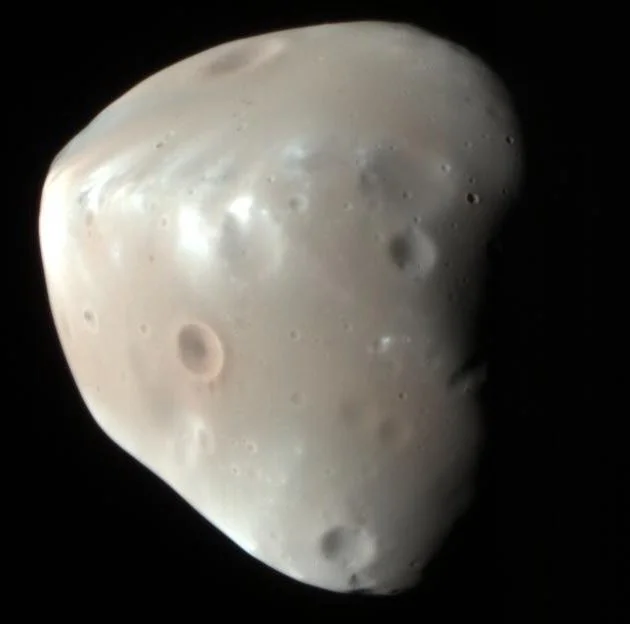
Deimos is the smaller of Mars’ two moons and the smallest moon in the inner solar system. Its max diameter of 16 km (10 mi) makes it barely larger than Chicxulub, the asteroid that wiped out the non-avian dinosaurs.
Deimos orbits about 20,000 kilometers away from Mars’ surface. Although this is still far closer to Mars than our Moon is to Earth, Deimos is so small that it appears from the Martian surface as little more than a bright point of light (probably as bright as Venus in our sky). At this distance, Deimos takes about 30 hours to complete an orbit. This is slower than Mars’ rotation meaning Deimos does cross the sky in a traditional east-to-west direction. However, because their durations are so close, it takes Deimos about 2.7 days to travel from horizon to horizon.
While Deimos shares a carbon-rich composition with Phobos, it is noticeably smoother, lacking its companion’s colossal craters and radial grooves. That being said, Deimos does have some impact craters. Two are of particular note: Swift and Voltaire, named after two 19th-century writers who speculated about the existence of the Martian moons.
Unlike Phobos, Deimos is actually slowly drifting away from Mars, following similar mechanics as Earth’s moon. One day it will escape orbit and become just another asteroid floating around the Sun.
Fun fact: Gravity on Deimos is so low that you could easily reach escape velocity simply by jumping!