
ASTEROIDS
Ancient nomads that drift through space.
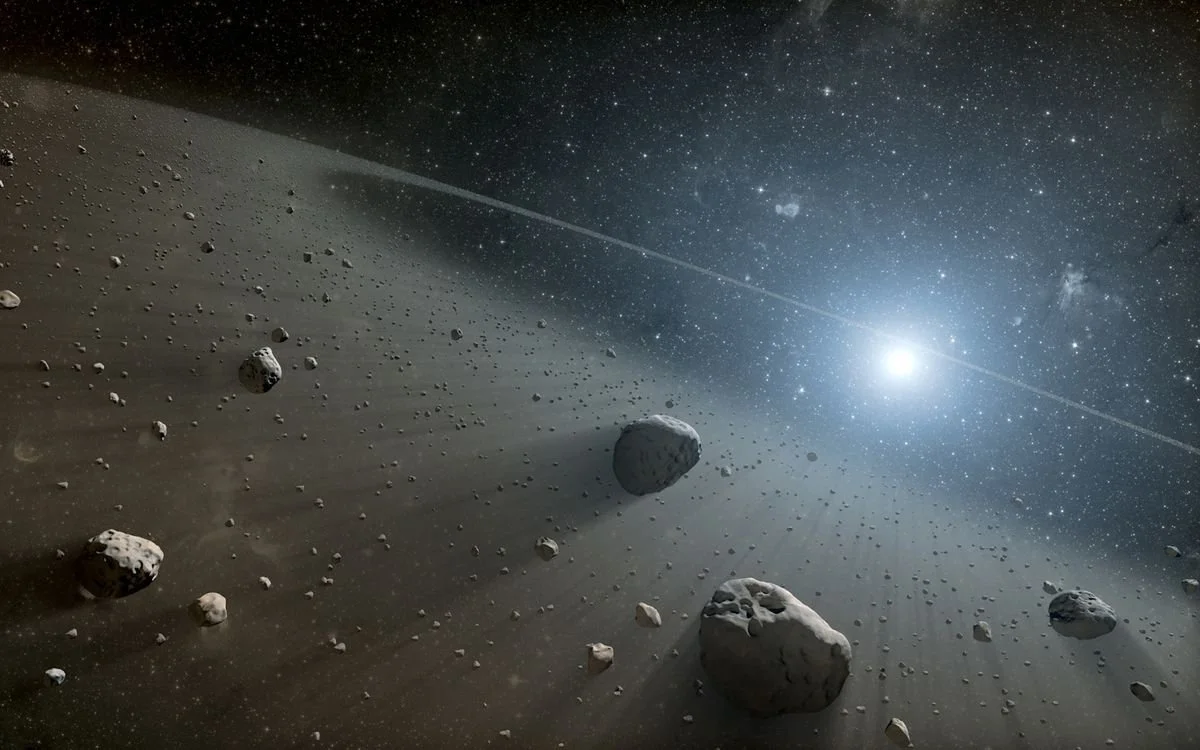
WHAT IS AN ASTEROID?
An asteroid is a relatively small, rocky or metallic body that orbits the Sun, typically with an irregular shape and no atmosphere.
I say relatively because these objects vary wildly in size, with many being smaller than a car and some being larger than entire U.S. states! So, they are small when compared to planets but can be incredibly large when compared to us! We don’t really have a hard-and-fast rule for what size or mass something must be to qualify as an asteroid. The smallest asteroid we’ve ever found was just two meters wide, about the size of a human.
On the other end, some asteroids get so big and massive that their gravity starts to crush themselves into a rounded shape (this is known as hydrostatic equilibrium). The best example of this is actually the first “asteroid” ever discovered, Ceres! At the beginning of the 19th century, astronomers understood the solar system to be occupied by the Sun, planets, moons and comets and pretty much nothing else. It was on the first day of 1801 that an Italian astronomer named Giuseppe Piazza spotted an object orbiting between Mars and Jupiter. It was named Ceres and initially confirmed to be a planet. However, over the next half-century, astronomers found more and more objects orbiting in the same region; too many to suggest they were planets. In 1852, they were redefined as members of a new class of object: asteroids. The name was coined by German-British astronomer William Herschel and is Greek for “star-like” due to their pinpoint appearance from Earth. The region they were discovered in became known as the main asteroid belt (more on that later). Ceres would be grandfathered in as an asteroid in 1867, dubbed 1 Ceres. Today, Ceres is classified as a dwarf planet, the only one to be considered an asteroid (if only symbolically).
Most asteroids are remnants left over from the formation of the solar system about 4.56 billion years ago. When our young protostar was surrounded by a rotating disk of gas and dust, called a protoplanetary disk, tiny solid particles frequently collided and stuck together, gradually building into larger and larger objects. This is rather informal, but the progression goes something like:
dust particle > pebble > rock > asteroid > dwarf planet > planet
The Sun and planets make up virtually all of the solar system’s mass, leaving but a fraction of a fraction of a percent remaining to form all the asteroids. We’re talking ~0.00000012%. If you were to combine all the asteroids into one object, its mass would be only 3% of Earth’s moon and about a third of that belongs to Ceres. Don’t think this means there aren’t a lot of asteroids. NASA has identified over a million individual asteroids floating around in our solar system, though most of them are in the main asteroid belt. There are likely far more we haven’t discovered yet because they are simply too small, dark or distant to see. Astronomers globally discover more than 50 asteroids every day.
METEO-WHAT?
66 million years ago, the non-avian dinosaurs were wiped out when a huge asteroid collided with Earth. Oh, I mean, it was a comet. Or maybe a meteor? Meteor… ite? Or, no, meteoroid! I think… Large things flying around space and raining fire from the sky can trigger the use of a lot of words that get used interchangeably. In casual conversation it’s probably not that big of a deal but if you’re reading about astronomy, they have meanings. Before we continue talking about asteroids, we should clear up the confusion once and for all.
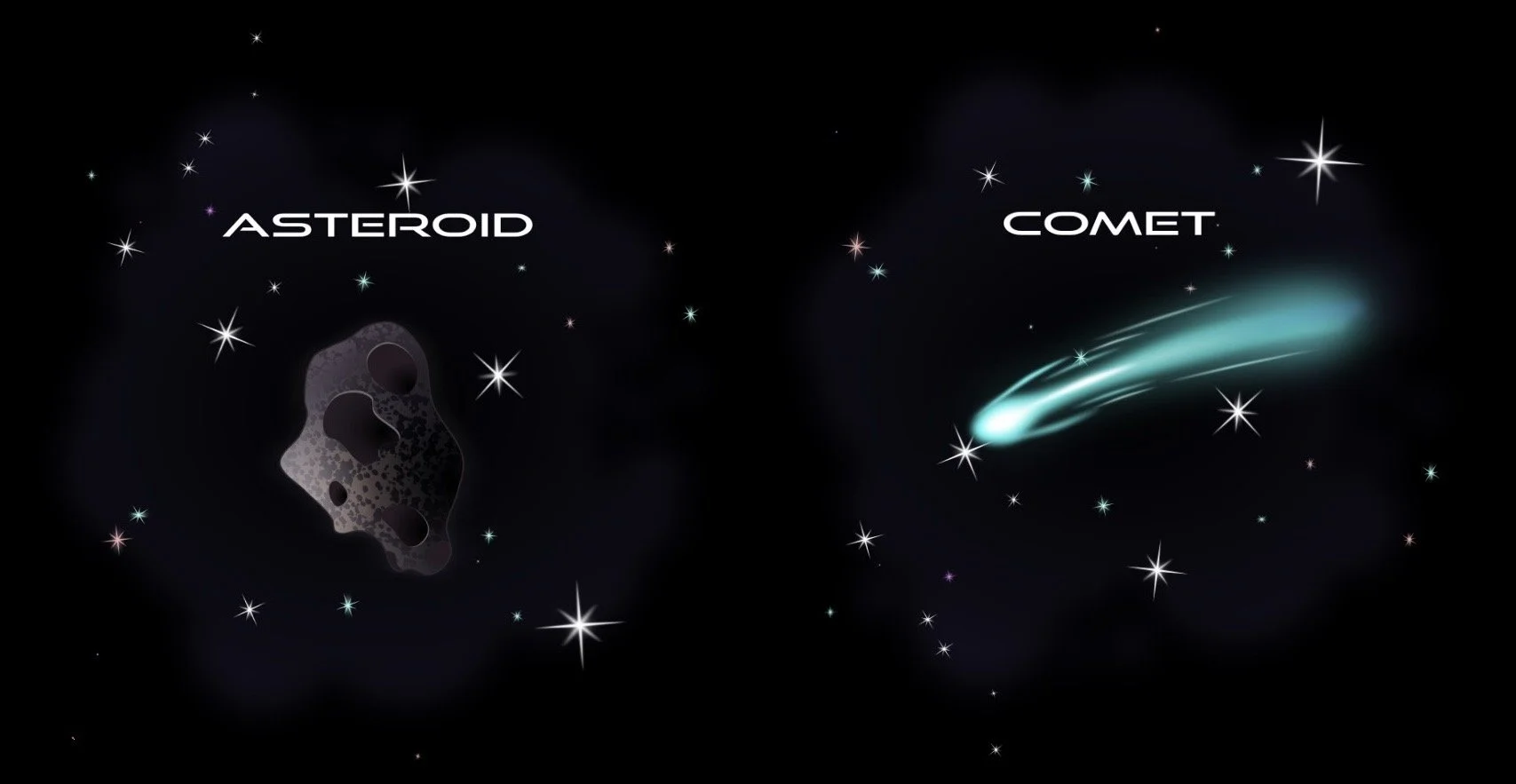
Let’s start with the difference between asteroids and comets.
We generally distinguish between them in a few broad ways. Asteroids tend to be rocky or metallic in composition while comets are made of ice mixed with dust, a combination that has earned them the nickname “dirty snowballs.” Their paths through the solar system also tend to differ, with asteroids typically following more stable, planet-like orbits around the Sun, while comets travel along much more elongated paths that bring them close to the Sun only occasionally. There’s a bit of grey area where some asteroids are known to contain ice, and some comets originate in regions traditionally associated with asteroids. When such differences are not important to the discussion, astronomers often group both comets and asteroids under the broader category of small solar system bodies.
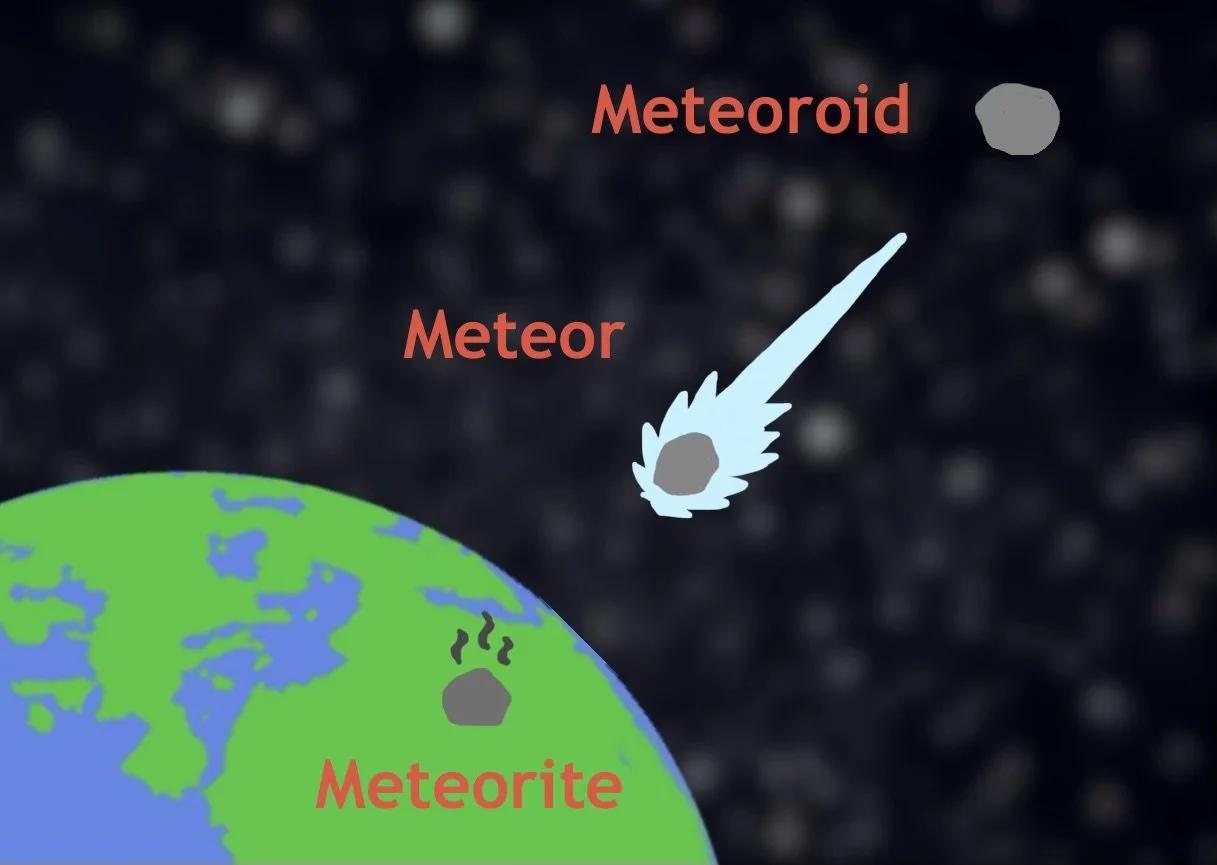
Now let’s move on to the three “M” words: meteor, meteorite, and meteoroid.
Earlier we learned that the smallest confirmed asteroid is about two meters wide. But surely there are smaller rocks floating through space. There are! Some are only a meter across, others are small enough to hold in your hand, and many no bigger than pebbles! So, what do we call them? The International Astronomical Union (IAU) defines asteroids less than one meter across as meteoroids and those smaller than 30 micrometers as micrometeoroids.
It’s important to remember that meteoroids are still rocks in space. And with so many of them floating around, some are bound to find their way to Earth. The solar system is an expansive shooting gallery. When one of these chunks of rock or ice approaches Earth, it cuts its way into the atmosphere at incredible speed, tens of thousands of kilometers per hour! At such speeds, the air molecules in front of the object are compressed so violently that it heats to extreme temperatures, becoming ionized and forming a glowing sheath of plasma around it. The resulting streak of light is called a meteor.
You may associate meteors with apocalyptic, planet-killers falling from the sky, and that’s not wrong, but it’s incomplete. We see them almost every night as shooting stars. Most are tiny, often dust or pebble-sized, and burn up and vaporize before reaching the ground. From Earth, they appear as brief flashes of light that zip across the sky and vanish in the blink of an eye.
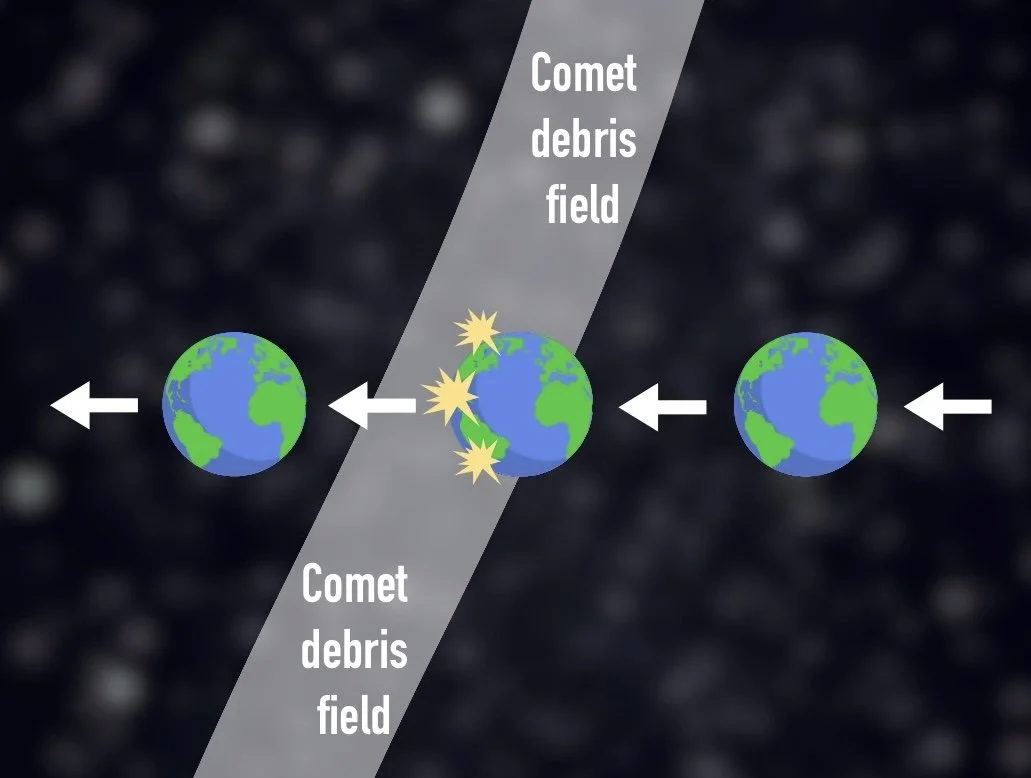
There are countless dust particles and pebbles floating around the solar system and some find their way to Earth. While this does happen millions of times every day, Earth is really big so your chance of seeing one on a typical night especially if you were in light polluted skies is kind of low. However, there are regions of space where these dust particles and tiny rocks are much more frequent. These are large trails of debris leftover by some passing asteroid, comet or the remnants of some cosmic collision. Earth’s orbit pretty regularly passes through these regions, sweeping up a bunch of meteoroids. From the surface, we see this in the form of meteor showers, a dramatic spike in the frequency of shooting stars. To use a colorful analogy: Imagine a truck (Earth) driving down the road (orbiting the Sun) where a swarm of bugs (dust and rocks) are buzzing around (floating through space) and they get splattered on the windshield (burn up in Earth’s atmosphere).
While meteor showers can happen at any time, there are many that occur in regular annual intervals as Earth passes through the same debris field at the same point in its orbit. For example, we experience the brilliant Geminids meteor shower every year around December 13-14th. It’s named as such because its radiant, the point in the sky from which the shooting stars appeared to originate from, is located in the constellation Gemini. This meteor shower is associated with a debris field left behind by 3400 Phaethon, one of the few annual meteor showers associated with an asteroid (comets are far more prone to produce these debris fields).
Not every meteor burns up completely. If part of it survives its fiery passage through the atmosphere and reaches the ground without vaporizing, it becomes a meteorite.
In other words, the same object can be a meteoroid in space, a meteor as it streaks through the atmosphere, and a meteorite once it lands on Earth.
TYPES OF ASTEROIDS
There are many different ways we categorize asteroids. The main two things we look at are where they are and what they are made of.
Let’s start with the latter.
We don’t need to hold a piece of an asteroid in our hands to know what they are made of. Instead, we use a spectrometer that separates reflected light from distant asteroids into its component wavelengths. In the spectrum, we find patterns of dark bands that represent the wavelengths that weren't reflected but absorbed by the asteroid. These patterns identify the minerals, and chemical compounds present on the asteroid's surface, and are very highly distinctive, like fingerprints.
Note: A limitation of spectroscopy is that we can’t use spectroscopy to analyze an asteroid’s interior which could potentially be compositionally quite different from the surface.
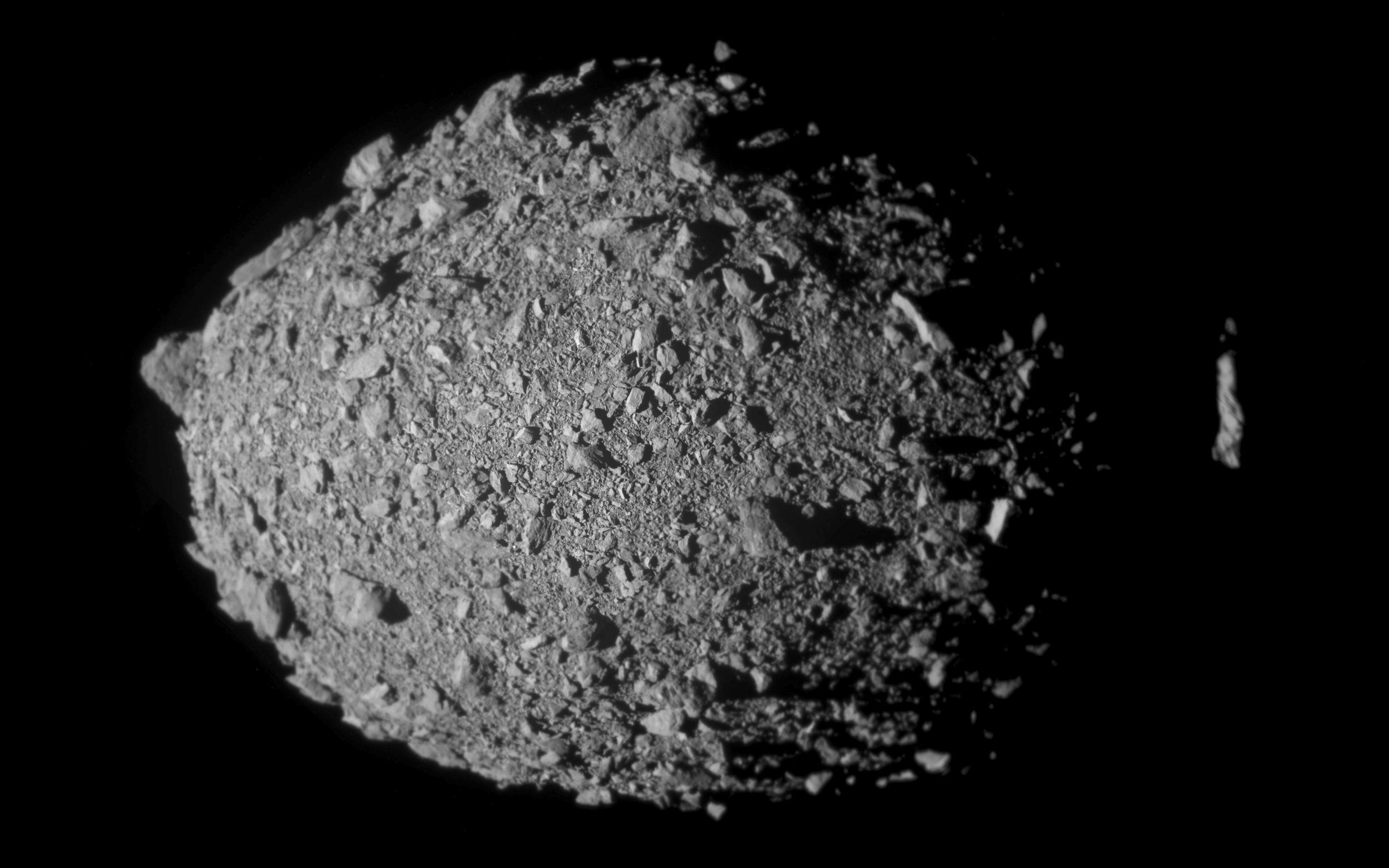
Carbonaceous asteroids (C-type) are by far the most common type, accounting for about 75% of known asteroids. Particularly common in the outer regions of the asteroid belt, C-type asteroids are defined by their carbon-rich composition. This gives them very low albedos, reflecting very little sunlight. This dark complexion makes them more difficult to spot against the blackness of space. These are some of the most ancient objects in the solar system. That’s not to say they formed the earliest, but that their forms are the most unchanged. They essentially act as time capsules that allow astronomers to study what the early solar system was like.
Although they are carbonaceous, C-type asteroids contain a wide variety of minerals, including abundant silicates, similar to their stony S-type counterparts. What’s interesting is that many C-types show evidence of having undergone aqueous alteration early in their history. This occurred when heat from radioactive decay melted internal ice, allowing liquid water to react with and chemically alter the asteroid’s minerals, forming hydrated minerals such as phyllosilicates. C-types also contain a variety of organic compounds such as amino acids and hydrocarbons. These are not necessarily biological in origin, but some can serve as the ingredients for prebiotic chemistry. The presence of both hydrated minerals and organic compounds makes C-types an interesting subject for scientists interested in how Earth might have been delivered the building blocks for life.
C-types tend to be quite porous, with extra empty space and low-density material throughout their interiors. During impacts, these voids can collapse and compact, absorbing impact energy that might otherwise go into fracturing and ejecting material and potentially dampening shockwaves. This can reduce fragmentation and ejecta compared with denser asteroids, which transmit shock more efficiently. However, absorbing impact energy does not mean C-types are harder to break apart: their low bulk strength can make them structurally fragile, especially rubble piles like Bennu, whose rocks and dust are held together loosely by gravity. Their weak structure can also make them susceptible to fragmentation during atmospheric entry, when intense aerodynamic heating and forces act upon them.
Pictured: Dimorphos, a rubble pile that’s part of a binary system. It was intentionally impacted by a NASA spacecraft in 2022, just seconds after this image was taken.
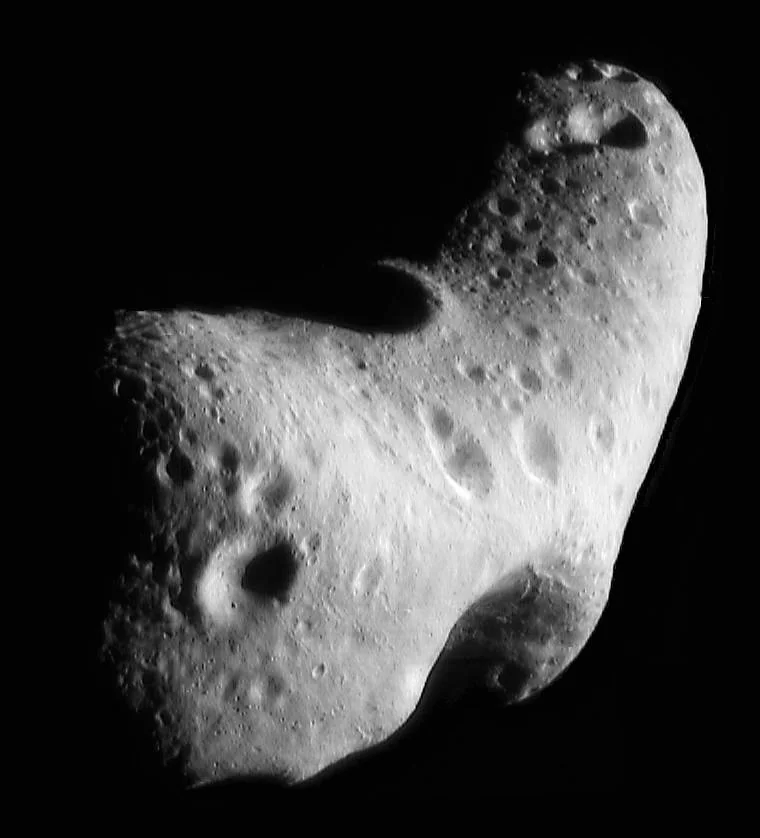
Siliceous asteroids (S-type) are the second most common type, though there is a big drop off after their carbon-rich counterparts. They account for about 17% of known asteroids (roughly one sixth).
S-type asteroids are made of mostly silicate minerals, which has earned them the nickname “stony asteroids.” These families of minerals, such as olivine and pyroxene, are very commonly found in the crusts, and especially the mantles, of rocky planets like Earth and Mars, and even the Moon. S-types also contain varying amounts of iron and nickel, including in metallic form. In other words, they are made from some of the Solar System’s basic rock-forming materials. In other words, they are made from some of the solar system’s basic rock-forming materials. Compared with dark C-types, their rocky silicate surfaces give S-types a moderately high albedo, making them easier to spot from far away. Another way they differ from C-types is they are poor in volatiles (like water) and organic molecules. This contributes to their denser and more cohesive structure.
They are dominant in the inner asteroid belt, contrasting with C-types, which are more common in the outer asteroid belt. This dichotomy reflects in part the temperature gradient in the early solar system. Closer to the young Sun, higher temperatures favored the formation and survival of dry, rocky materials, while farther out, colder conditions allowed water ice and other volatile materials to remain stable.
Pictured: 443 Eros is an S-type asteroid and the second largest near-Earth asteroid.
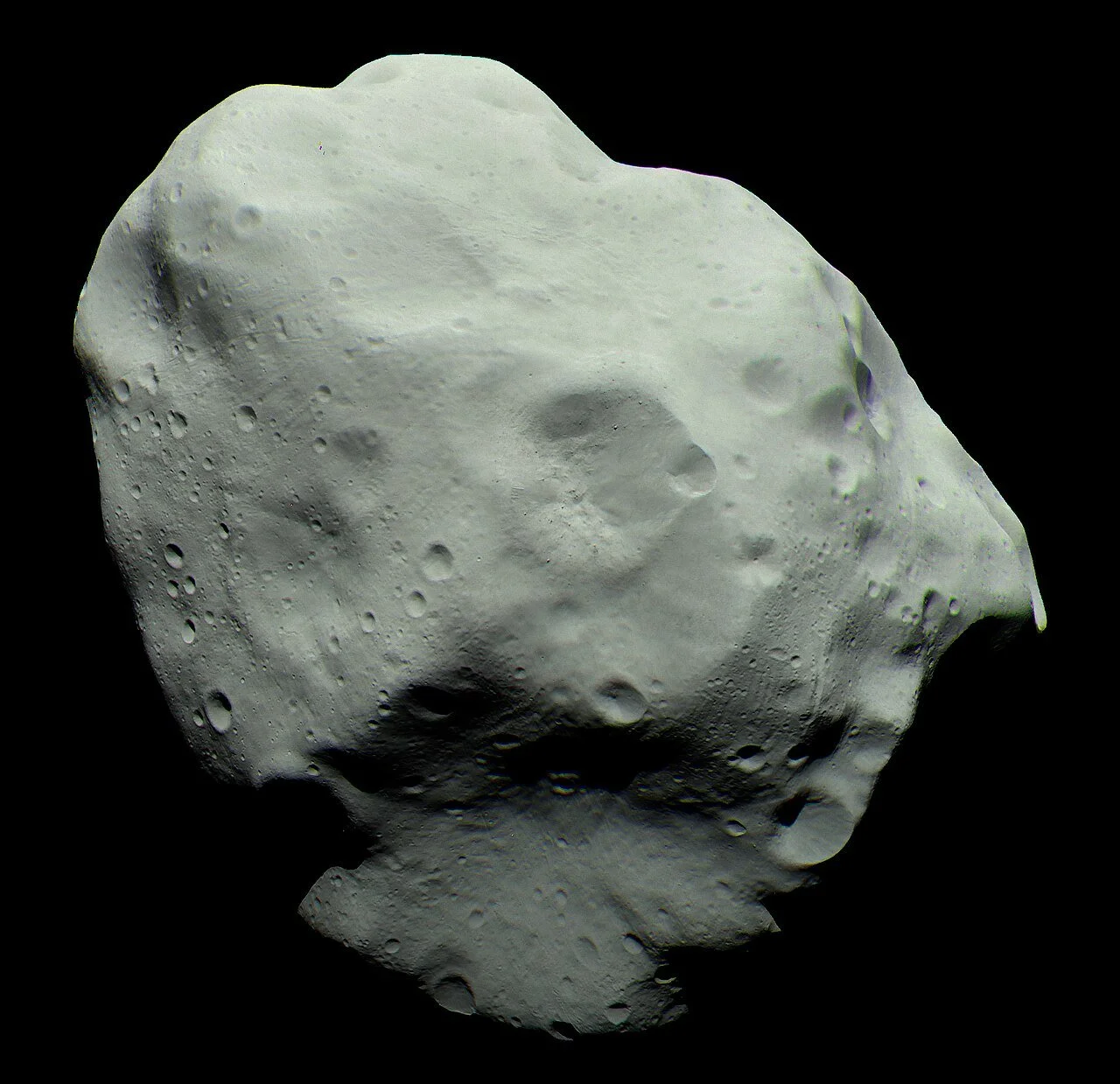
Metallic asteroids (M-type) make up only about 5% or less of known asteroids, despite being the third most common. They are defined by their abundance of metallic iron and nickel, though most are still very silicate rich as well.
M-types have proven difficult to analyze. Unlike silicate-rich asteroids, metals can produce weak or featureless spectra due to their free-moving electrons. However, some carbonaceous asteroids can also lack prominent spectral features. Metallic surfaces are generally moderately reflective in visible light and highly reflective to radar, though surface roughness and weathering can redirect this light away. Astronomers can look at the infrared emissions of rotating asteroids over time to identify metals, which are able to heat up and cool down quickly as they pass in and out of sunlight. Gravitational interactions can reveal an asteroid’s mass, which, combined with its volume, allows scientists to calculate its density. An asteroid packed with metals would generally be unusually dense for its size, unless it was really porous. While none of these observations can be conclusive on their own, the case for identifying a metallic asteroid is strengthened when many pieces of evidence converge.
The idea behind how these metallic asteroids may have formed is quite interesting. It is thought that asteroids in the early solar system contained a lot of isotopes with short-lived half-lifes, such as aluminum-26. The radioactive decay of these atoms could have generated enough internal heat to melt some of the asteroid’s materials, allowing molten iron and nickel to separate from the surrounding rock and sink toward the center. This process is similar to how the metallic cores of planets formed. Once the radioactive isotopes were depleted, the asteroid cooled and hardened. The asteroid continued to drift around the Sun until a hard collision blasted away its outer rocky layers, exposing fragments of the metallic core. It’s a leading hypothesis but remains unconfirmed.
Pictured: 21 Lutetia is an M-type asteroid in the main asteroid belt. It’s the second largest asteroid to be visited by a spacecraft.
ASTEROID GROUPS
An asteroid group is a population of asteroids that share one or more characteristics. This is most commonly their orbital characteristics, especially in how they relate to a planet. For example, Earth-crossing asteroids have orbits that regularly pass both inside and outside Earth’s orbital path. Another example would be Hilda asteroids which share a 3:2 orbital resonance with Jupiter, causing them to cluster in three broad regions and forming a distinct triangle pattern.
Note: It is customary to name a group of asteroids after the first member of that group to be discovered, which is often the largest.
The individual members of an asteroid group do not necessarily share a common origin. They could simply have been brought together by gravitational interactions. However, there is a kind of asteroid group that is all about common origins, called an asteroid family. These are thought to be asteroid fragments that broke off from a parent asteroid following a heavy collision. They were first proposed by Japanese astronomer Kiyotsugu Hirayama in 1918. He noted that some asteroids orbit the Sun along unusually close trajectories, more so than chance would allow. Most asteroid families are in the main asteroid belt, and their number of members can range in the hundreds or thousands. For example, one of the first asteroid families that Hirayama identified is the Themis family. It consists of 4,700 fragments in the outer asteroid belt which are believed to have broken off from a large C-type asteroid, 24 Themis. However, it’s quite common for the initial collision to eject fragments into completely different regions. Many near-Earth asteroids are thought to have come from the asteroid belt.
NEAR-EARTH ASTEROIDS
There are many asteroids that orbit the Sun relatively close to Earth’s orbit, sometimes even crossing it! These are known as near-Earth asteroids (NEA). About 4% of known asteroids have been identified as NEAs. This adds up to about 37,000 asteroids. They break down into four main groups that are distinguished by how their orbits relate to Earth’s orbit. That relationship largely depends on their respective perihelion (closest distance to the Sun) and aphelion (furthest distance to the Sun).
Note: A broader category of NEAs is near-Earth objects. These include comets as well, which add 120 to the count.
Note: The following orbital diagrams of the various types of NEAs are only examples and can vary in shape considerably as long as they meet the necessary underlying criteria. Just something to keep in mind.
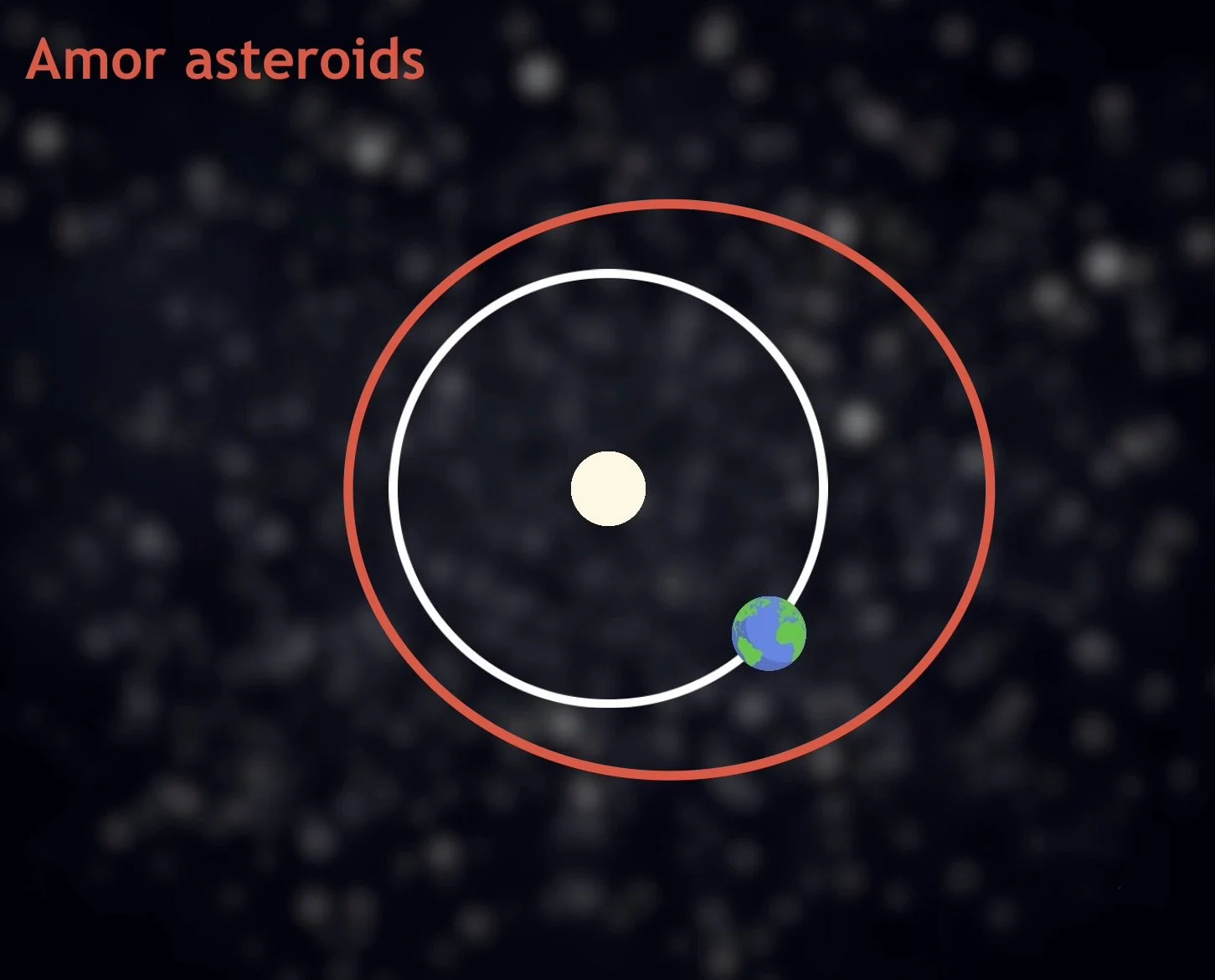
Amor asteroids have orbits that are always exterior to Earth's orbit. They are the second most common type of NEA, making up more than a third (~13,000). They are named after the group’s first recognized member, 1221 Amor. Most have eccentric orbits, with a perihelion that can near Earth’s orbit without crossing and an aphelion that commonly extend beyond the orbit of Mars. Gravitational encounters with Earth can nudge them off course and turn them into Apollo asteroids and even potentially hazardous ones. A famous Amor asteroid is 433 Eros, one of the largest NEAs (~17 km wide) and the first asteroid to be orbited and landed upon by a space probe.
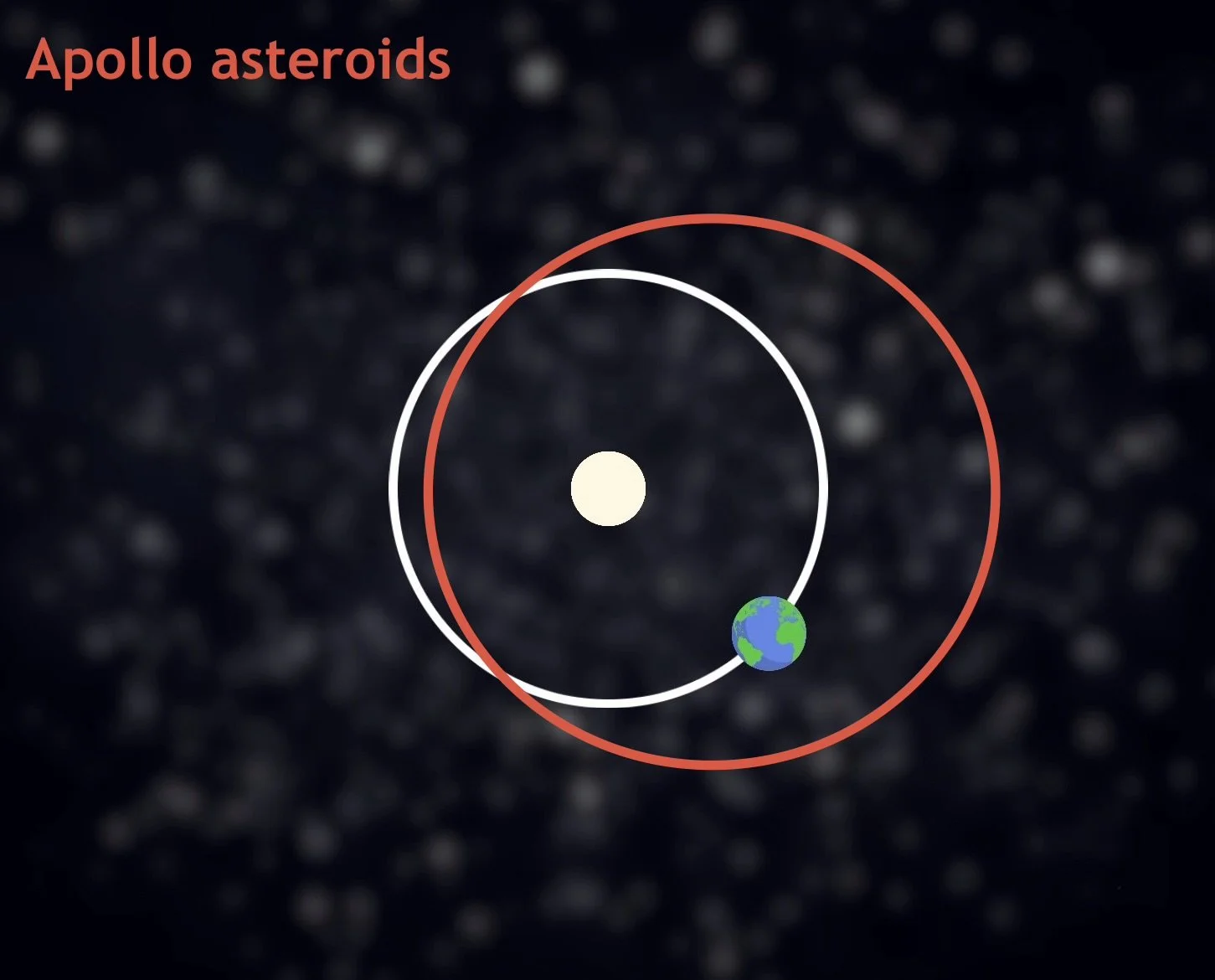
Apollo asteroids spend most of their time exterior to Earth’s orbit but regularly cross inside. They are the most common type of NEA, making up more than half (~21,000). This group is named after its first recognized member, 1862 Apollo. Coincidentally, this asteroid was discovered in the same year that Amor asteroids’ namesake was discovered. Individual asteroids in this group are typically named after Greek deities. Their orbital shapes can vary quite a bit. Some have mostly circular orbits, closely mimicking Earth’s orbit. Others are really stretched out with a perihelion that reaches inside of the orbit of Venus or an aphelion that reaches outside the orbit of Mars! Many Apollo asteroids are suspected to originate from the main asteroid belt before gravitational interactions from Jupiter or Saturn nudged them off course. Most potentially hazardous asteroids are in this group. Analysis of the infamous Chelyabinsk asteroid was determined to be an Apollo asteroid that we weren’t aware of!
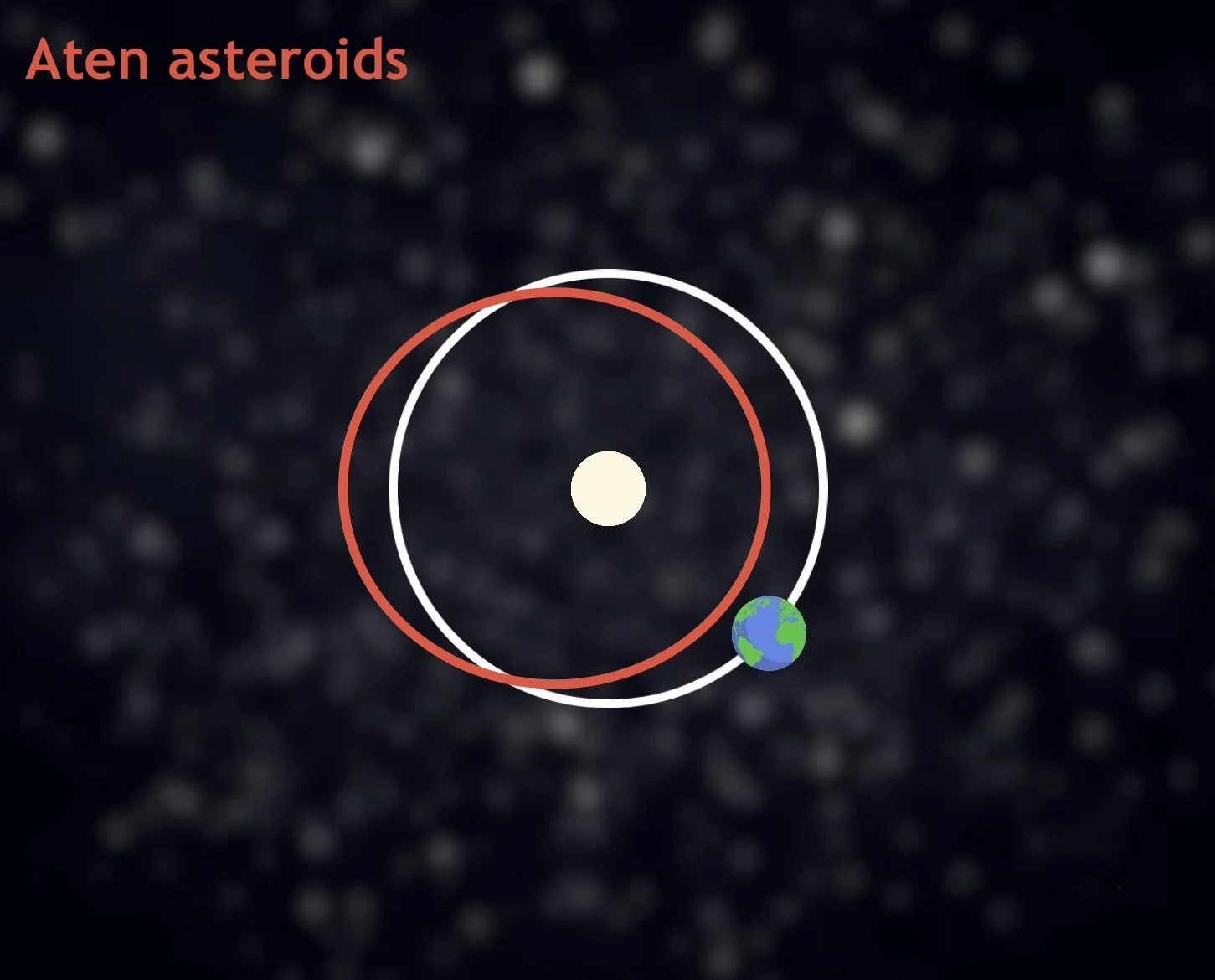
Aten asteroids spend most of their time interior to Earth’s orbit but regularly cross outside. This group is named after its first recognized member, 2062 Aten, while individual asteroids within the group are typically named after Egyptian deities. These are much less common than Amor and Apollo asteroids, accounting for less than a tenth of NEAs (~3,000). However, their numbers might be a bit deceiving. Because Aten asteroids spend more time inside Earth’s orbit, we must often contend with the glare of the Sun, making it harder to spot them. This creates a sampling bias that may make them seem rarer than they really are. This also makes them harder to identify as potentially hazardous asteroids. They account for a smaller share of PHAs than Apollo asteroids, but that difference may likewise reflect the same sampling bias. The most notable Aten asteroid is 99942 Apophis. It is a PHA which became very concerning in 2004 when it was thought it might impact Earth in 2029. That’s since been ruled out but will still pass quite close by us! It is also expected that this encounter will alter its trajectory and turn it into an Apollo asteroid!
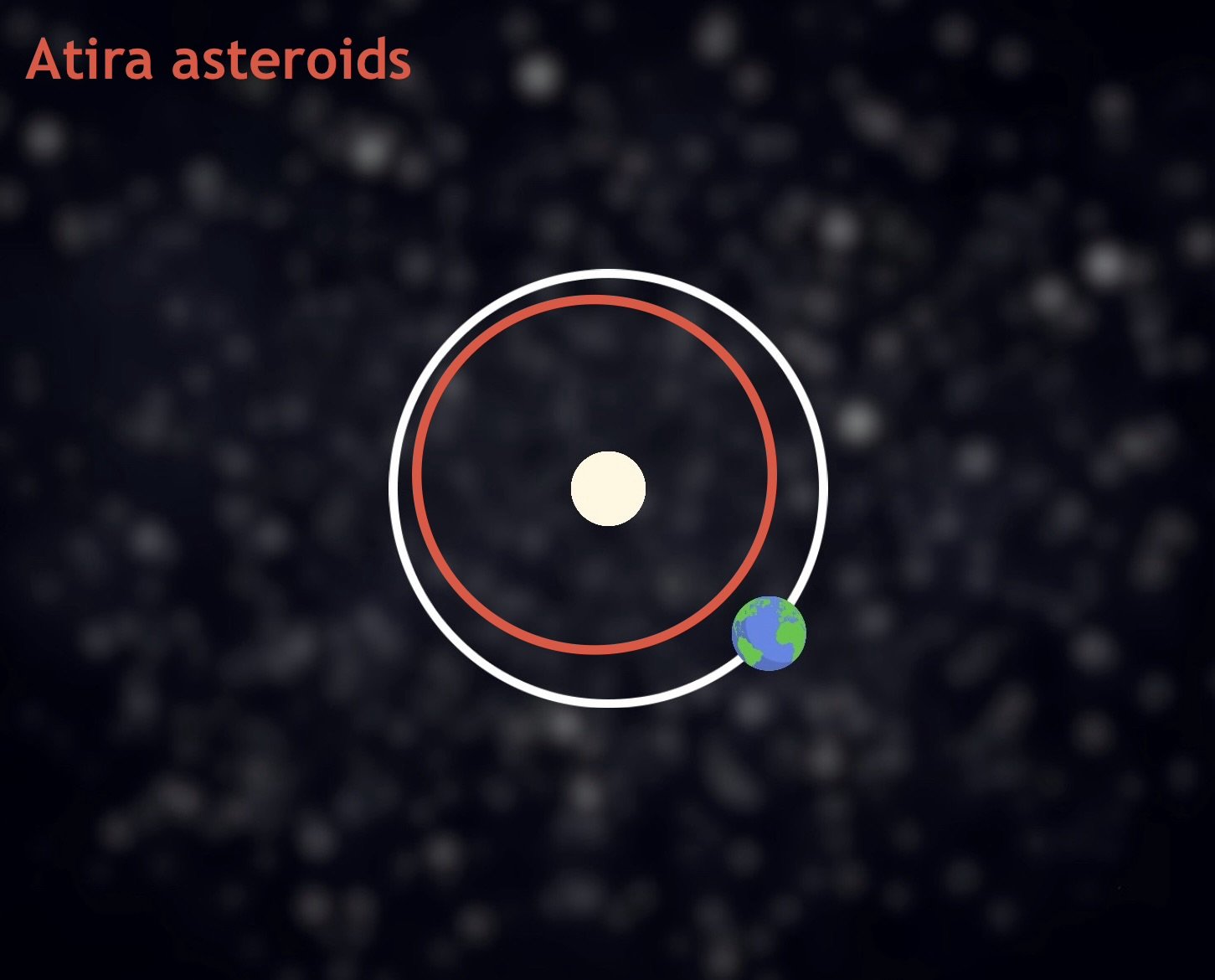
Atira asteroids have orbits that are always interior to Earth's orbit. This is the most recent group of NEAs, named after the first discovered member of the group, 1998 DK36. However, the object was subsequently lost so the namesake of the group went to the first confirmed member, 163693 Atira. These are extremely rare asteroids, making up just a tenth of a tenth of a percent of known NEAs (only 34 members). Their scarcity could be partly explained by a sampling bias, just like Aten asteroids, but the effect is even more pronounced here. Because Atiras never venture beyond Earth’s orbit, they spend even more of their time relatively close to the Sun from our perspective, making them particularly difficult to detect against its glare. For this reason, they can usually only be spotted during twilight, similar to Mercury and Venus. Speaking of, while no instance has been observed yet, astronomers speculate that gravitational interactions with the interior planets could potentially shift Atira asteroids outward into Aten asteroids, or even Apollo asteroids.
MAIN ASTEROID BELT
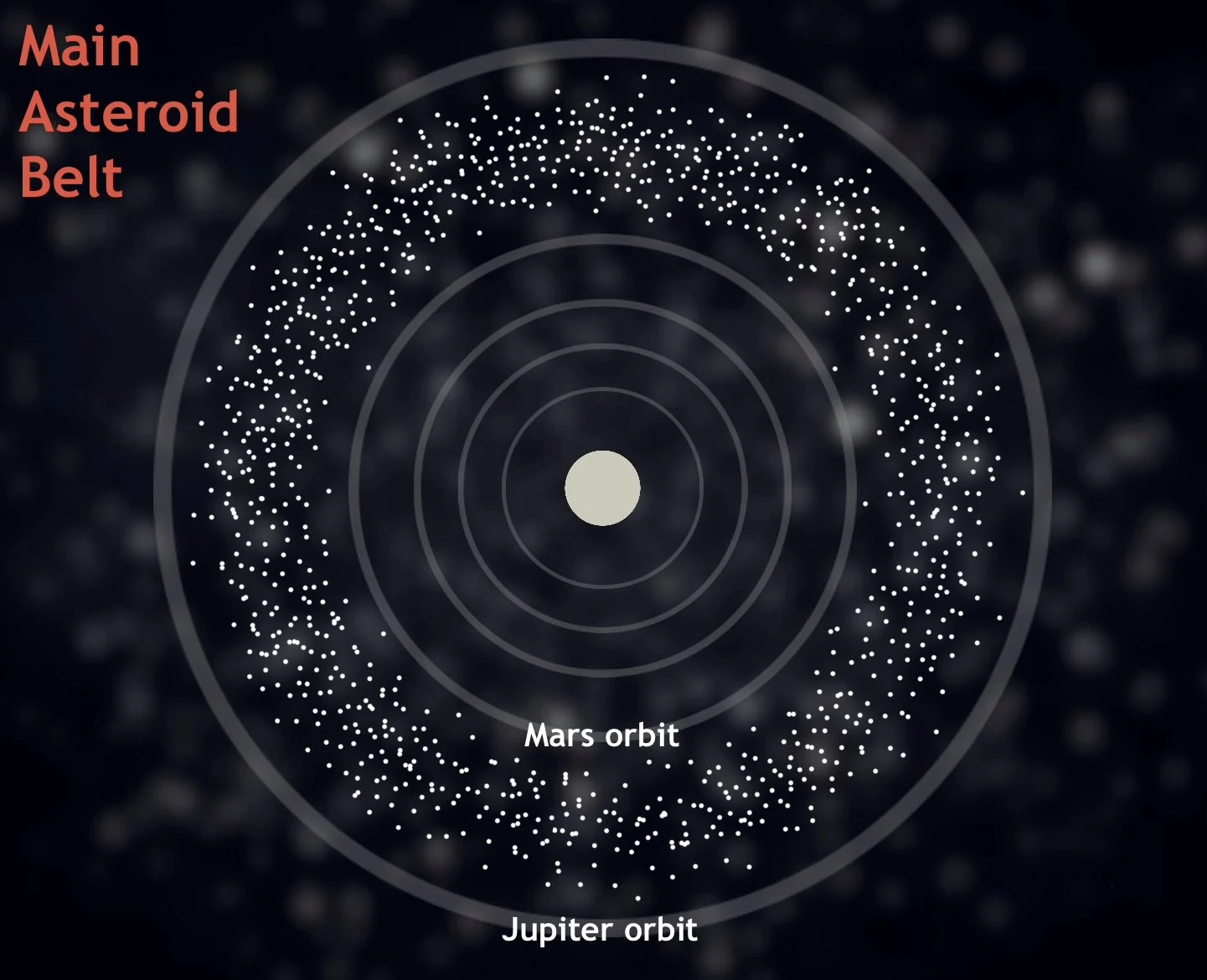
The vast majority of asteroids today are found in the main asteroid belt, a donut-shaped region centered around the Sun. It roughly spans the space between the orbits of Mars and Jupiter, from about 2 to 4 astronomical units (AU). The asteroid belt contains between 1 and 2 million asteroids at least 1 kilometer wide, including more than 200 that exceed 100 kilometers in diameter. Millions more are likely smaller than 1 kilometer. Despite its huge population and Hollywood portrayals of spacecraft bobbing and weaving through dense fields of rock, the vast majority of the asteroid belt is empty space. The average distance between asteroids here is roughly 1 million km (600,000 mi). You could put your spacecraft on auto pilot and take a nap as you travel through it with great confidence that you’ll be fine. The asteroids generally follow the same counterclockwise orbit as the planets, taking between three and six years to do a full revolution around the Sun.
But why does the asteroid belt even exist? Why does it orbit between Mars and Jupiter and why didn’t it coalesce into a planet? The asteroid belt has its roots in the protoplanetary disc that surrounded the young protostar when the solar system was still forming 4.6 billion years ago. Solid material in that disk gradually accumulated into larger bodies, eventually building the planets and smaller objects. Early hypotheses suggested that the asteroid belt might have been a protoplanet that was shattered by multiple collisions. However, too much energy would be required, and the diverse composition of the asteroids do not suggest an origin from the same planet. The region, however, did contain the necessary planet-building material. So, what happened?
A leading hypothesis is that the planetesimals that would eventually become the asteroid belt were interfered with by the strong gravity of neighboring Jupiter. Constant gravitational tugging forced planetesimals into varying orbital resonances, where they would repeatedly pass Jupiter at the same points in their orbit. This was later thrown into absolute chaos when Jupiter possibly migrated through the inner solar system and back again (known as the grand tack hypothesis). This gravitational disturbance may have made collisions between planetesimals faster and more destructive. Instead of gently colliding and merging into larger bodies, many smashed into one another and broke apart. Some were probably even ejected to another region or out of the solar system entirely. This made it extremely difficult for a planet to form.
Today, we generally divide the asteroid belt into an inner region dominated by silicate-rich asteroids and an outer region dominated by carbon-rich asteroids. This is not a hard rule, but a general trend. Furthermore, we find multiple points in the asteroid belt where asteroid numbers drop sharply at certain orbital distances. We call these Kirkwood gaps. These are caused by orbital resonances with Jupiter, where repeated gravitational tugs can destabilize asteroid orbits over time, eventually removing many asteroids from the region. Asteroid families are also scattered throughout the asteroid belt, forming distinct populations that astronomers can identify by their shared orbital characteristics. Some are large enough to account for a substantial concentration of asteroids within particular regions of the belt.
TROJAN ASTEROIDS
You might think of asteroids being pushed and pulled around by the gravity of the solar system’s planets being like a small boat amidst stormy seas. However, there are places in space where these gravitational forces find an equilibrium with the asteroid’s motion, like the calm waters of an eddy. These are known as Lagrange points. These are regions of space around any two orbiting bodies where their combined gravitational pulls balance the centrifugal force experienced by an object moving along with them.
There are five Lagrange points found around a two-body system, especially ones in which one is much more massive than the other. Think of the Earth and Moon or the Sun and Jupiter. Three of these Lagrange points (L1-L3) lie along a straight line through both objects and are considered unstable. The other two (L4-L5) lie along the less-massive body’s orbit, with one leading and one trailing, and are considered stable.
Note: For a refresher, check out the Lagrange points section of the gravity primer.
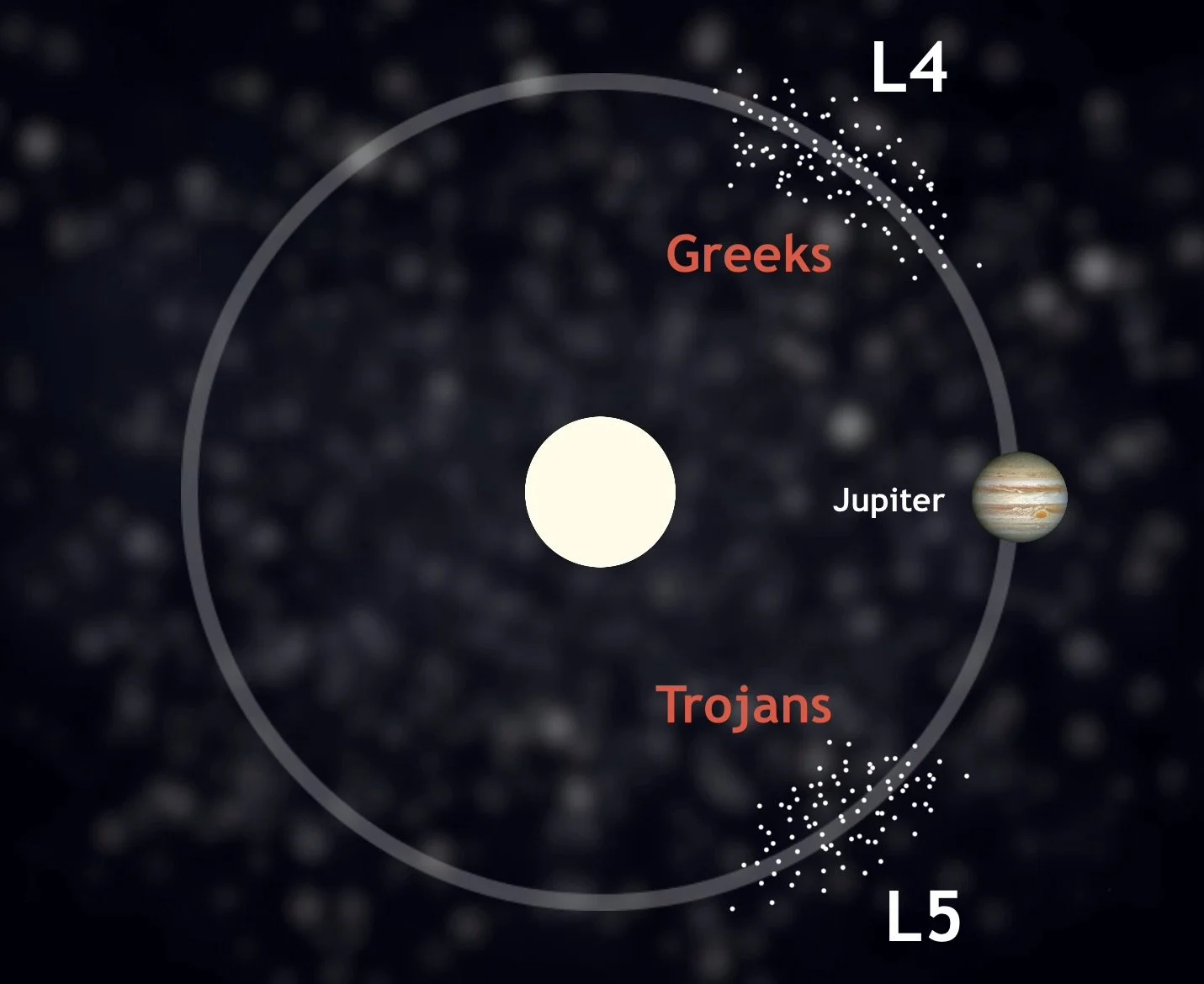
In 1906, German astronomer Max Wolf discovered an asteroid called 588 Achilles orbiting within Jupiter’s L4 point. This is the Lagrange point that leads Jupiter in its orbit. It is the counterpart of L5 which trails Jupiter. For objects located within these regions, the Sun and Jupiter’s gravitational pull finds an equilibrium with the centrifugal force from the object’s solar orbit. These three forces pulling equally in opposing directions allow these regions to trap passing asteroids like a spider web catching a fly. Every planet has an L4 and L5 point and asteroids found within them are dubbed trojan asteroids of that planet, named after the Trojan War in Homer’s Iliad. 588 Achilles was the first trojan ever discovered. Jupiter has the most prominent trojan population in the solar system. Today, we know of over 15,300 confirmed in the Sun-Jupiter system, though astronomers suspect the true number to be close to a million.
Fun fact: Jupiter’s leading (L4) Trojans have Greek names, while trailing (L5) Trojans have Trojan names. There are two exceptions named before the rule: 624 Hektor, a Trojan in the Greek camp, and 617 Patroclus, a Greek in the Trojan camp.
We have found trojans at the stable Lagrange points around many other planets in the solar system but not every planet seems to have them, their numbers vary wildly in ways that don’t correlate to the gravity of the planet, and not all trojans are permanent fixtures of their respective systems.
CENTAUR ASTEROIDS
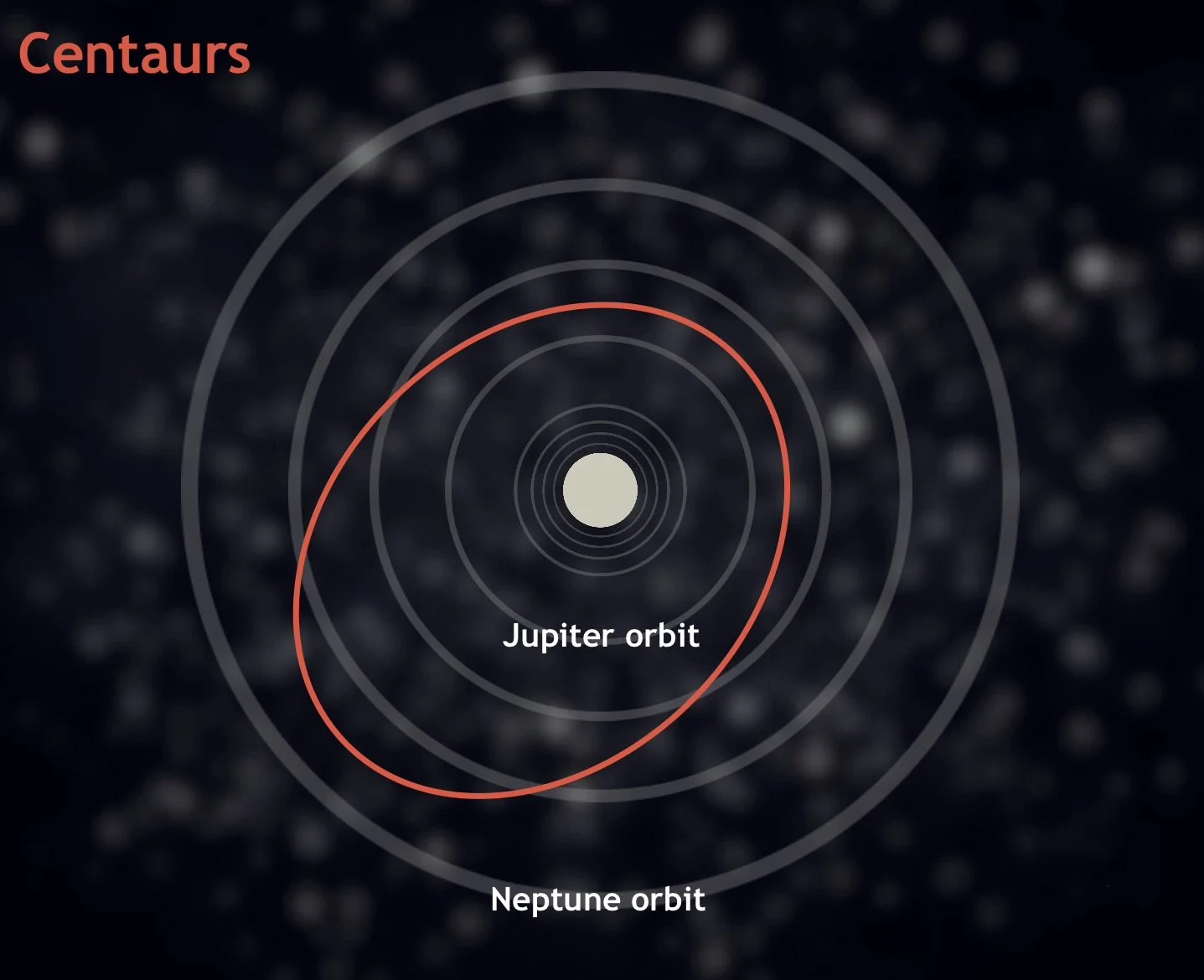
Until the early 20th century, asteroids were only known to travel through space at or within the orbit of Jupiter. In 1920, German astronomer Walter Baade discovered 944 Hidalgo, an unusual asteroid whose highly elongated, inclined orbit carried it from the inner asteroid belt all the way to Saturn’s orbit. Its path more closely resembled that of a comet than a typical asteroid. Hidalgo would later be recognized as the first member of a new class of objects following the 1977 discovery of 2060 Chiron by American astronomer Charles Kowal. These objects became known as centaurs, small solar system bodies that orbit between Jupiter and Neptune, crossing the paths of one or more of the giant planets. Their orbits displayed characteristics of both asteroids and comets, much like the mythical centaurs were half human and half horse.
The earlier reference to “boats in stormy seas” is especially relevant here. Centaurs’ orbits are constantly harassed by the gravitational tugs from Jupiter and other planetary titans, twisting their trajectories every which way. This makes their orbits highly unstable and precarious. Most centaurs remain in this category for only a few million years before they are pushed inward towards the terrestrial planets, outward to the Kuiper belt beyond Neptune or ejected from the solar system entirely. In fact, it’s thought that they originate from the Kuiper belt before Neptune yanked them inward. For this reason, some astronomers think of centaurs as being in a transitional state.
We don’t really know how many centaurs are out there because they are relatively small and distant. While there are less than 1,000 of them officially catalogued there could be anywhere between 44,000 and more than 10 million centaurs larger than 1 km in diameter.
Note: There are countless more small solar system bodies outside the orbit of Neptune, from the Kuiper belt and beyond. These can be rocky and/or icy but tend to lean much more toward the latter and astronomers don’t really call any of these objects “asteroids.”
ASTEROID COLLISIONS
Let’s get to the really fun and dangerous stuff: asteroid collisions and impacts. Despite the great distances between asteroids, collisions do happen. In fact, they’re a regular occurrence on astronomical timescales. In the main asteroid belt, asteroids around 10 km wide collide with each other about once every 10 million years. Collisions between smaller asteroids are much more frequent.
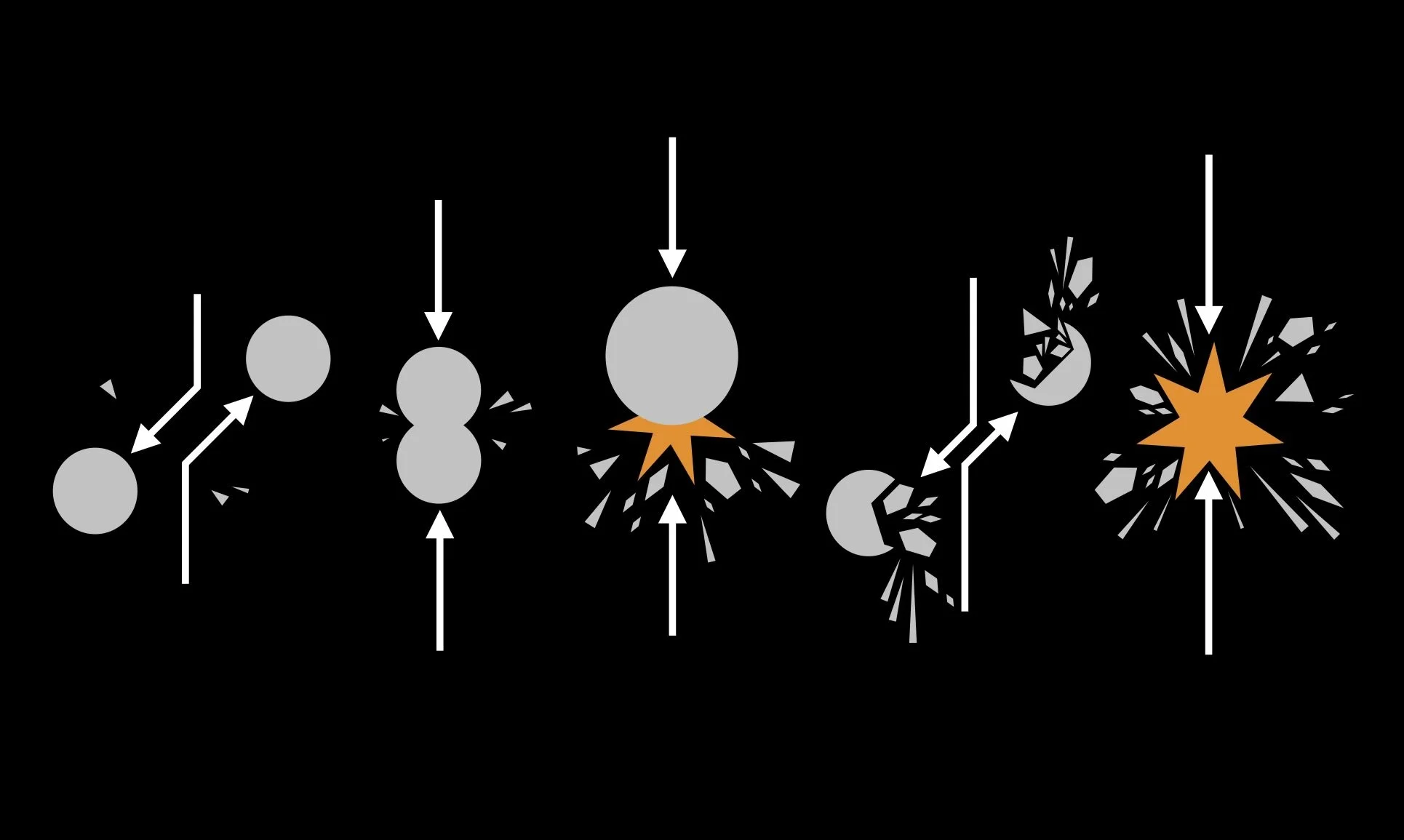
What happens when two asteroids collide depends on several variables, including their size, mass and composition, as well as their relative velocities and angle of impact.
When two solid asteroids collide at low speeds (relative to each other) they often simply bounce off each other if it's a glancing blow where they strike at an angle. There may be some local fragmentation at the point of contact, but they could remain very much intact. Both may leave the collision moving in new directions and at different speeds. Their rotations may also alter as well. This is thought to be the most common cause of near-Earth asteroids. In other cases, particularly when porous asteroids collide, the two bodies may stick together rather than deflect. If they collide slowly enough, their deformed, fractured surfaces can interlock, helping hold them together. Gravity may also help keep them bound, depending on their masses and the conditions of the collision. The result can be a single, peanut-shaped object known as a contact binary. A classic example is Arrokoth, which orbits beyond Pluto and was visited by the New Horizons spacecraft in 2019.
If we assume a much faster collision, things get considerably more violent. As the asteroids’ relative speed increases, so does their kinetic energy, which drives the deflection, compression, fracturing and crushing of rock while also generating heat and shockwaves. Because kinetic energy increases with the square of speed, doubling the speed quadruples the energy. A collision this energetic can produce an intense but brief flash of light, with larger, more energetic impacts generally producing brighter flashes. There won’t be any conventional fire, but some material may become hot enough to glow or even melt briefly.
Let’s imagine a small asteroid colliding with a much larger one at high speed. We can probably guess which one isn’t going to fare well. In almost all cases, the smaller asteroid is toast. Even a near head-on collision produces intense compression and shockwaves, releasing enormous amounts of energy in a fraction of a second. Rock at the impact site fractures, and material can be blasted outward at extreme speeds. The smaller asteroid will likely be destroyed, leaving behind a crater on the larger asteroid’s surface. Its best chance of survival is a very shallow-angle impact. When two asteroids of roughly equal size and mass collide at high speed, both are likely to break apart, ejecting material in all directions. This can happen whether the asteroids are small or large. The main difference is what happens to the debris afterward: more massive asteroids’ gravity may pull some material back together, while the rest escapes into space. Any fragments that remain in orbit around the Sun can eventually become part of an asteroid family.
EARTH IMPACTS
Every planet in the solar system is constantly bombarded by asteroids and space debris, but not all preserve the evidence equally. Earth and Venus conceal much of their impact history through atmospheric shielding, erosion, and volcanic activity, while the giant outer planets swallow incoming objects whole, leaving only temporary blemishes on their cloud tops. In contrast, airless worlds like Mercury and the Moon preserve countless impact scars, exposing the solar system for the shooting gallery that it is.
Potentially hazardous asteroids (PHA) are near-Earth asteroids whose orbits bring them relatively close to Earth, and which are large enough to cause significant damage if they strike Earth. They make up about 8% of the total near-Earth population. More than 2,300 PHAs that come within 7.5 million km of Earth’s orbit and exceed 140 meters in diameter. Over 150 of them exceed a 1 km in diameter. Almost all of these PHAs currently pose no impactful threat within the next century, and we do our best to keep track of them. However, there are likely many PHAs we simply haven’t spotted yet. Also, collisions with other asteroids mixed with gravitational interactions with planets can subtly alter an asteroid’s trajectory and turn it into a PHA. Asteroids can and do impact Earth without our anticipation.
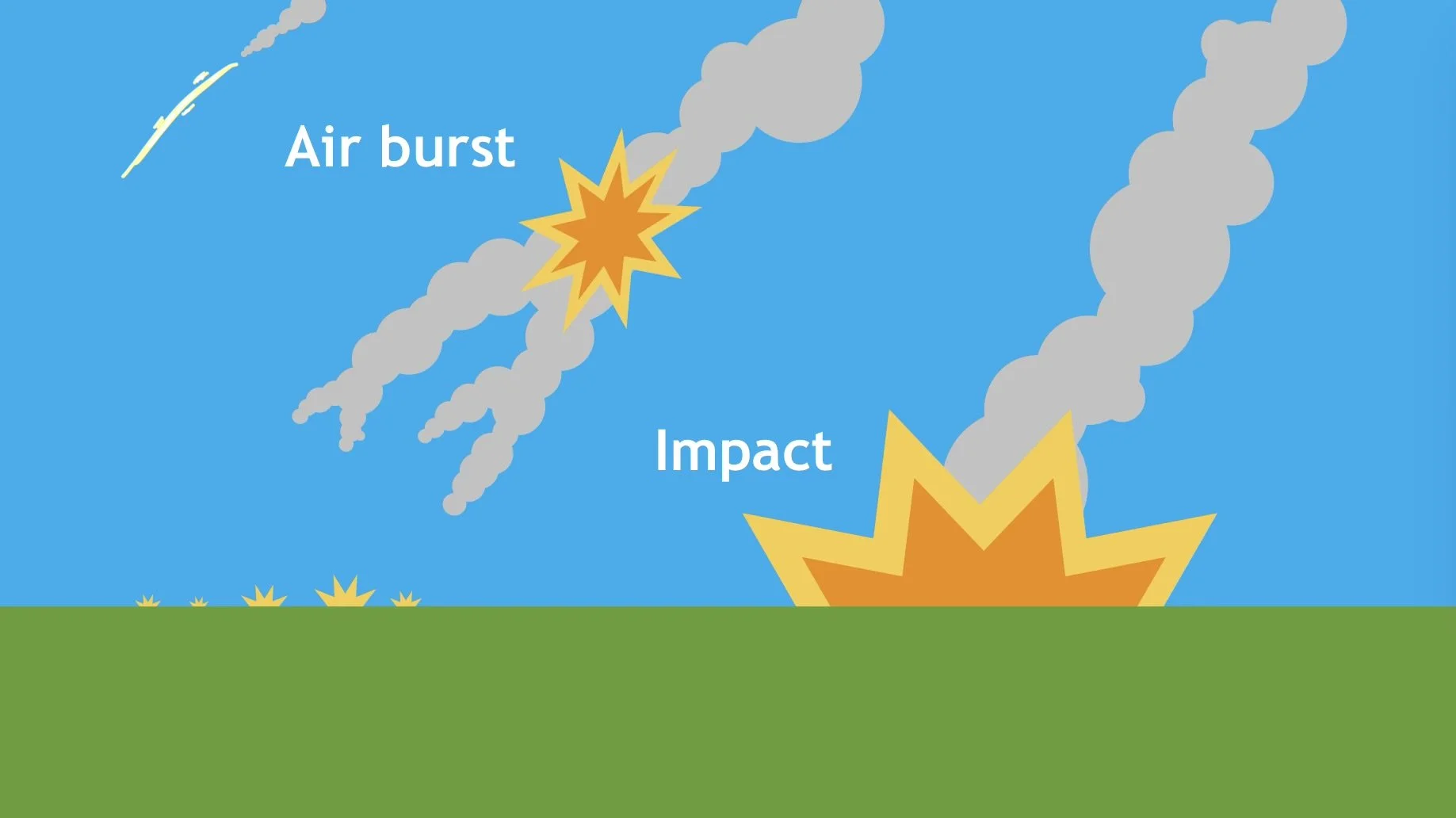
If a meteoroid does enter our atmosphere at great speed, there are three likely outcomes that are largely dependent on the object’s size and mass, entry speed and angle, composition and structure, and a bunch of other smaller factors.
The most common outcome is that it heats up and vaporizes harmlessly, high above the surface. These are simple shooting stars, originating from small dust particles and rocks.
When you start getting asteroids bigger than a human, they are sturdier and cut their way through much more of the atmosphere. As it encounters increasing pressure and heat from the air around it, the asteroid ablates and eventually its structural integrity fails about one or two dozen km above the surface. The asteroid breaks apart violently, unleashing a powerful blast wave that expands outward at supersonic speeds. This is known as an air burst. The leftover fragments continue careening towards the ground, turning what was once an asteroid into a celestial shotgun that peppers the earth below with high impact rock and metal. Meanwhile, the blast wave has the potential to shatter windows, rupture ear drums, flatten trees, or even crumble buildings. After everything has settled, what remains is a long trail of vapor looming ominously in the sky.
Asteroids with a 5-meter diameter (16 feet or the size of a large pickup truck) enter Earth’s atmosphere about every few years, more or less. They produce a 1 kiloton air burst.
Asteroids with a 20-meter diameter (65 feet or the size of a single-family home) enter Earth’s atmosphere about every 50-100 years. They produce a 500-kiloton air burst. This is equivalent to the 2013 Chelyabinsk asteroid which outshined the Sun and shattered windows dozens of km away.
Asteroids with a 50-meter diameter (164 feet or the length of an Olympic swimming pool) enter Earth’s atmosphere about every 1,000 years. They produce a 15-megaton air burst. This is equivalent to the 1908 Tunguska asteroid which flattened an area of Siberian forest the size of London. If the object is particularly dense, it may impact the surface.
Some asteroids are large and robust enough to survive their passage through the atmosphere and impact the surface with full force. Depending on the asteroid’s size, composition, speed, and angle of impact, the resulting destruction could range from devastating a city to triggering a global catastrophe. The asteroid screams through the atmosphere at hypersonic speed and burns bright like a second Sun. It strikes the surface with the energy of dozens to thousands of nuclear warheads, even millions for the largest asteroids. The asteroid is completely destroyed upon impact, emitting a blinding flash. The ground below is melted and crushed inward. Powerful shockwaves surge through both the Earth and the atmosphere potentially causing earthquakes and hurricane winds. Some of the energy is converted into a thermal pulse that scorches the local area, catching trees and clothing on fire.
After the flash of the initial impact fades, what remains is a towering plume of superheated vapor. Molten and pulverized rock around the impact site is ripped from the crust and launched outward into soaring ballistic arcs. The larger the asteroid, the further the destruction can spread. A relatively small impactor might pepper a county with debris. A larger impactor could hurl debris across an entire state. In the most extreme cases, an impactor could rain down fire and rock across the globe, injecting enough dust into the atmosphere to disrupt the global climate and threaten life around the entire planet.
Asteroids with a 100-meter diameter (330 feet or the size of a football field) strike Earth every 5,000 years. They produce a 75-megaton blast and leave a 2 km-wide (1.25 mi) crater.
Asteroids with a 300-meter diameter (980 feet or the height of the Eiffel tower) strike Earth every 75,000 years. They produce a 2,000-megaton blast and leave an 8 km-wide (5 mi) crater. This is comparable to 99942 Apophis, an asteroid expected to pass very close to Earth in 2029.
Asteroids with a 1-km diameter (0.62 mi) strike Earth every 500,000 years. They produce a 75,000-megaton blast and leave a 20 km-wide (12.5 mi) crater.
Asteroids with a 5-km diameter (3 mi) strike Earth every 20 million years. They produce a 12.5 million-megaton blast and leave a 100 km-wide (62 mi) crater.
The Chicxulub asteroid was the last time a 10-km diameter (6 mi or the size of Brooklyn) asteroid hit Earth 66 million years ago and we all know how that turned out (check out the associated link to get the whole apocalyptic story). They are estimated to strike Earth every 100 million years.
When the dust finally settles, what remains is a gaping crater surrounded by a devastated landscape. Smaller asteroids excavate simple bowl-shaped craters while the larger asteroids produce complex craters with central peaks and possibly concentric rings across a vast impact basin.