
NEPTUNE
The furthest planet from the Sun.
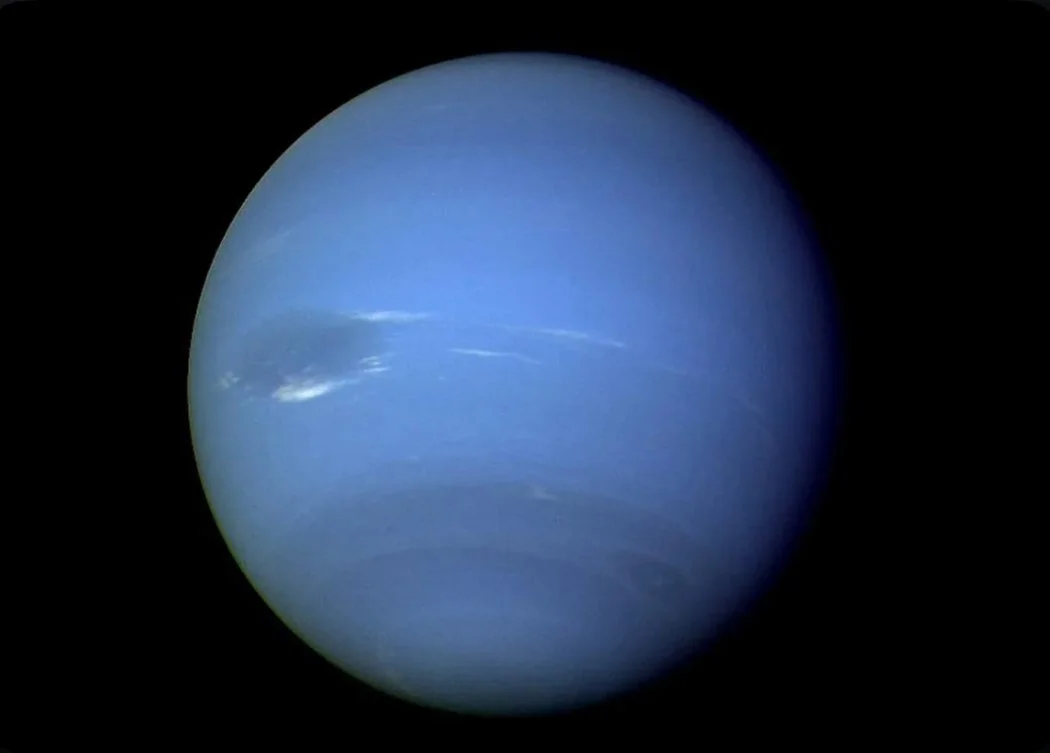
Distance from the Sun: 4.5 billion km (30 AU or 4.1 light hours)
Diameter: 49,530 km
Rotation period: 16 hours
Orbital period: 165 years
Neptune holds a unique place in the history of astronomy as the first planet ever mathematically predicted before its subsequent discovery. The proposal of a potential eighth planet came in the wake of observations that indicated that the orbit of Uranus was being perturbed by the gravitational pull of some mysterious mass beyond. In 1846, French astronomer and mathematician Urbain Le Verrier made a series of calculations based on those perturbations to predict the mass and location of this hypothetical planet. The same night that the Berlin Observatory received Le Verrier’s calculations, Neptune was found within a single degree of where he had predicted.
There was debate over what to name this new planet, with Le Verrier wanting to name the planet after himself. Others suggested Janus or Oceanus. It was eventually settled that the planet was to be named after the Roman god of the sea, Neptune, referencing its seemingly azure hue.
Like Uranus, Neptune is categorized as an ice giant due to the higher concentrations of icy volatiles (compounds with very high melting points) such as water, ammonia and methane.
Fun fact: It is the greater presence of methane, which notably absorbs redder wavelengths of light, that gives the ice giants their cooler tones.