
COMETS
Frozen vagabonds that blaze through the night sky.
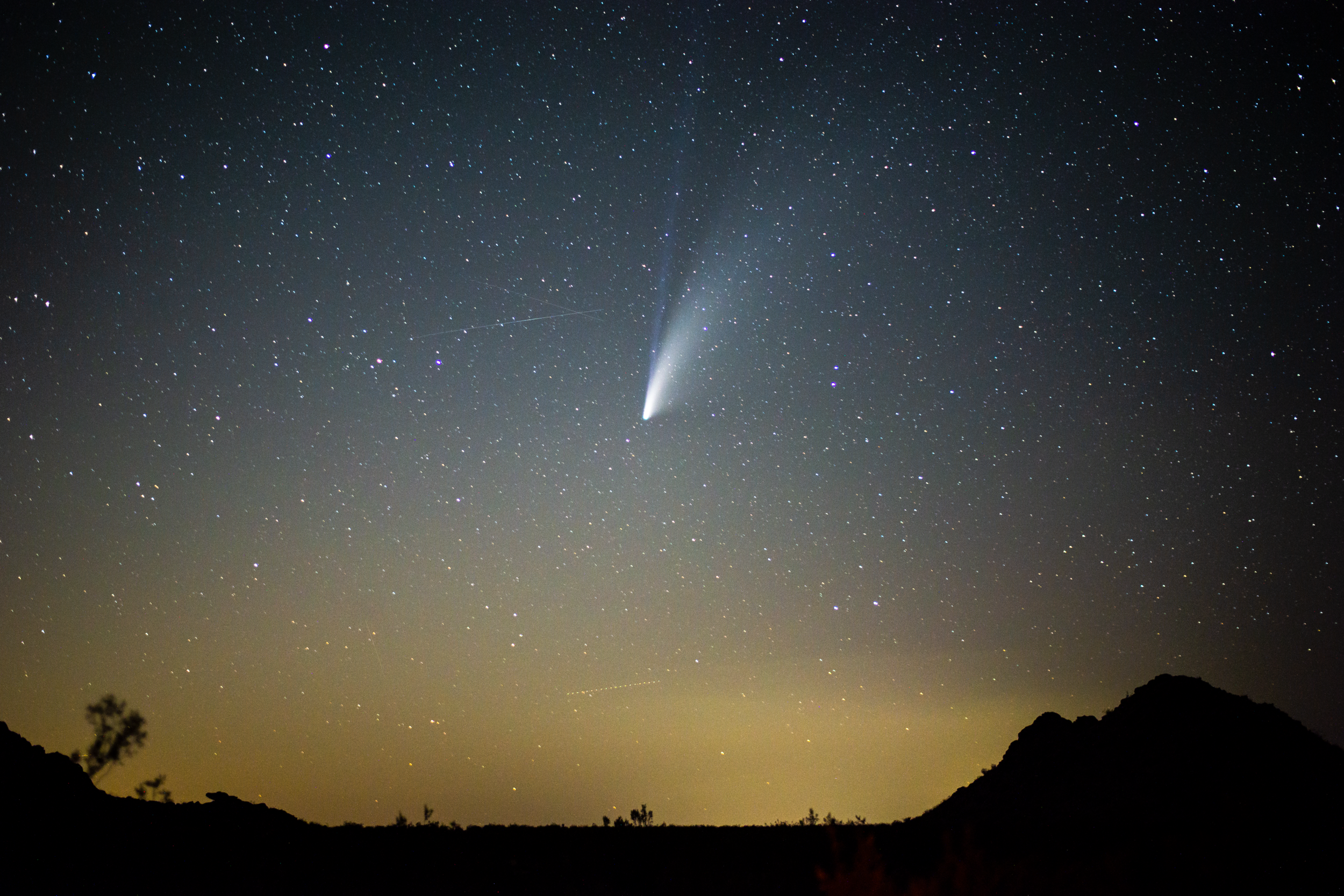
Long ago, ancient humans periodically looked up at the stars and saw a strange, ghostly figure appear. Glowing brighter and brighter, it would crawl across the night sky for weeks, then mysteriously vanish. These heavenly visitors were met with feelings of wonder and fear. Many cultures interpreted these occurrences as omens foretelling great change: war, famine, the deaths of kings or divine judgment. Considering they knew so little about the cosmos, what else could they have thought?
The earliest recorded sighting of a comet was from Chinese astronomers in 240 BC, who unknowingly observed Halley’s Comet. Over the following centuries, subsequent generations around the world would report similar sightings. The ancient Greek philosopher, Aristotle, suggested that these occurrences were regular disturbances in Earth’s atmosphere. Danish astronomer Tycho Brahe proved this idea false in 1577 when he used parallax measurements to demonstrate that comets travelled beyond the Moon.
It wasn’t until 1705 that the comet’s namesake, Edmond Halley, determined that these appearances in the sky were the periodic return of the same object (hence why they are called periodic comets). He even predicted when to expect the comet’s return based on Newtonian understandings of gravity. Though he would not live to see it, the comet retuned to the inner solar system, and Halley’s contemporaries would confirm that it reached perihelion (it’s closest pass of the Sun) in March 1759, just one month before Haley’s prediction.
So, what actually are comets?
Comets are essentially large chunks of ice mixed with some rock.
The terms comet and asteroid are sometimes used interchangeably, which can lead to confusion. We generally distinguish between them in a few broad ways. Asteroids tend to be rocky or metallic in composition while comets are made of ice mixed with dust, a combination that has earned them the nickname “dirty snowballs.” Their paths through the solar system also tend to differ, with asteroids typically following more stable, planet-like orbits around the Sun, while comets travel along much more elongated paths that bring them close to the Sun only occasionally.
There’s a bit of grey area where some asteroids are known to contain ice, and some comets originate in regions traditionally associated with asteroids. When such differences are not important to the discussion, astronomers often group both comets and asteroids under the broader category of small solar system bodies.