SATURN
The ringed wonder.
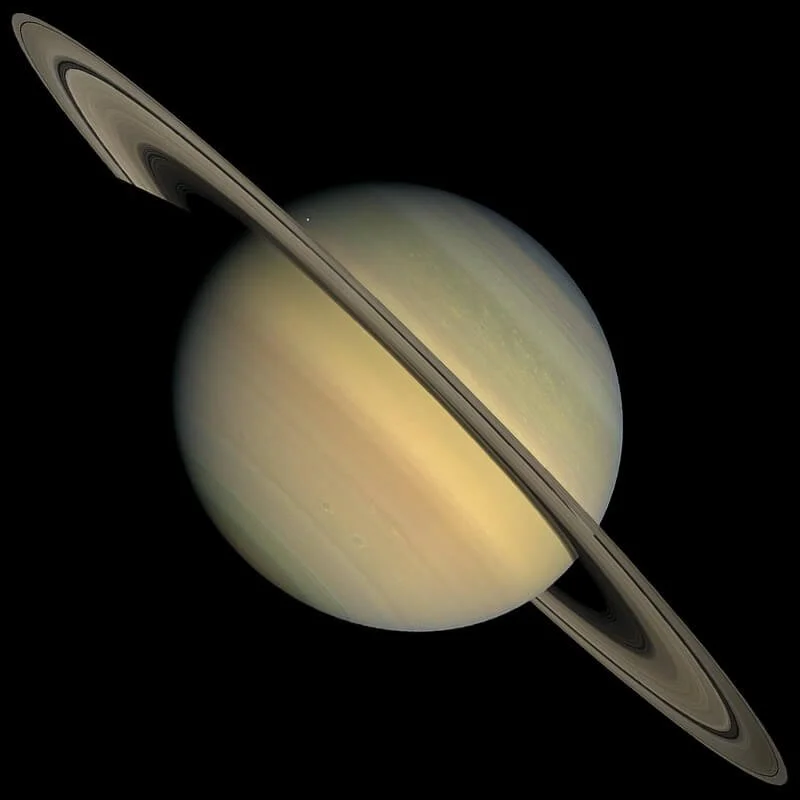
Distance from the Sun: 1.4 billion km (9.5 AU or 1.3 light hours)
Diameter: 120,500 km
Ring Diameter: 282,000 km
Rotation period: 10 hours, 30 minutes
Orbital period: 29.5 years
Very few things in the night sky have captured the imagination of people across the world, both children and adults alike, as the majesty of Saturn. The last and most distant of the classical planets, Saturn has been known to humanity since prehistoric times. It is indeed the farthest planet that can be reliably seen with the naked eye and, consequently, generally the dimmest of the classical planets, though it occasionally outshines Mercury. It appears as a beige point of light with an apparent brightness that generally falls between that of the stars, Vega and Fomalhaut. It could be easily mistaken for a star, but when you look at it through even a modest backyard telescope, it is transformed into one of the most awe-inspiring views in all of astronomy. The planet’s magnificent rings and even one or more of its moons can be easily observed! The look on people’s faces when they see Saturn with their own eyes for the first time just never gets old.
Of the classical planets, Saturn moves across the night sky the most sluggishly. Today, we understand this as a function of its farther distance, but for ancient people, it was just Saturn’s nature. Its slow passage through the heavens led them to associate Saturn with the slow passage of time. For Romans, Saturn was an agricultural deity that signaled the coming of a bountiful harvest. For Greeks, Saturn was Cronus, who was not only the father of Zeus (just as Saturn supersedes Jupiter) but consumed each of his children at birth just as time consumes all else. Cronus, by the way, later became associated with Chronos, the personification of time.
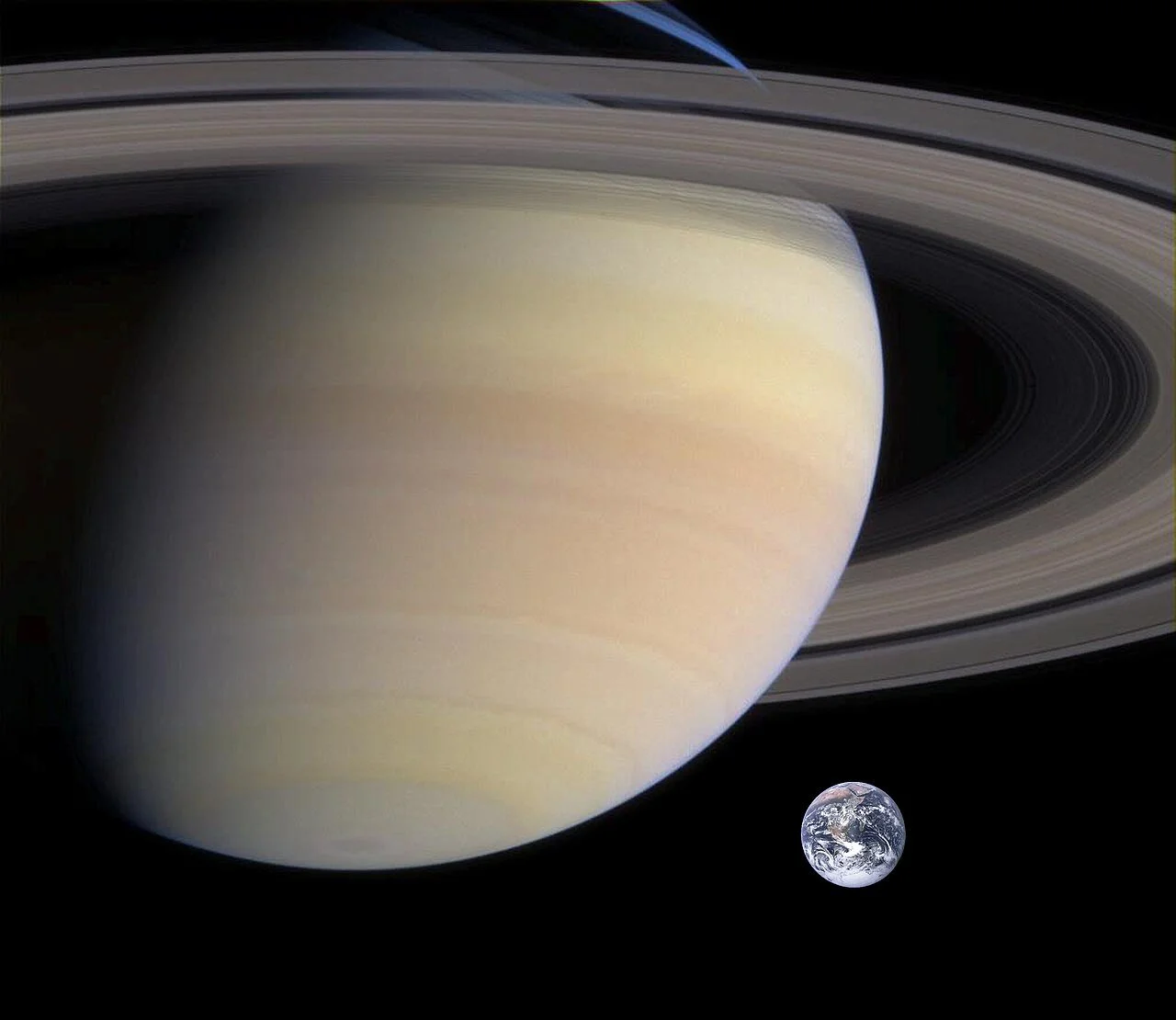
Saturn is the second largest planet in the solar system, surpassed only by Jupiter. Don’t think that puts Saturn in the mid-tier, though. It’s still an absolute giant, measuring more than twice the diameter of its ice giant cousins, Uranus and Neptune, and nine times the diameter of Earth. By volume, you could fit 764 Earths inside it. Despite its enormous size, Saturn is surprisingly lightweight. It’s 97 times the mass of Earth, which is no doubt a lot, but it’s less than a third the mass of Jupiter. Amongst all the combined mass of the solar system’s planets, Saturn accounts for about 20%. Saturn is actually the least dense planet in the solar system.
Fun fact: Saturn is the only planet that is less dense than water. If you had a big enough bathtub, Saturn would float in it. Don't take this too literally, though.
Like Jupiter, Saturn rotates very fast. Saturn’s rotation trails Jupiter’s by only about a half an hour, the second fastest rotation in the solar system. The centrifugal force produced by this rapid rotation also causes Saturn to bulge in the middle. Saturn is much less dense and has weaker gravity than Jupiter, so despite rotating slightly slower, Saturn can’t hold in its material as tightly and thus its equatorial bulge is more prominent. Saturn is wider at the equator compared to its pole-to-pole diameter by 11,800 km (7,330 mi). Saturn is the most flattened planet in the solar system.
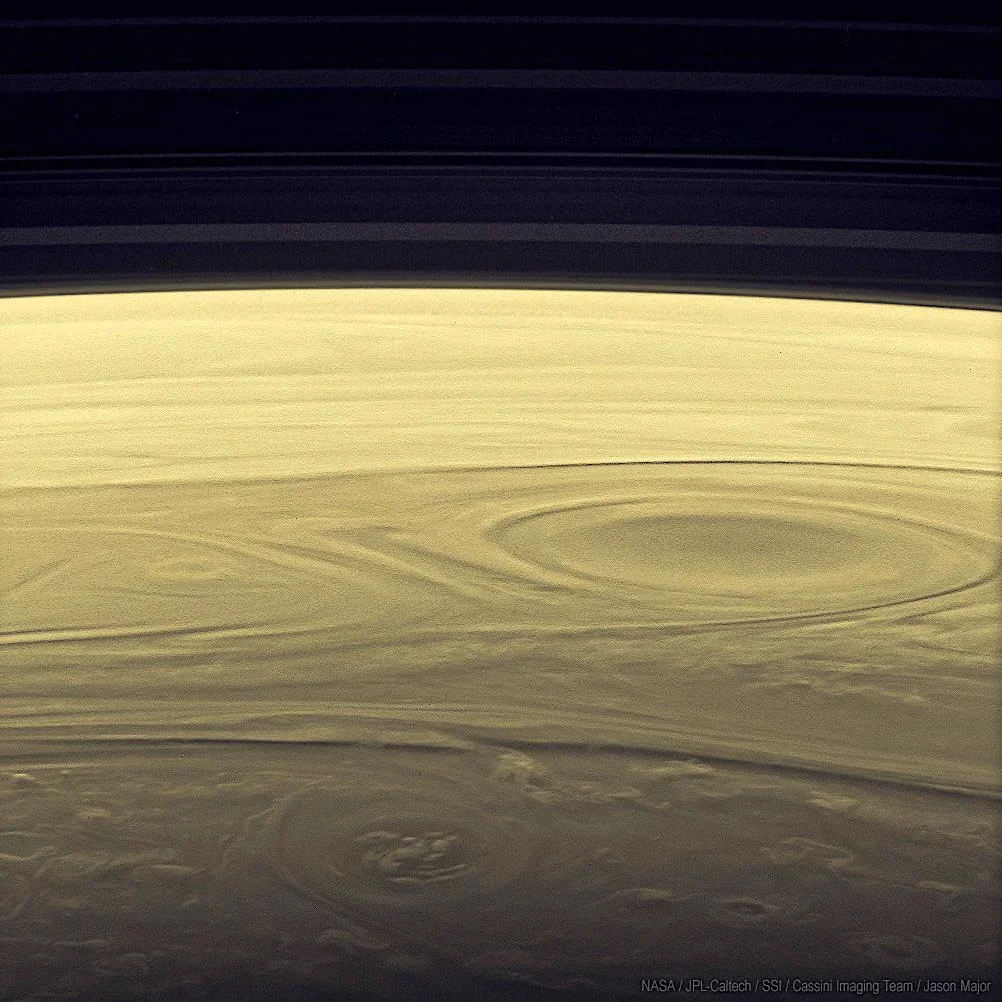
Pictured: Low-angle view of Saturn’s cloud tops imaged by NASA’s Cassini orbiter in 2006. At the top of the image, you can see Saturn’s rings. Credit: NASA/JPL-Caltech/Jason Major
Saturn is a gas giant, meaning it is a colossal sphere composed almost entirely of hydrogen and helium gas. Of course, the reality is more complicated than that, but you may notice how closely this description also applies to the Sun. Granted, the Sun is 1,600 larger in volume and 3,500 times more massive than Saturn. Regardless, both are composed predominantly of the same two elements. It makes sense that the gas giants most resemble the Sun considering they formed from the same gas and dust of a collapsing nebula and emerge relatively soon after the Sun itself. Because the gas giants were earliest, they got first dibs on the most abundant elements.
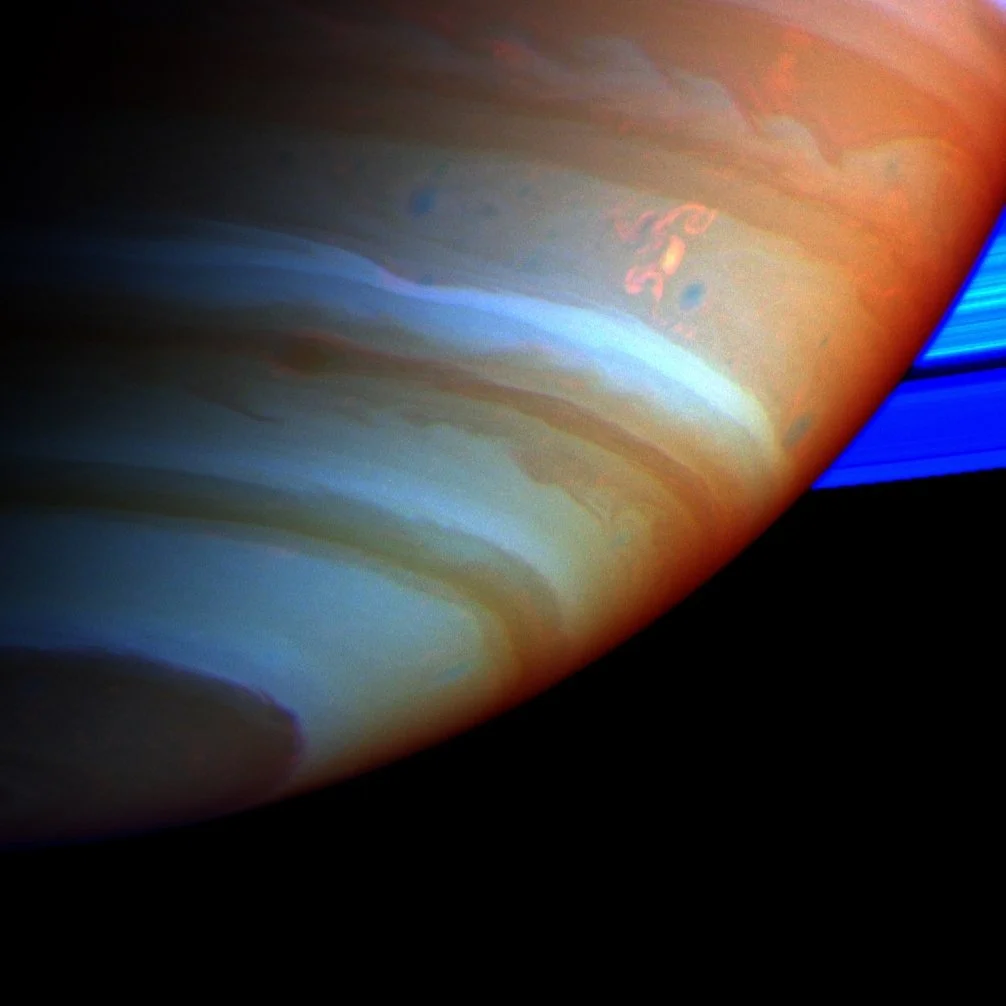
In 2004, NASA’s Cassini orbiter discovered an unusual storm in Saturn’s southern hemisphere. Specifically, it was approximately at 35° south latitude, in a particularly turbulent atmospheric region scientists nicknamed Storm Alley. Where most storms found on giant planets resemble swirling oval shakes, this storm featured intricate, branching spiral arms resembling the shape of a Chinese dragon. This inspired the storm to be named the Dragon Storm.
It is a long-lived storm that periodically flares up to produce dramatic cloudy plumes, not unlike Jupiter’s Great Red Spot. Beyond its distinct shape, the Dragon Storm has many interesting features. First, it produces extraordinarily powerful lightning. The Cassini orbiter’s instruments picked up repeated radio bursts that resembled static produced by lightning on Earth. What was particularly interesting was that they occurred only when the Dragon Storm was on the planet’s nightside. When it passed into the dayside, the physical clouds remained but the radio emissions stopped completely. When the storm reentered the nightshade, the emissions started back up again. What exactly is happening here is an unresolved mystery. Is the storm actually shutting on and off or is there something on the side that blocks the radio emissions?
Pictured: False-color composite image by the Cassini orbiter in 2004. The Dragon Storm is the bright orange feature just to the upper right of the center.
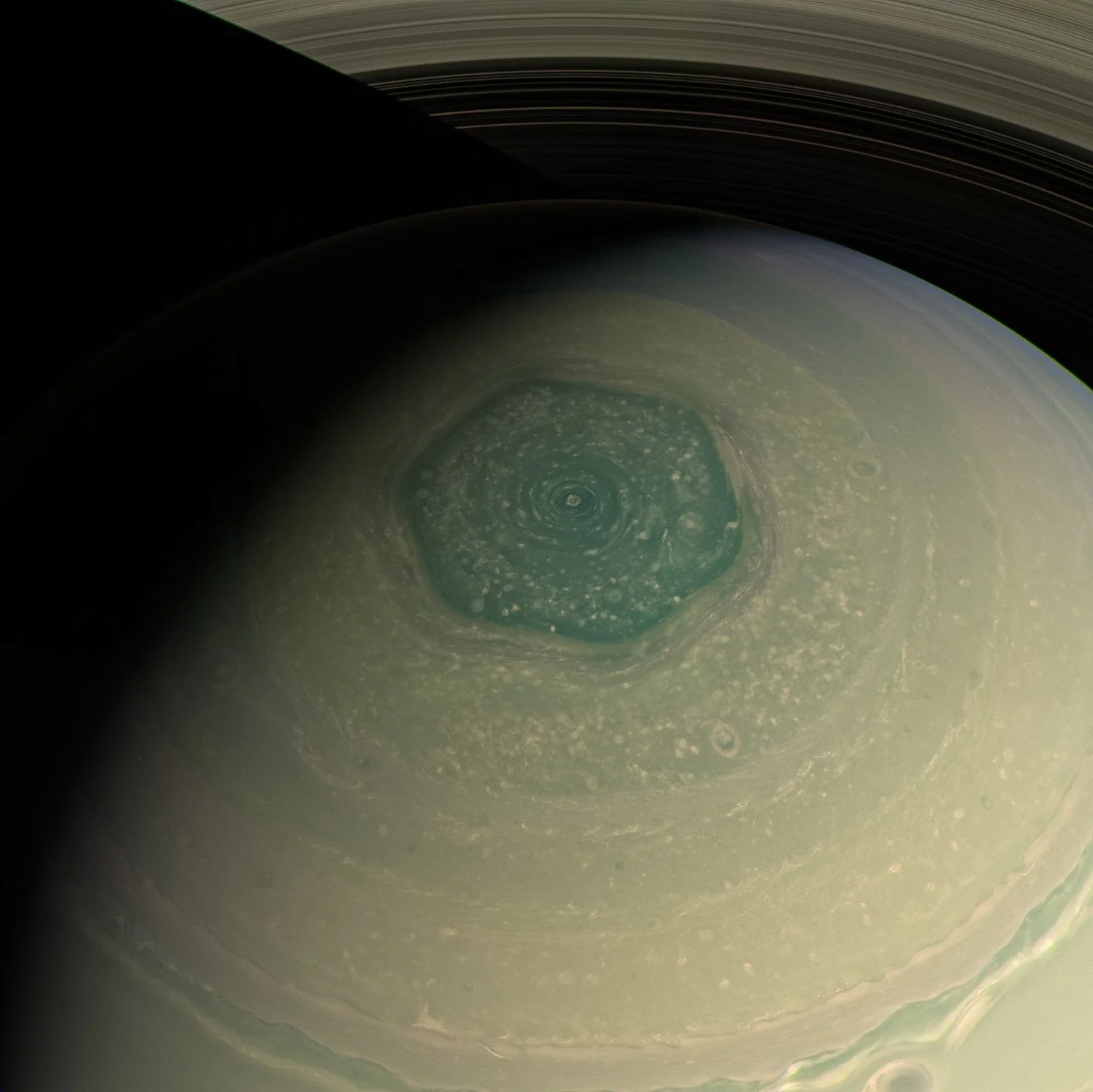
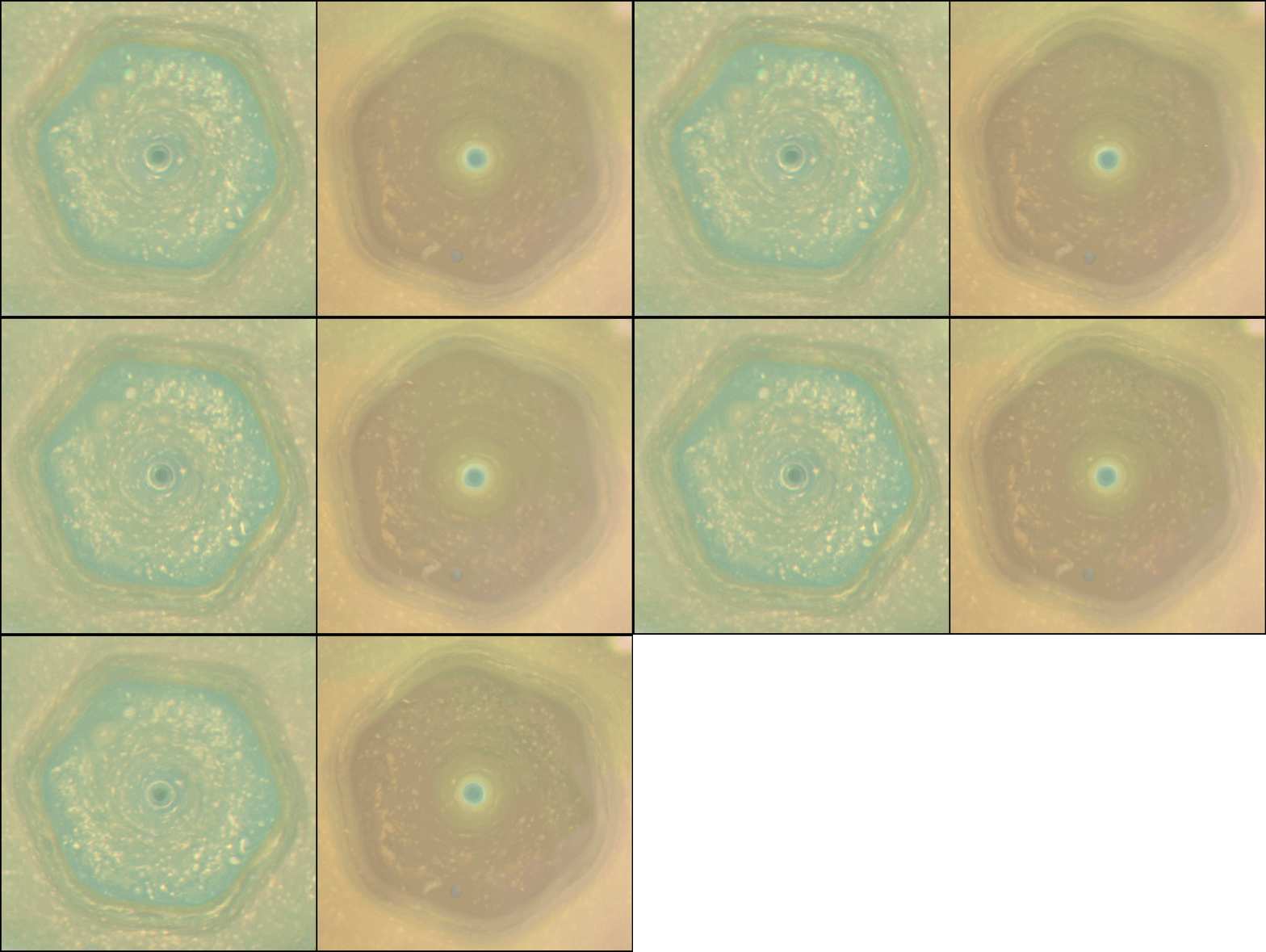
Fun fact: Between 2013 and 2017, Saturn’s hexagon shifted from pale bluish green to golden as increased summer sunlight produced a golden atmospheric haze.
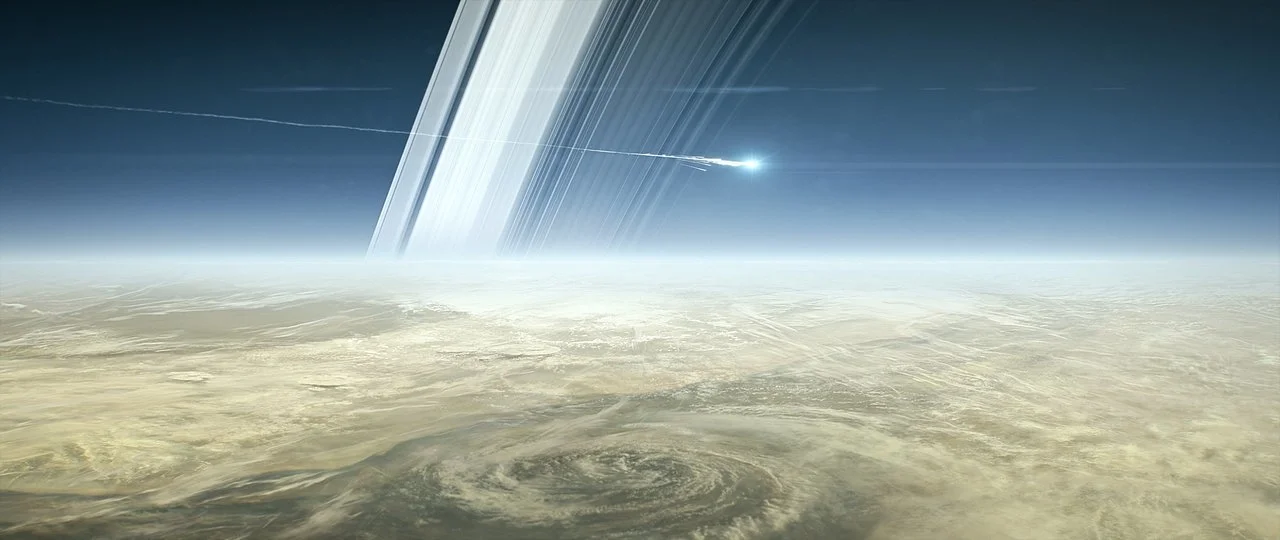
In 2017, NASA’s Cassini orbiter, which had been spacefaring for 20 years and a resident of Saturn for 13 years, brought its mission to a dramatic end. Leaving the spacecraft in orbit carried a slight risk that it could eventually crash into one of Saturn’s moons, potentially contaminating them with microscopic biological piggybackers and compromising future research. To prevent this, NASA chose to end Cassini’s mission with a daring death dive into Saturn’s atmosphere, an event dubbed the Grand Finale. It started in April, taking place across five months and 22 eccentric orbits around Saturn, each time passing through the 2,000 km (1,200 mi) wide gap between the planet’s cloud tops and its innermost rings. During these close encounters, Cassini took detailed measurements of Saturn’s gravity, magnetic fields, and ring density. On September 15, 2017, during its final approach, Cassini soared down into the thickening gas of the planet’s upper atmosphere. It reached as close as 1,500 km above the cloud tops, moving an incredible 122,000 km/h. This created catastrophic friction as it cut through the gas that was hot enough to melt its aluminum chassis. Cassini began to tumble and burn up like a meteor.
Pictured: Artist’s depiction of Cassini’s final plunge into Saturn’s atmosphere in 2017. Credit: NASA/JPL-Caltech
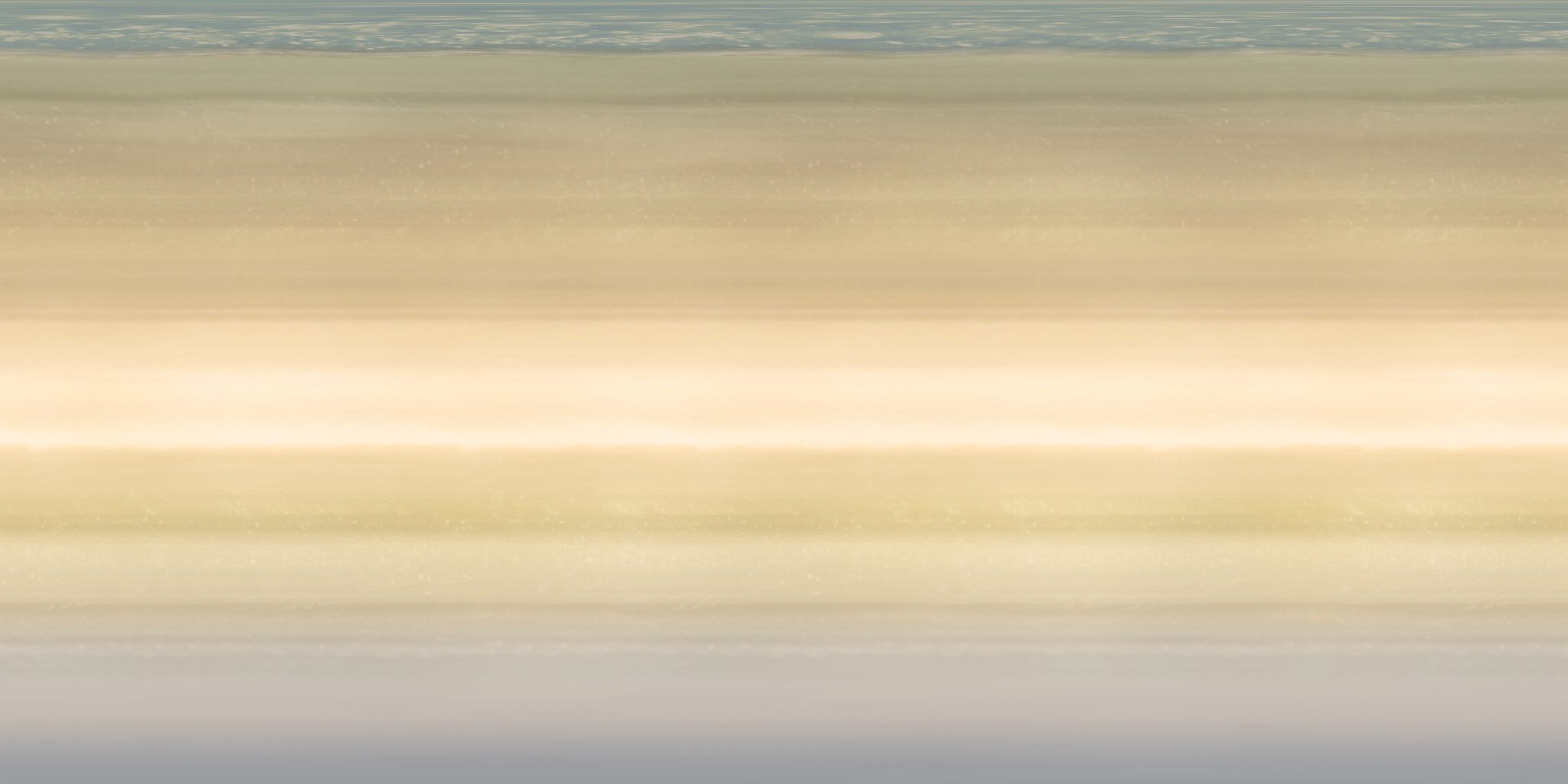
Pictured: Equirectangular projection of the atmosphere of Saturn based on NASA elevation and imagery data. Colors are slightly more saturated, and gaps filled with similar fictional terrain. Credit: Solar System Scope
Saturn doesn’t have a solid surface like the terrestrial planets do. What we see as the visible “surface” is actually the cloud tops of Saturn’s thick atmosphere. As you study this layer of gas, you’ll notice that it has been organized into a series of different colored bands parallel with the equator. Granted, these bands don’t show the same contrasts that we see on Jupiter but more striking than those of Uranus and Neptune. There are probably multiple factors contributing to their more muted appearance, including cloud thickness and altitude, chemistry, and an extensive layer of haze throughout the upper atmosphere that partially obscures the bands below.
The bands operate much the same way as they do on Jupiter. They are organized into darker belts, which often appear brown or caramel, and lighter zones, which often appear beige or pale yellow. They are named in relation to their latitude, starting with the equatorial belts and zones at the middle, moving out to the tropical and temperate ones, until we reach the polar regions. Each move in alternating east-west directions, driven by powerful jet streams between them. Saturn has some of the fastest winds in the solar system. The planet’s rapid rotation actually stretches these torrents of supersonic winds into horizontal bands via the Coriolis effect. The main difference between Saturn’s belts and zones lies in their atmospheric circulation: belts are generally associated with descending gas that warms as it sinks, while zones are associated with rising gas that expands and cools. As this gas cools, embedded ammonia vapor condenses into bright, hazy clouds of ammonia ice, making zones appear lighter. Because Saturn is cooler than Jupiter, these ammonia clouds can form deeper in its atmosphere, creating additional haze that obscures the underlying bands and gives Saturn its comparatively subtle appearance.
Fun fact: The color of Saturn’s hemispheres is heavily influenced by seasonal changes. In the summer, ultraviolet light from the Sun breaks down methane gas into a golden hydrocarbon haze. In the winter, weaker sunlight and shadows cast by Saturn’s rings allow methane to absorb red light and reflect a striking azure color, much like the ice giants!
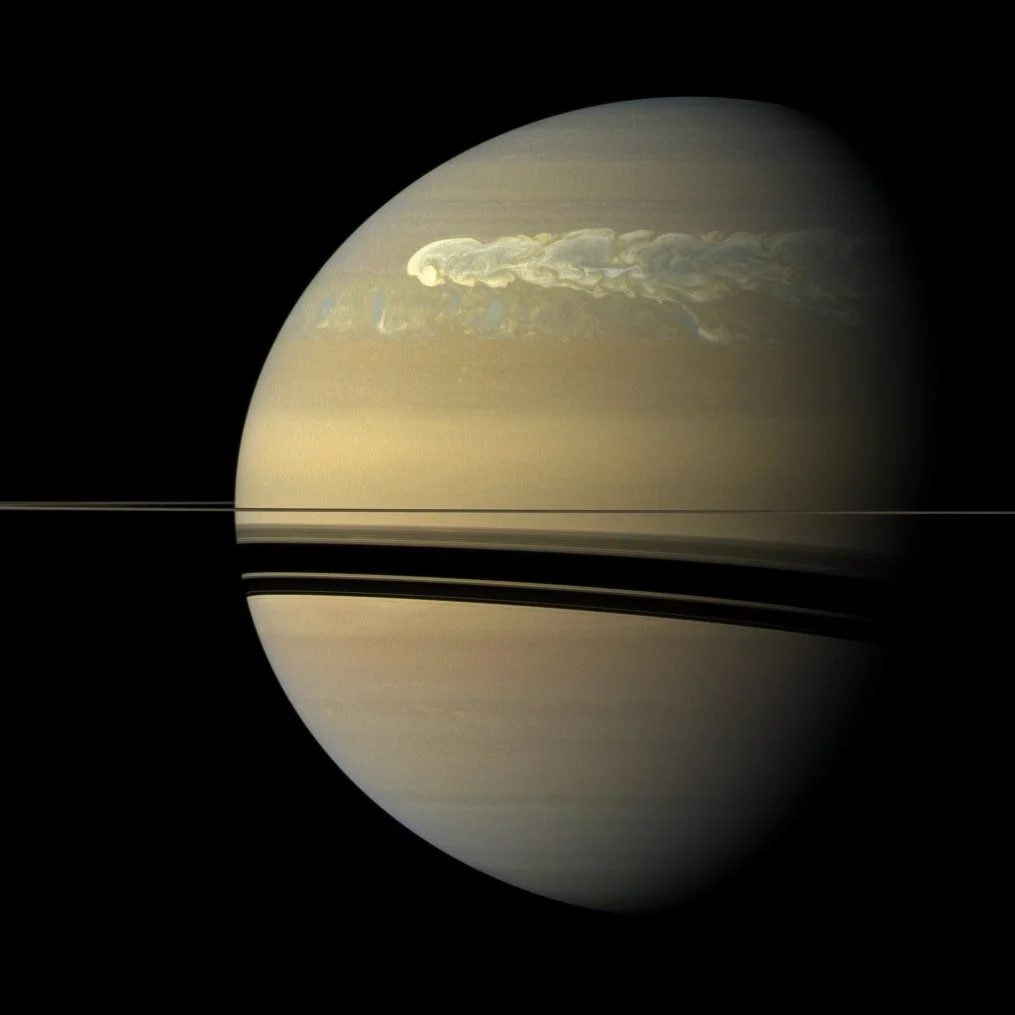
About every 20-30 years, or roughly once per revolution around the Sun, Saturn experiences enormous periodic megastorms known as Great White Spots. These storms begin as relatively small, discrete thunderstorms that gradually expand, eventually spanning thousands of kilometers. As they intensify, powerful updrafts carry material from deep within Saturn’s atmosphere toward higher altitudes, where progressively colder temperatures cause water vapor and other compounds to condense and freeze into ice crystals. These clouds contain ammonia and water ice, making them exceptionally bright and reflective compared to Saturn’s surrounding atmosphere. They can also rise high above the normal cloud tops, becoming prominent enough to observe through telescopes from Earth.
However, the initial thunderstorm is only the beginning. Saturn’s powerful east-west jet streams stretch and carry the expanding clouds longitudinally across the planet. The enormous updrafts also generate large-scale atmospheric disturbances that extend far beyond the original outbreak. In some cases, these storms have grown so large that they encircled the entire planet within a particular band. Although the visible clouds typically persist for several months, their effects can extend much deeper into Saturn’s atmosphere and linger for decades or even centuries. The powerful convection redistributes atmospheric compounds such as ammonia between different layers, leaving behind chemical and thermal disturbances that remain detectable long after the visible storm has dissipated.
The intervals between these strange storms closely match Saturn’s orbit around the Sun, suggesting they may be tied to its seasons, although the precise mechanism remains uncertain. Six major Great White Spots have been recorded since 1876, all within the northern hemisphere around its spring or summer season. Saturn’s axial tilt is much more prominent than Jupiter’s (26.7° versus 3.1°, respectively), so it experiences considerably more distinct seasons. A 2015 Caltech study proposed that their recurring formation could be explained by an unusual interaction between atmospheric water vapor and convection. As water vapor rises into the upper atmosphere, it condenses into heavier droplets and ice crystals that eventually rain down into deeper layers. This loss of moisture makes the upper atmosphere lighter and more stable, suppressing convection and allowing it to cool gradually over many years. Eventually, this suppression is overcome, allowing warmer, moisture-rich gas from deeper within the atmosphere to rise rapidly. The resulting powerful thunderstorms initiate the enormous convective systems that become Great White Spots. There is still a lot of mystery surrounding these storms, and hopefully the next occurrence gives us more data to work with. Based on previous patterns, we can expect the next one sometime in the 2030s.
Pictured: The most recent Great White Spot observed by the Cassini orbiter in 2011.
One of the weirdest and most fascinating features on Saturn is its hexagonal polar storm. This gargantuan six-sided vortex resides at Saturn’s north pole and appears to be a persistent fixture of the planet. It was first discovered in 1987 by astronomer David Godfrey when he was piecing together fly-by views of Saturn from images taken by the Voyager 2 probe six years earlier. The feature has since maintained its recognizable shape. The hexagon spans about 30,000 km (18,600 mi) between opposing sides and each individual side is 13,800 km (8,600 mi) wide, a little more than Earth’s diameter. In other words, you could fit seven Earths inside the hexagon! That being said, it’s not perfectly symmetrical.
In simple terms, Saturn’s hexagon is a powerful jet stream that circles the north pole, not unlike those bordering Saturn’s atmospheric bands. Unlike Earth, where polar jet streams are frequently disrupted by mountains and oceans, Saturn’s atmosphere lacks solid surface features that can influence their paths. But why does it form a hexagon? Imagine a sine wave that oscillates up and down on a graph. What does that look like when wrapped around in a circle? Its alternating crests and troughs create a series of bends that, when viewed from above, produce the familiar hexagonal shape. This is known as a standing atmospheric wave: the air continues flowing, but the overall pattern remains relatively stationary. The number of sides depends on atmospheric conditions, and scientists have even recreated hexagons, octagons and other polygonal shapes in rotating laboratory experiments. In fact, observations in 2025 revealed a developing ten-sided atmospheric pattern surrounding Saturn’s south pole!
Pictured: Saturn’s hexagonal storm images by the Cassini orbiter in 2013.