
The Destroying of Everyone’s Childhood
by Sam Atkins
Today is the 20th anniversary of everyone’s favorite planet getting the big, ugly axe. Let this act as a eulogy for our dearly departed Pluto and the loss of our collective innocence.
NOTE: Tap or hover over images for captions and credits.
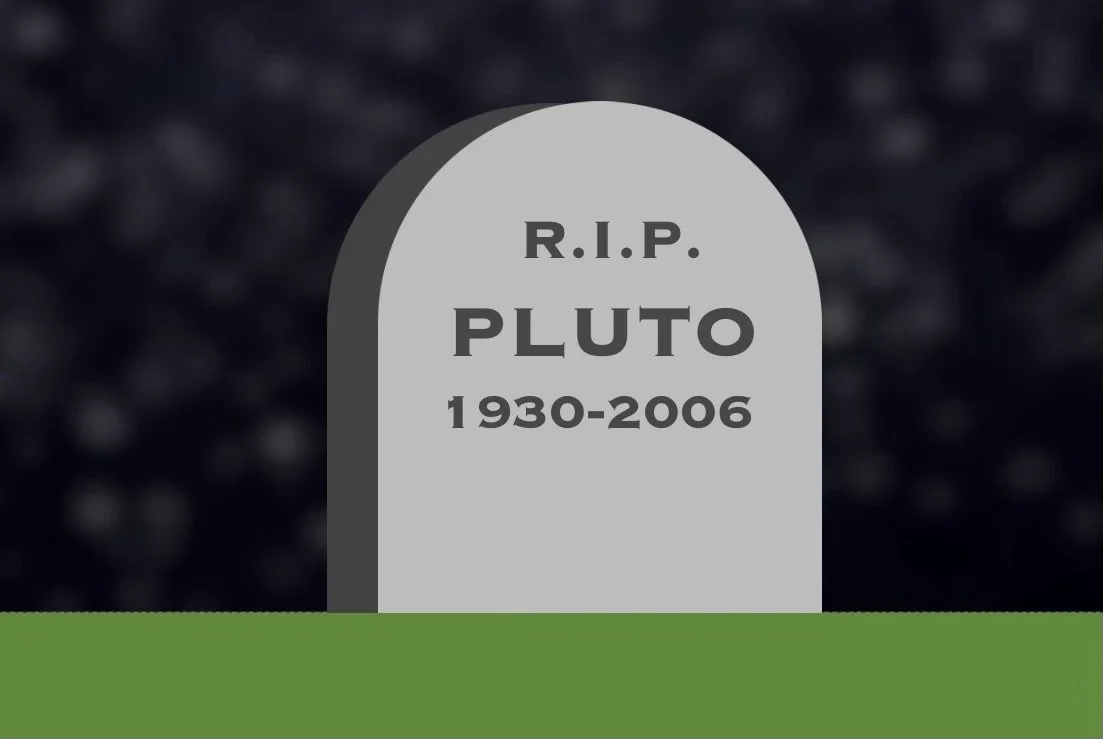
Image credit: Sam Atkins (HCAS)
Okay, okay, I know I’m being a bit facetious, but there’s no denying that the demotion of Pluto from planet to dwarf planet ruffled a lot of feathers. Even now, two decades later, the wound still hasn’t healed and some people still refuse to acknowledge what happened. It wasn’t just everyday people, either. There are professional astronomers that still dispute the decision. But what’s done, was done. Pluto is gone… and we’d only just started to get acquainted.
For those who completely missed one of the worst things to ever happen to multiple generations of people:
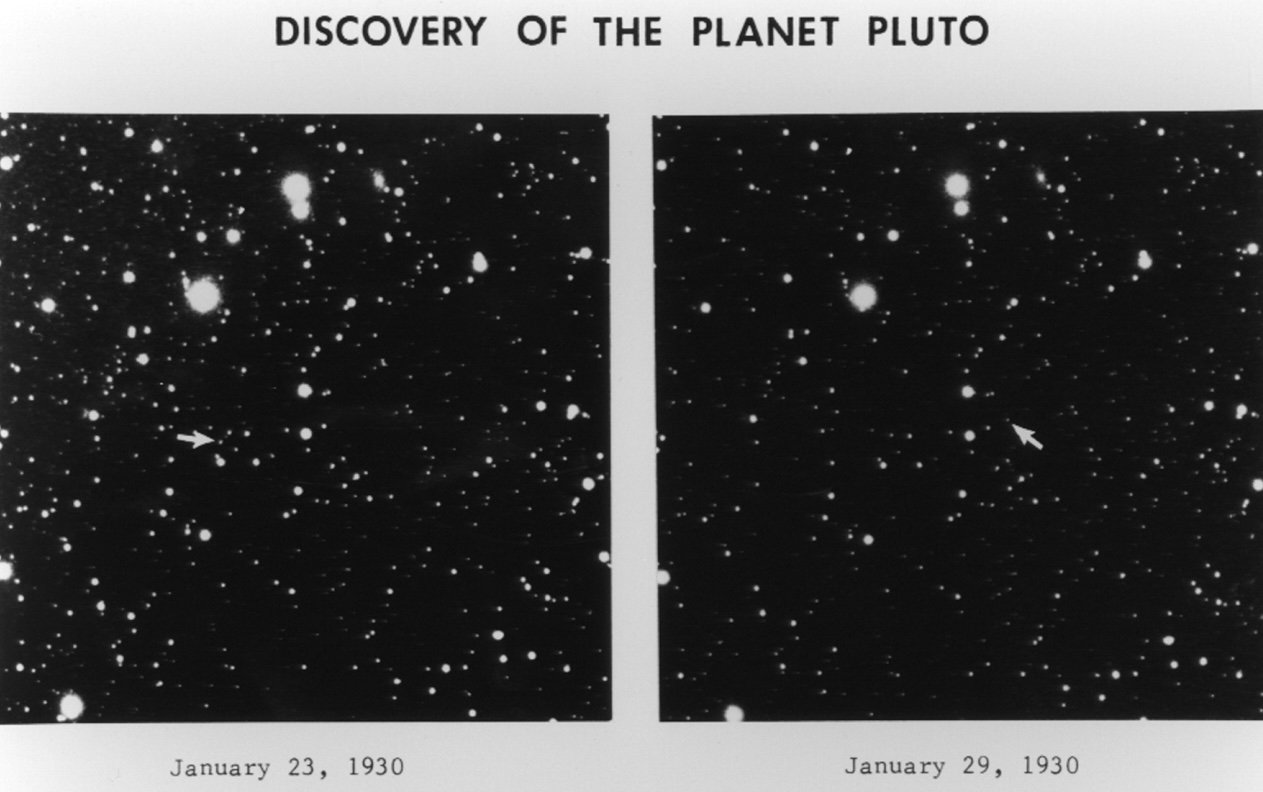
The original plates from Clyde Tombaugh’s discovery of Pluto. See how the point of light moves significantly across just six days. Image credit: Lowell Observatory Archive, Clyde Tombaugh
In 1930, American astronomer Clyde Tombaugh discovered a modestly sized object moving far out beyond the orbit of Neptune. This turned out to be what would be dubbed Pluto, the ninth planet of our solar system. It was small and far away, so it was difficult to glean a ton of information about it, but that didn’t stop people from falling in love. Pluto became a fan-favorite for many people that cared to have one. Maybe some saw Pluto as a plucky underdog. For others, its association with the Greek god of the underworld might have given it an alluring gothic edge. Some people are just really into rocks, I guess.
Whatever it was that people loved about Pluto, you can imagine the excitement buzzing around when New Horizons launched in January 2006 to become the first space probe to visit the distant ice world. For any whom this article hits home for, I wrote another article about New Horizons’ journey to Pluto that you can read here.
As pumped as people were, something would put a bit of a damper on the buzz of the mission…

The logo of the International Astronomical Union. Image credit: IAU
Just seven months after the New Horizons space probe left Earth, the International Astronomical Union (IAU) met in the Czech Republic to pass down the sentence for Pluto. More specifically, they voted to reclassify Pluto as a dwarf planet. Yeah, I know. You can take a moment to shake your head with quiet contempt if you need. Where did these people get off? Who did they think they were? Well, you probably came here for an actual answer, so I’ll tell you.
The IAU is a non-governmental organization made up of thousands of members, many of whom are professional astronomers. It acts as the global authority on naming celestial bodies, defining physical constants, setting astronomical standards, and promoting global cooperation in space research, education, and outreach. It’s existed as an institution longer than Pluto has been known about. So why would such a prestigious organization do something so obviously foolish? Well…
Words are a funny thing. We use them to identify and represent things and ideas, but words can often have many different meanings in many different contexts. The meaning of words can even change to fit the needs of those using them. This can happen gradually over time without people even noticing or can happen suddenly with intent. Sometimes people don’t agree with the use of certain words, and they argue back and forth until people fall to different sides. Words are much more complex than people give them credit for. The point being is that this challenge of words is often wrestled with in science as much as it is anywhere else.
In the case of demoting Pluto, this was not out of left field either. This had been a topic of informal debate amongst professional astronomers for years. Since 1992, astronomers had discovered several large bodies out beyond Neptune in the region where Pluto was. The 2005 discovery of an object even more massive beyond Pluto, called Eris, swept up a whole firestorm of controversy. The central question was: “What even is a planet, anyway?” We kind of already knew this. Planets are giant massive spheres that orbit the Sun! Simple enough. But it became less simple for some scientists when faced with the prospect of having possibly several dozen new planets added to the roster. A line had to be drawn somewhere, however arbitrary it may be.

The 26th General Assembly of the International Astronomical Union voting to reclassify Pluto as a dwarf planet. Image credit: Astronomical Institute, Academy of Sciences of the Czech Republic
At the August 2006 General Assembly of the IAU in Prague, a proposal to update the definition of ‘planet’ was put forth and debated. The votes were then cast and the proposal was accepted. From that point on, a planet was officially defined by the IAU as meeting three criteria:
It orbits a star.
It’s mostly round.
It has cleared its orbit of similarly-sized objects.
The major planets in our solar system like Earth and Saturn meet all three criteria, while some objects only meet two of them. The latter are what we call dwarf planets. These are objects that orbit a star and are mostly round, but they have not cleared their orbits of significant debris, often because they are too small and their neighbors too big or too numerous. It is this third criteria that led astronomers to reclassify Pluto as a dwarf planet.
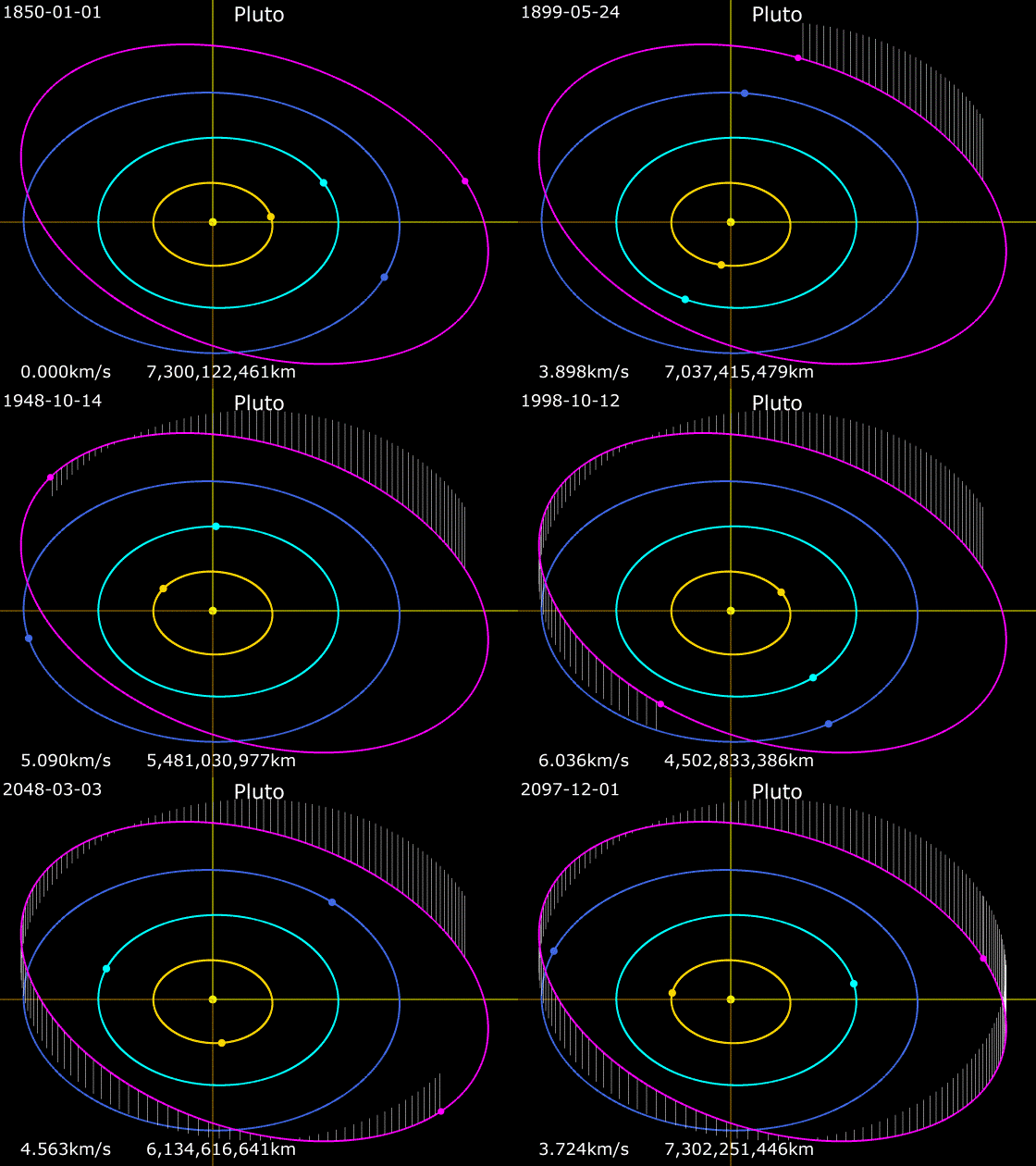
Animation of Pluto’s orbit from 1850 to 2097. Color code: Saturn (yellow), Uranus (light blue), Neptune (dark blue), Pluto (pink). Animation credit: Pheonix7777
Pluto orbits the Sun at an average distance of 6 billion kilometers, way beyond Neptune’s orbit. At least most of the time it is. Pluto’s orbit is much more elliptical than the other planets, so much so that part of its orbit actually brings it closer to the Sun than Neptune. Some people have taken this to mean that it may be possible for Pluto and Neptune to collide one day. I assure you they won’t and can’t because Pluto’s orbit is unusual in another way. It is inclined with respective to Earth’s orbit by 17°. This makes it stand out even more from the other planets, almost resembling the orbit of a comet.
The true reason Pluto’s orbit actually got it demoted is that its orbit occupies a region of the solar system known as the Kuiper belt. Think of it as a kind of a larger, icier, more distant cousin of the main asteroid belt that lies between Mars and Jupiter (which is actually relevant to this, and we’ll talk about in a moment). Pluto only makes up about 7% of the total mass of countless pieces of ice and rock in the Kuiper belt.
It’s not even the most massive object out there. While Pluto is 2% larger in diameter, Eris is 27% more massive than Pluto. It’s even worse when comparing Pluto to Earth’s moon. The Moon is 46% larger in diameter than Pluto and a whopping six times more massive.
Between its whacky and crowded orbit and its insufficient mass, it’s hard to argue that Pluto is dominating its orbit. It’s certainly not in the same league as planets like Jupiter. For these reasons, it was determined that Pluto had more in common with its frozen neighbors than with the eight major planets.
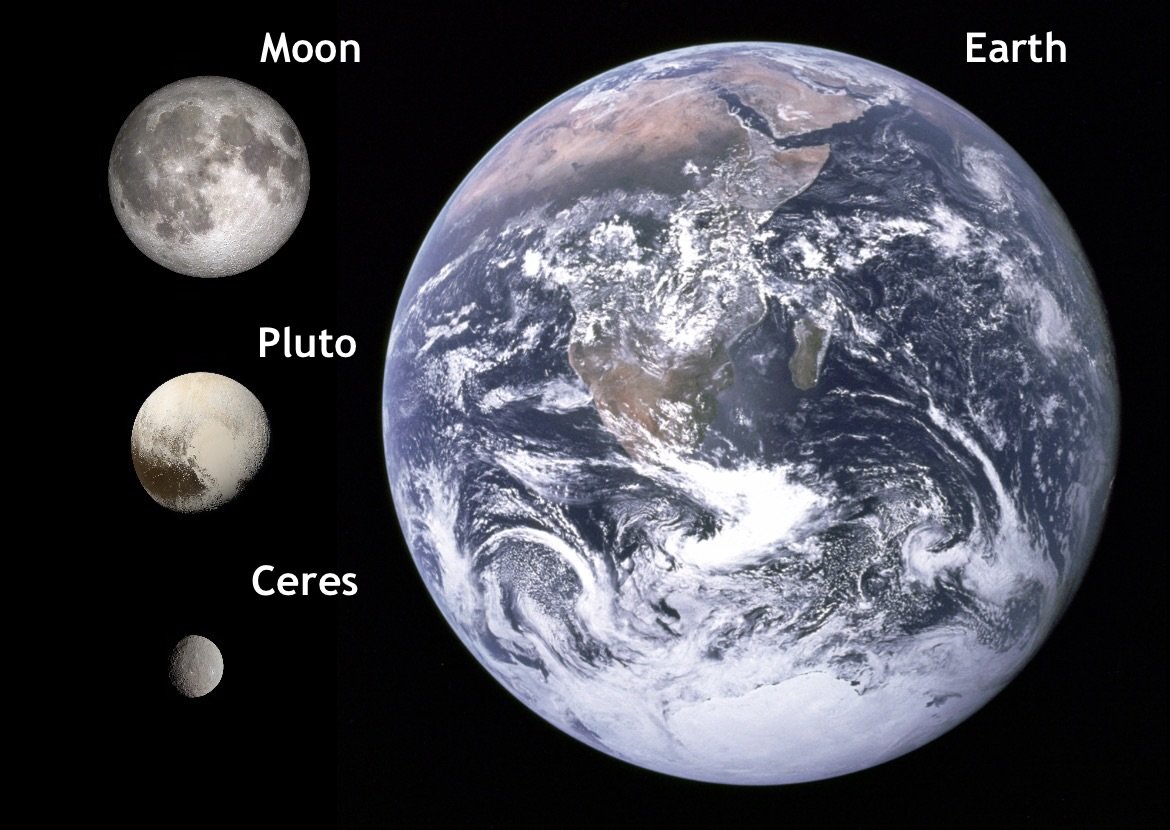
Size comparison between Earth (12,750 km), Moon (3,475 km), Pluto (2,370 km) and Ceres (950 km). Image credit: NASA, Sam Atkins
This also wasn’t even the first time this had happened. On New Year’s Day of 1801, Italian astronomer Giuseppe Piazzi discovered a moving object between the orbits of Mars and Jupiter. This was subsequently confirmed to be a planet, which we called Ceres, and it remained one for the next half a century. As astronomers started to discover a bunch of other similar objects floating in the same region, they started to suspect that these weren’t planets but a new class of object altogether. These objects became the largest members of what we now know to be the asteroid belt.
In 1852, a new naming scheme was devised to apply to these asteroids. In 1867, Ceres itself would be grandfathered in as the first asteroid ever discovered, officially designated 1 Ceres. You could argue that demotion stung much more than what Pluto got. Reduced to an asteroid! Well, I guess there wasn’t quite as much sour grapes as Ceres hadn’t garnered the same cult following as Pluto. In fact, Ceres ended up getting somewhat redeemed in 2006, as the same rule that demoted Pluto also promoted Ceres. Today, both are considered dwarf planets along with several other possible candidates.

Photo of Tenzing Montes (left foreground), Hillary Montes (skyline), and Sputnik Planitia (right) taken by the New Horizons space probe during its 2015 flyby of Pluto. Image credit: NASA / Johns Hopkins University Applied Physics Laboratory / Southwest Research Institute
For better or worse, Pluto is a dwarf planet. Sorry to all you Plutonians out there. Frankly, I think I agree with the decision. I recognize that the definition is not without some ambiguity and the standard isn’t evenly applied to planets orbiting other stars. However, you’re probably never going to find a perfect classification system free from contradictions. Perhaps one day astronomers will revisit the issue, and Pluto will have its day in court once again.
In all honesty, you really shouldn’t fret too much about it as there is a positive spin to be put on this. As a dwarf planet, Pluto is now the biggest object in its class instead of the runt. And nothing about it being a dwarf planet makes Pluto any less fascinating. There are so many cool things about Pluto you might not know. It’s got five moons, one of which it’s tidally locked with. It has ice fields made out of nitrogen and mountains made out of water. It has a huge heart shape on its surface. Its atmosphere glows blue during the sunset. It’s been professionally studied by the guitarist from Queen. If you haven’t yet, you should check out my article on the New Horizons space probe. You’ll come to appreciate Pluto more than ever, no matter its rank!