
The Nancy Grace Roman Space Telescope
by Sam Atkins
The Nancy Grace Roman Space Telescope launches at the end of this month. Let’s take a closer look at how this next-gen observatory will attempt to answer fundamental questions about the universe at the largest scales!
NOTE: Tap or hover over images for captions and credits.
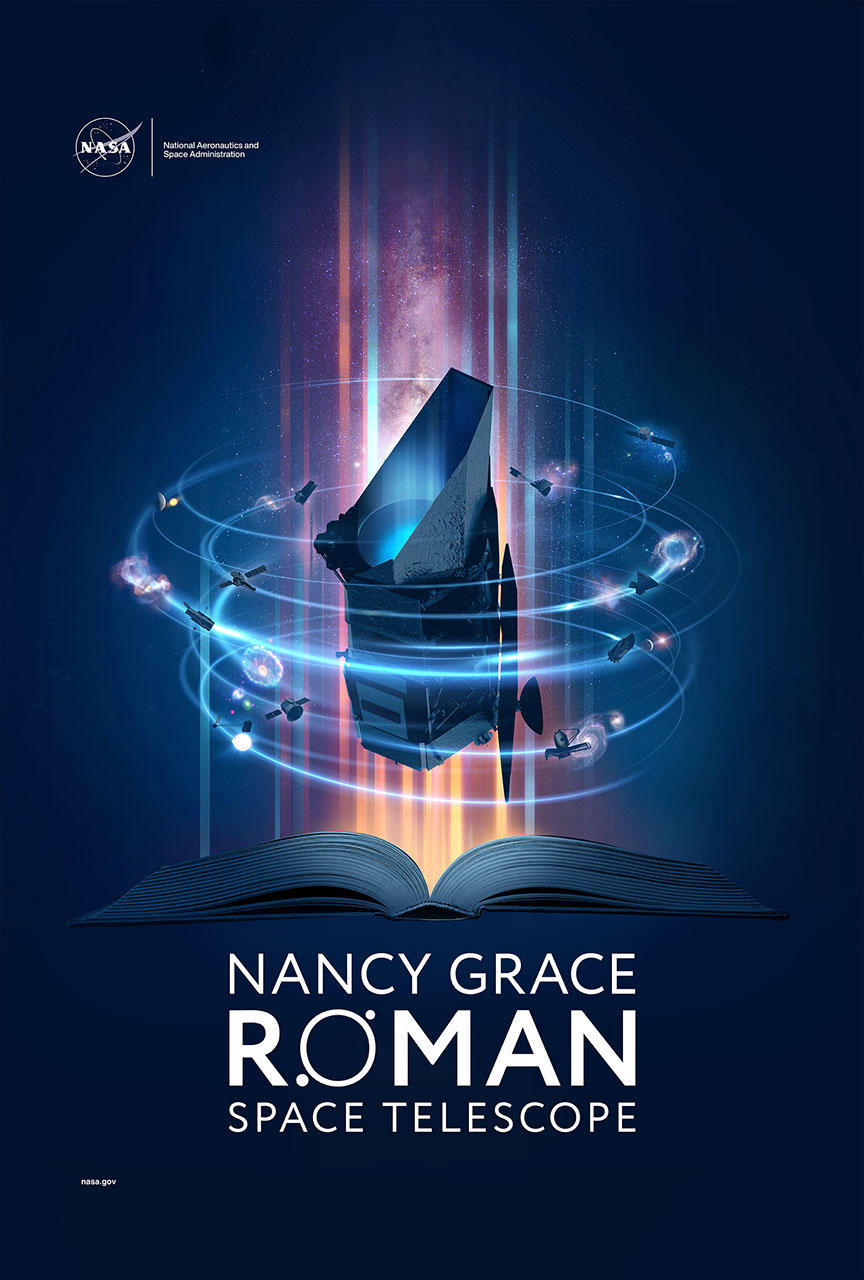
Image credit: NASA / Jenny Mottar
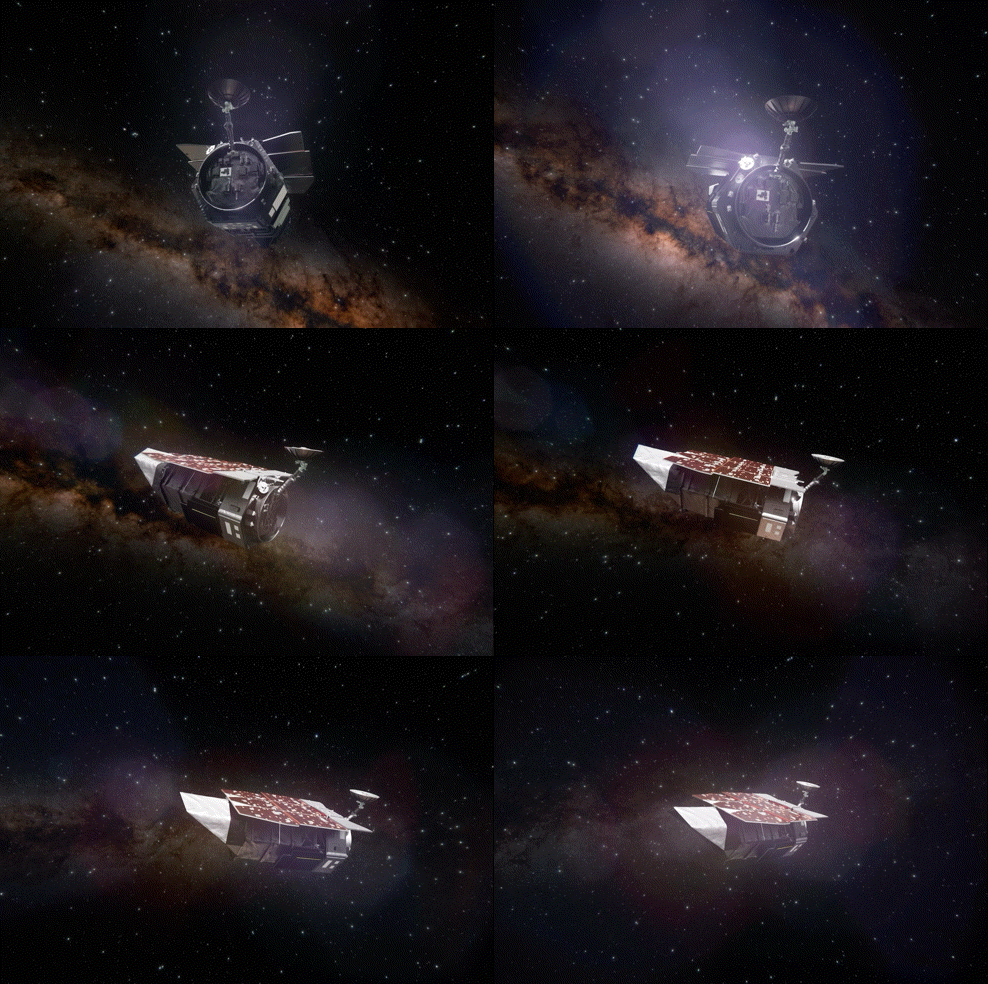
Image credit: NASA’s Goddard Space Flight Center Conceptual Image Lab
On August 30, 2026, NASA will launch the Nancy Grace Roman Space Telescope, a next-generation observatory designed to survey enormous portions of the sky. After years of development and construction at NASA’s Goddard Space Flight Center in Maryland, Roman was completed in November 2025 and arrived at the Kennedy Space Center in Florida in June 2026. It will launch aboard a SpaceX Falcon Heavy rocket and travel to the Sun-Earth Lagrange 2 point, a region about 1.5 million kilometers from Earth in the direction opposite the Sun. From there, Roman will orbit the Sun in step with Earth, using relatively little fuel to maintain its orbit. Roman will join other observatories at L2, including the James Webb Space Telescope, and begin its planned five-year mission.
WHO IS NANCY GRACE ROMAN?
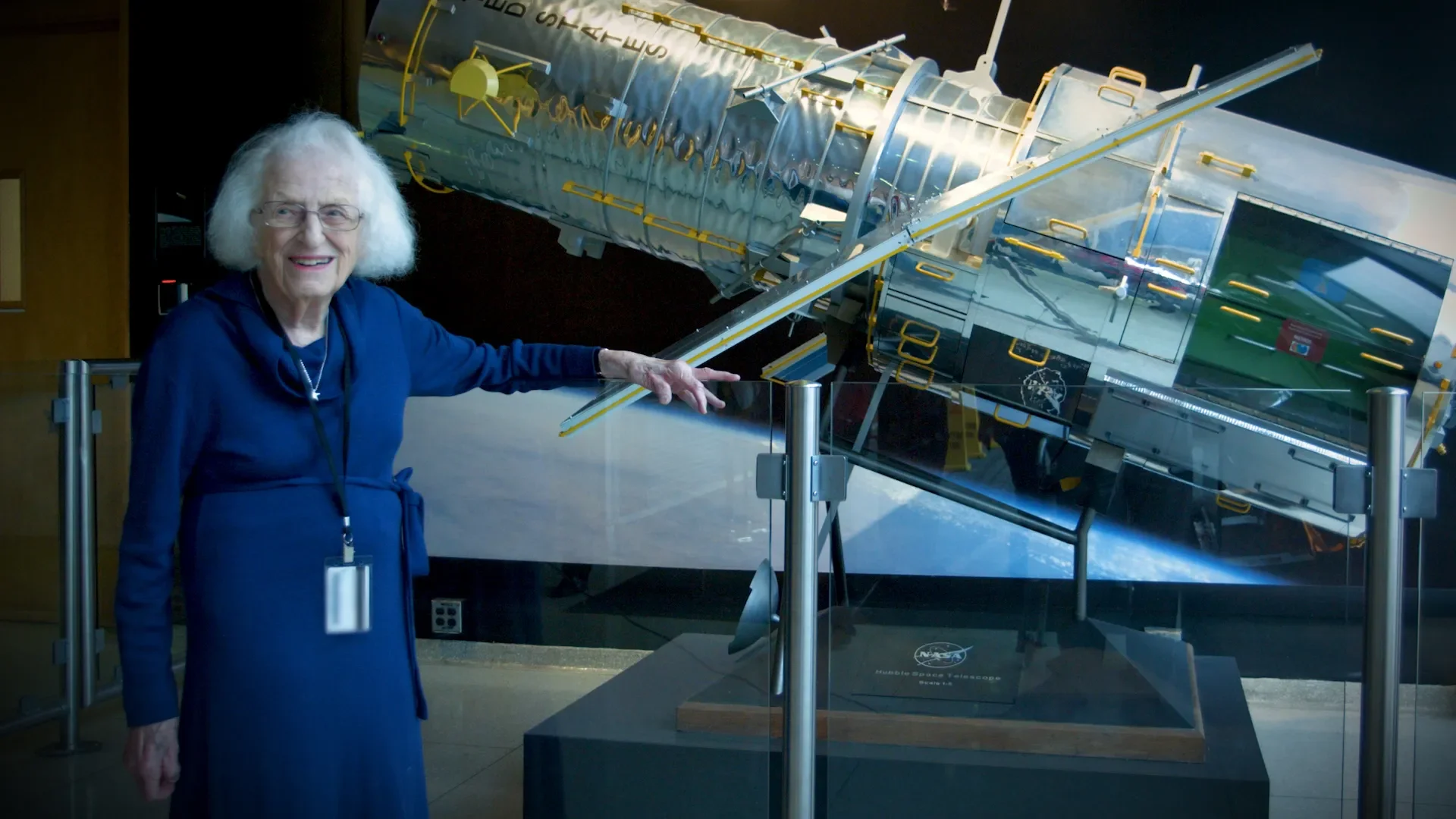
Pictured: Nancy Grace Roman standing next to a scale model of the Hubble Space Telescope at the Goddard Space Flight Center in Greenbelt, MD. Image credit: NASA
Nancy Grace Roman was an American astronomer who played a big role in establishing space-based astronomy as a major field of science. Born in 1925, Roman studied astronomy at Swarthmore College in Pennsylvania and later at the University of Chicago. She learned how to use astronomical instruments and make astronomical measurements. She earned her doctorate in astronomy in 1949. After graduating, conducted research on the spectroscopy of Sun-like stars, high velocity stars, and detection of exoplanets. Her work became some of the most frequently cited papers of the time. She later worked at the Naval Research Laboratory where she was immersed in a new field of astronomy that uses radio waves to study celestial objects.
Roman joined NASA in 1959 at the invitation of Jack Clark, who would soon become the director of NASA’s Office of Space Sciences and Applications. Roman was tasked with creating a space astronomy program and served as NASA’s first Chief of Astronomy and the first woman to hold an executive position at the administration. She toured the country to convince astronomers of the importance in conducting astronomy using space telescopes instead of just ground observatories. She believed this would enable the discovery of planets orbiting distant stars. Her advocacy culminated in possibly her defining contribution to astronomy by being the driving force behind the Hubble Space Telescope. She convinced astronomers to support it and she convinced Congress to fund it. Hubble launched in 1990 and has become without a doubt one of the most profoundly influential pieces of space technology, producing some of the most important contributions to our understanding of the universe.
Now, her namesake will lend itself in continuing that legacy with this next-generation space telescope.
Pictured: Nancy Grace Roman standing next to a scale model of the Hubble Space Telescope at NASA’s Goddard Space Flight Center in Greenbelt, MD. Image credit: NASA
WHAT IS ROMAN’S GOAL?
Roman’s primary objective is the study of dark energy, the mysterious “force” that seems to be accelerating the expansion of the universe. What does any of that mean?
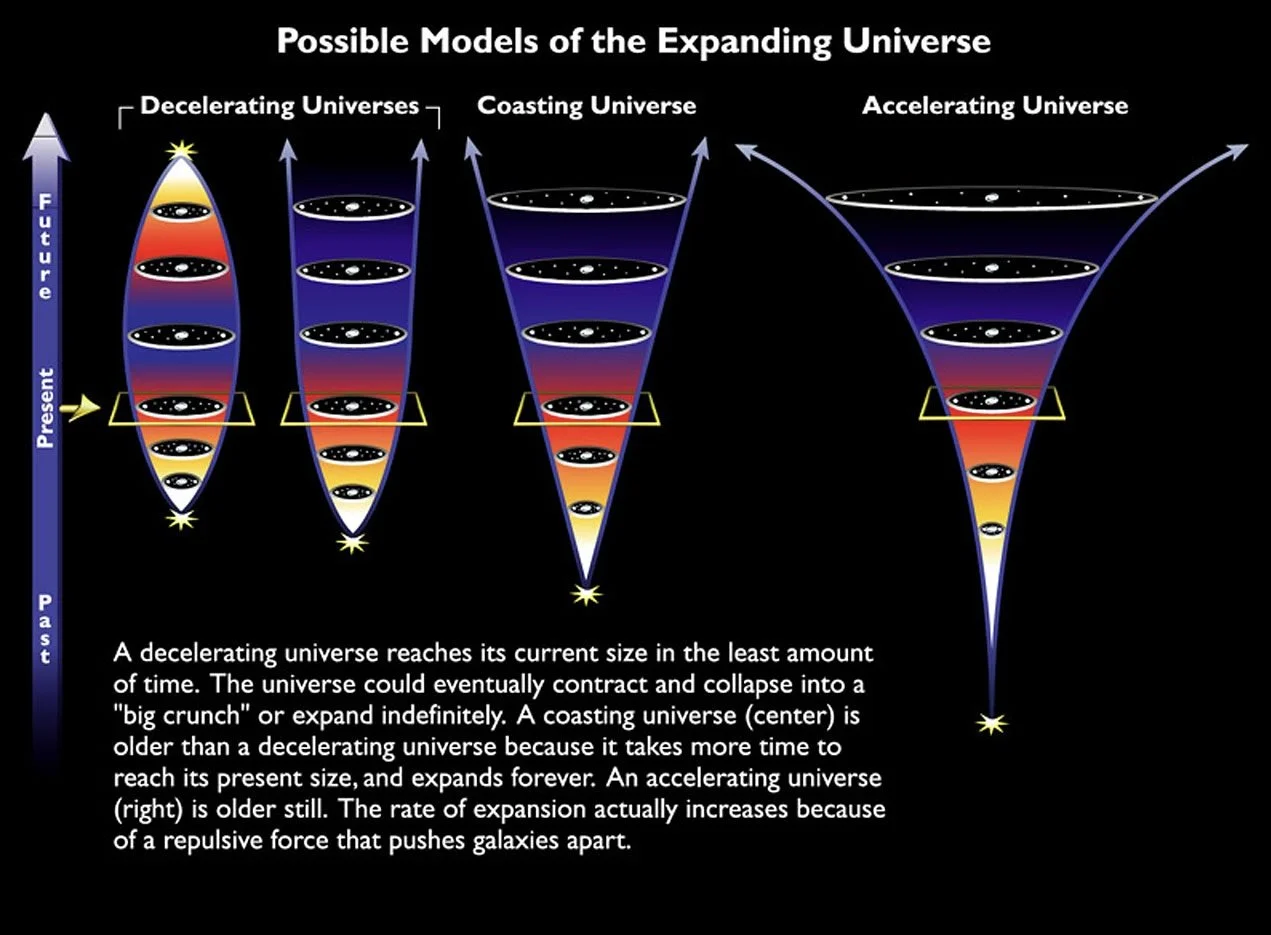
Various models have been proposed for how an expanding universe might evolve over time. The current evidence most favors an accelerating universe. Image credit: NASA, ESA
In the early 20th century, astronomers studying the light from distant galaxies made a remarkable discovery. Their spectra were redshifted (frequencies shifted toward the red end of the spectrum), meaning the light waves had been stretched as the galaxies appeared to recede from us. More distant galaxies showed greater redshifts, indicating that they were receding faster. This relationship, known as the Hubble-Lemaître law, revealed that the universe itself was expanding, much like dots drawn on the surface of an inflating balloon move farther apart as the surface stretches. It was a profound discovery, and one of the first crucial pieces of evidence for the Big Bang theory.
But in the 1990s, astronomers discovered that the story was even stranger. Two independent teams were searching for Type Ia supernovae, explosions involving white dwarfs that can reach a critical mass after drawing material from a companion star. Because these explosions have remarkably consistent intrinsic brightnesses, astronomers can use them as “standard candles,” comparing how bright they truly are with how bright they appear to determine their distances. By comparing those distances with the redshifts caused by cosmic expansion, the teams expected to find an expansion that was gradually slowing under the gravity of a matter-dominated universe. Instead, the supernovae were consistently fainter, and therefore farther away, than expected.
Many explanations were considered but only one made sense. The expansion of the universe was accelerating. Whatever is driving that acceleration became known as dark energy, but its true nature remains one of the great mysteries of modern astronomy. Roman may help unravel it by observing thousands of Type Ia supernovae, among other phenomena, allowing astronomers to map how the universe’s expansion has changed across vast regions of space and billions of years of cosmic history.
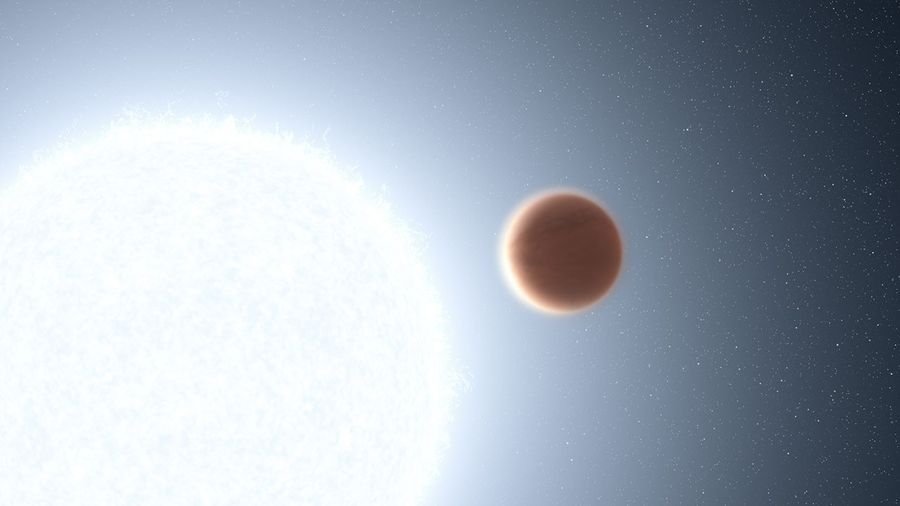
Artist’s conception of a “hot Jupiter”, a common type of gas giant hugging its parent star. Image credit: NASA, ESA, Leah Hustak (STScI)
In little more than a generation, we’ve gone from only knowing the planets and moons in our own solar system to finding thousands of worlds orbiting distant stars, called exoplanets. The coolest thing about this is that these alien worlds are radically different from our planets in some ways and very similar in other ways. With rapidly advancing technology, our knowledge about exoplanets is expected to grow exponentially and Roman will very much be a part of that. Roman has been tasked with completing a census of up to 100,000 exoplanets! This would be a staggering addition to the current roster of extraterrestrial worlds which sits at around 6,350. The more we find, the more we can learn about the conditions under which planets form and evolve. What is typical, what is exceptional? What kind of planets might sustain life?
Roman will rely on three main methods for detecting exoplanets:
Direct imaging: By blocking out the bright light of stars with its coronagraph, Roman will reveal the dust disks and planets hiding within their glare. Roman’s highly sensitive camera will be able to take direct photographs of these Jupiter-sized exoplanets and show how these planetary systems are organized.
Transits: Whenever an exoplanet passes directly in front of its parent star, it causes a detectable dip in the star’s brightness and then a second shallower dip when the planet passes directly behind it. This works particularly well for exoplanets that are at least Neptune-sized and hug their star.
Microlensing: The warping power of the star’s gravity can bend and magnify the light of background stars passing directly behind it. If the lensing star has planets, that world can produce a sharp, secondary spike on top of the smooth light curve. This works particularly well even for exoplanets that orbit far from their star.
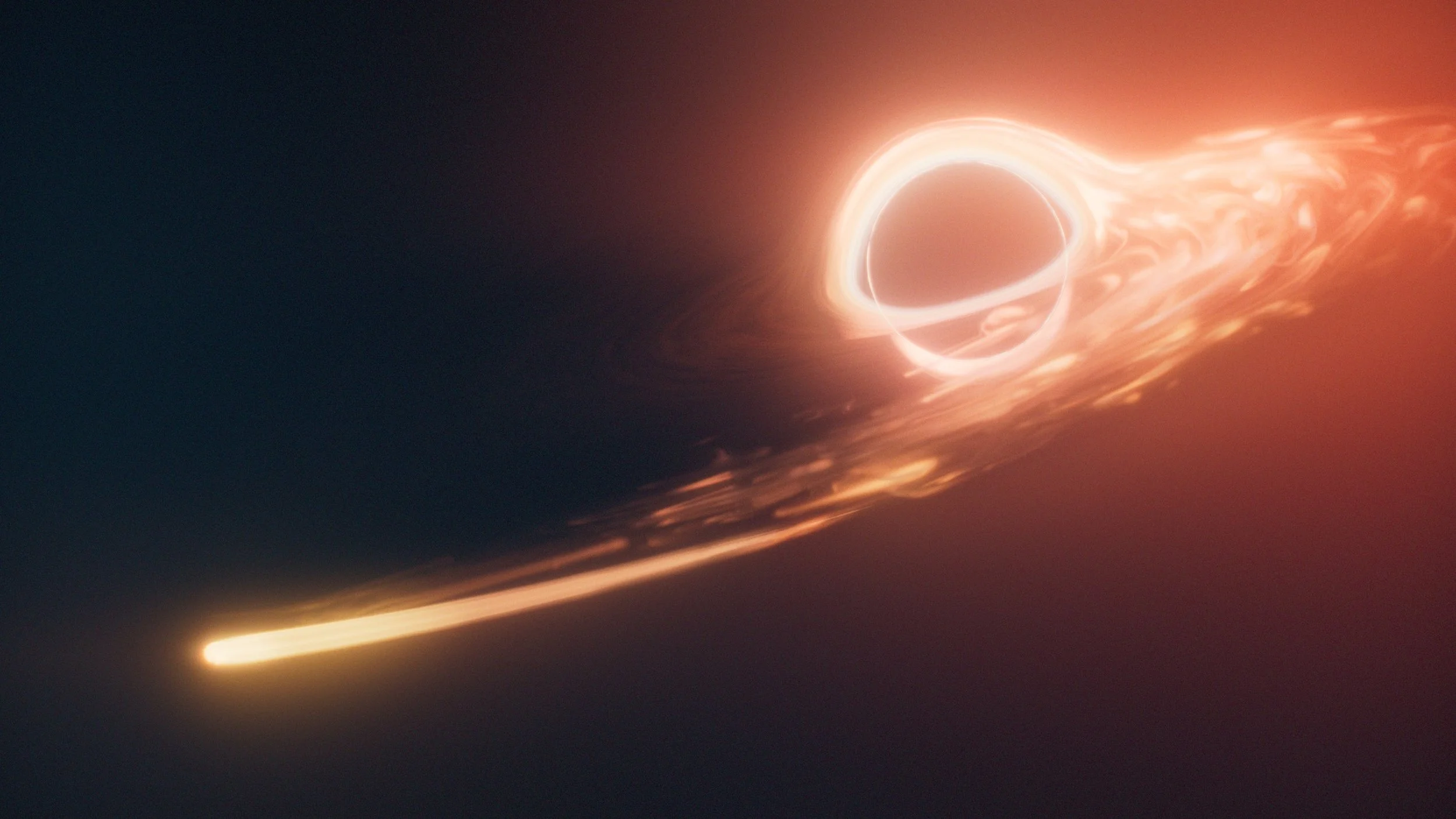
Artist’s conception of a Sun-like star being shredded by a supermassive black hole. Image credit: NASA, Ralf Crawford (STScI)
When a sufficiently massive star collapses and triggers a supernova, its core may collapse into a black hole. This is an object so extremely dense that it warps the surrounding spacetime to such an extent that, once anything passes beyond its event horizon, not even light can escape. The black hole itself is therefore invisible, but its presence can be revealed through its effects on surrounding matter and light, including the gravitational lensing of background objects. These objects range wildly in mass, from a few times the Sun’s mass to tens of billions (we call these supermassive black holes).
Black holes can capture nearby stars and consume them, which is why they are sometimes called “star eaters.” They can even collide and merge with other black holes. These celestial “feedings” are probably how some black holes get so massive, but that process takes an incredible amount of time. When we look into the furthest reaches of the cosmos, we do find black holes that existed quite early in the universe’s history. How did these objects form so quickly? We don’t really know. That’s one of the questions Roman will investigate. By scouring the universe for and cataloguing these ancient black holes, astronomers will be able to analyze and compare them to see what kind of black holes form under different conditions.
Supermassive black holes with over a billion solar masses can quickly swallow a star whole which doesn’t leave much to observe. For supermassive black holes that are between 10 and 100 million solar masses, it is more common for them to gradually slurp stars up into a glowing spiral of superheated gas (pictured). These are known as tidal disruption events and they tend to be incredibly bright, even outshine the entire galaxy within which they occur. These are easily detectable by astronomers and offer great opportunities for Roman to do its thing.
WHAT TECHNOLOGY WILL ROMAN USE?
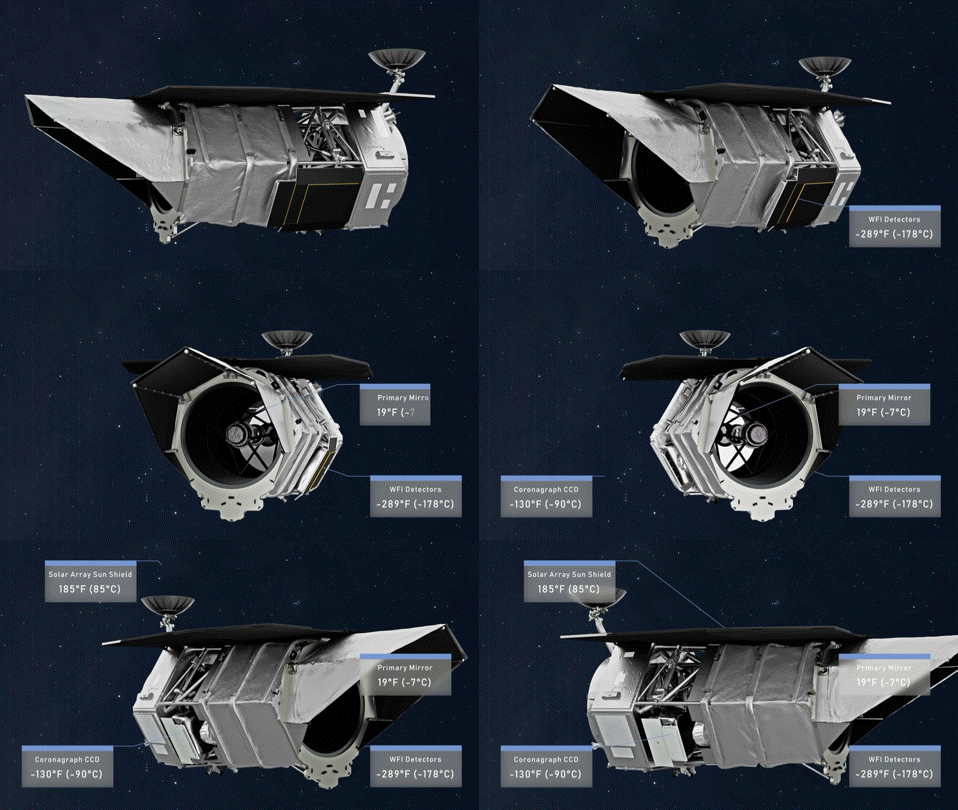
The location of Roman’s primary instruments and equipment, as well as the temperatures they will operate in. Credit: NASA SVS
Roman’s overall structure is fairly typical of a space telescope, and its dimensions are comparable to those of Hubble. When fully deployed, it’s about the size of a semi-truck trailer and has a mass roughly equivalent to that of a Tyrannosaurus rex. At its heart is a 2.4-meter (7.9-foot) primary mirror, the same diameter as Hubble’s, but only about a quarter of the weight. Where Roman really differs is in its optical design: three additional flat folding mirrors redirect the incoming light along a zigzagging path before sending it into the camera. This folded optical path allows Roman to fit a much wider field of view into a relatively compact telescope.
To safeguard the clarity of Roman’s imaging and maintain a steady source of power to its equipment, Roman is mounted with a Solar Array Sun Shield. About the size of a garage door, the sun shield is made up of six connected panels, each covered in thousands of solar cells that absorb the sunlight and convert it directly into electricity that powers the telescope’s various functions. Once deployed, the face of the panels is always directed at the Sun to provide a steady and to shade much of the observatory to keep its instruments cool.
For communication, Roman is fitted with a 1.7-meter (5.6-foot) high-gain antenna dish. This allows the telescope to receive commands as well as transmit up to 1.4 terabytes of data back to Earth everyday at a rate of 500 megabits per second. Despite being as tall as a refrigerator, its carbon composite design gives it an easy 24-pound weight.
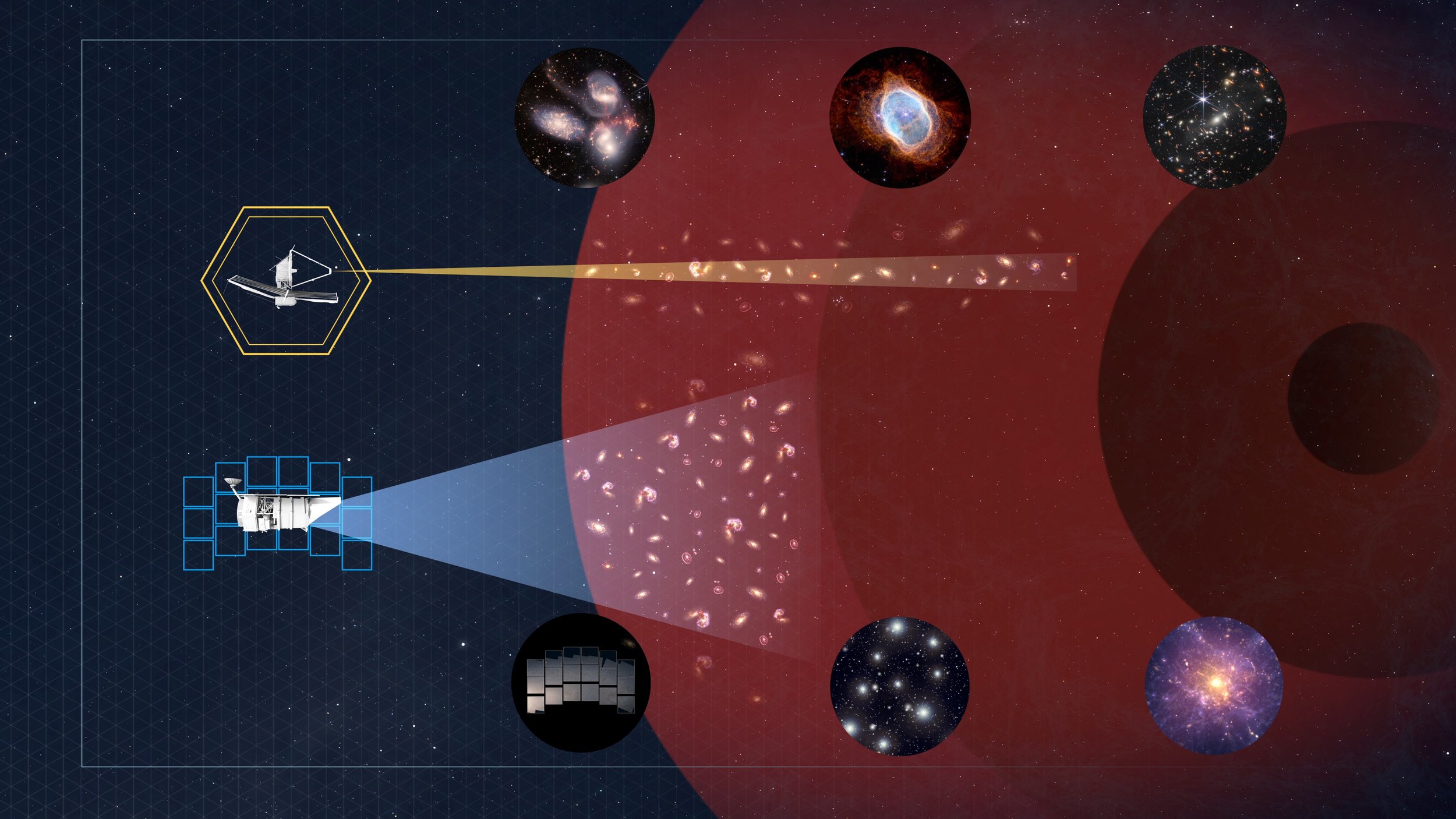
While Webb has the sensitivity and wavelength range to capture detailed images deeper into the universe, Roman has an incredibly wide field of view to rapidly survey huge areas of the sky. Image credit: NASA’s Goddard Space Flight Center
Roman is, like the James Webb Space Telescope, an infrared telescope. It is sensitive to light with a frequency that sits below the visible range of the electromagnetic spectrum. This is similar to how there are pitches of sound that are below what is audible to our ears. The advantage of detecting infrared light is that it’s able to pierce through the thick gas that permeates interstellar space where visible light would be blocked. This helps peer through the dusty cocoons surrounding newborn protostars and observe the redshifted light of distant receding galaxies.
These infrared sensors can be easily interfered with by visible light which is why both telescopes operate at the Lagrange 2 point. This region puts the brightest sources of interfering light (the Sun, Earth and Moon) on one side of their sun shield, cloaking their sensitive infrared instruments in cold darkness. It also gives them an unobstructed view of most of the cosmos at any given time of year and Roman has a lot it needs to cover.
In order to scour 12% of the entire night sky as is currently planned, Roman’s design does take a different approach than Webb. While Webb specializes in extremely deep, high-resolution observations of distant galaxies and star formation, Roman will take a broader approach by conducting fast, panoramic surveys of enormous regions of the sky. Roman will cover 50 times as much sky in its first five years as Hubble covered in its first 30! Together, Roman and Webb will cooperate and complement each other, combining breadth with depth. Webb will tell us about the early universe and Roman will reveal how the universe evolved from there!
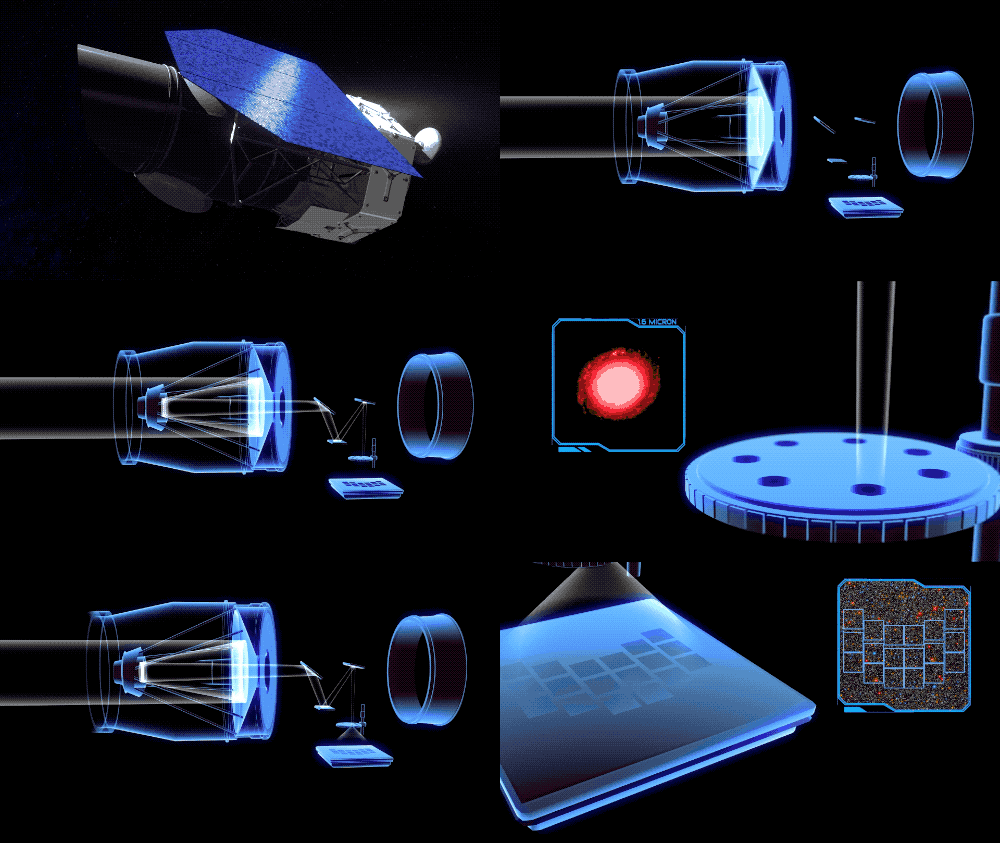
Animation demonstrating the process of using the Wide Field Instrument (WFI). Credit: NASA SVS
WIDE FIELD INSTRUMENT
The Wide Field Instrument (WFI) is a 302-megapixel infrared camera. This is what converts the light funneled through the telescope into data and images. It will provide the same high resolution that Hubble has but with a field of view at least 100 times larger, larger than the apparent size of the full moon! Over the course of Roman’s planned five-year mission, this camera will produce up to 20,000 terabytes of data for astronomers to sift through and analyze.
Light passes through a rotating wheel equipped with a suite of filters for imaging and prism dispersers to split the light for spectral analysis. The filtered or dispersed light then reaches the focal plane array, consisting of 18 infrared detectors arranged into the recognizable 3-by-6 mosaic we see in many Roman logos. Each individual detector is made up of 16.7 million pixels. This results in a field of view of 0.4° × 0.8°, combining for a total of 0.281 square degrees of sky at any given time (when accounting for gaps between the detectors). For comparison, the full moon appears about 0.5° across.

Animation demonstrating the process of using the Coronagraph Instrument (CGI). Credit: NASA SVS
CORONAGRAPH INSTRUMENT
The Coronagraph Instrument (CGI) is a system of masks, prisms, detectors, and even self-flexing mirrors built to block out the glare from distant stars and reveal the planets in orbit around them.
After the starlight enters the primary mirror, the telescope’s optics redirect the light into the CGI. Specially shaped “masks” are used to block out the starlight the same way you would hold up your hand to block the glare of the Sun. The masks are designed to use the manipulate the unwanted starlight into waves that interfere with each other, effectively canceling them out while preserving light from potential adjacent planets. The remaining light encounters a pair of deformable mirrors. Thousands of actuators moving like pistons are able to change the shape of the mirrors in real time to compensate for the imperfections of the telescope’s optics. These changes are precise enough to compensate for flaws the width of a DNA strand!
The end result is the sharp dimming of blinding stars to expose the faint planets lost in their glare. This clears the way for Roman to take direct images of those planets and track their movement over time. Testing of the coronagraph will be conducted in the first year and a half before becoming available for open scientific use.
As we see the progression of the Nancy Grace Roman Space Telescope’s mission, I’ll try to periodically update this article in the future. Keep an eye out!