
Star Trek: Why The Future Is Bright
by Sam Atkins
NOTE: Tap or hover over images for captions and credits.
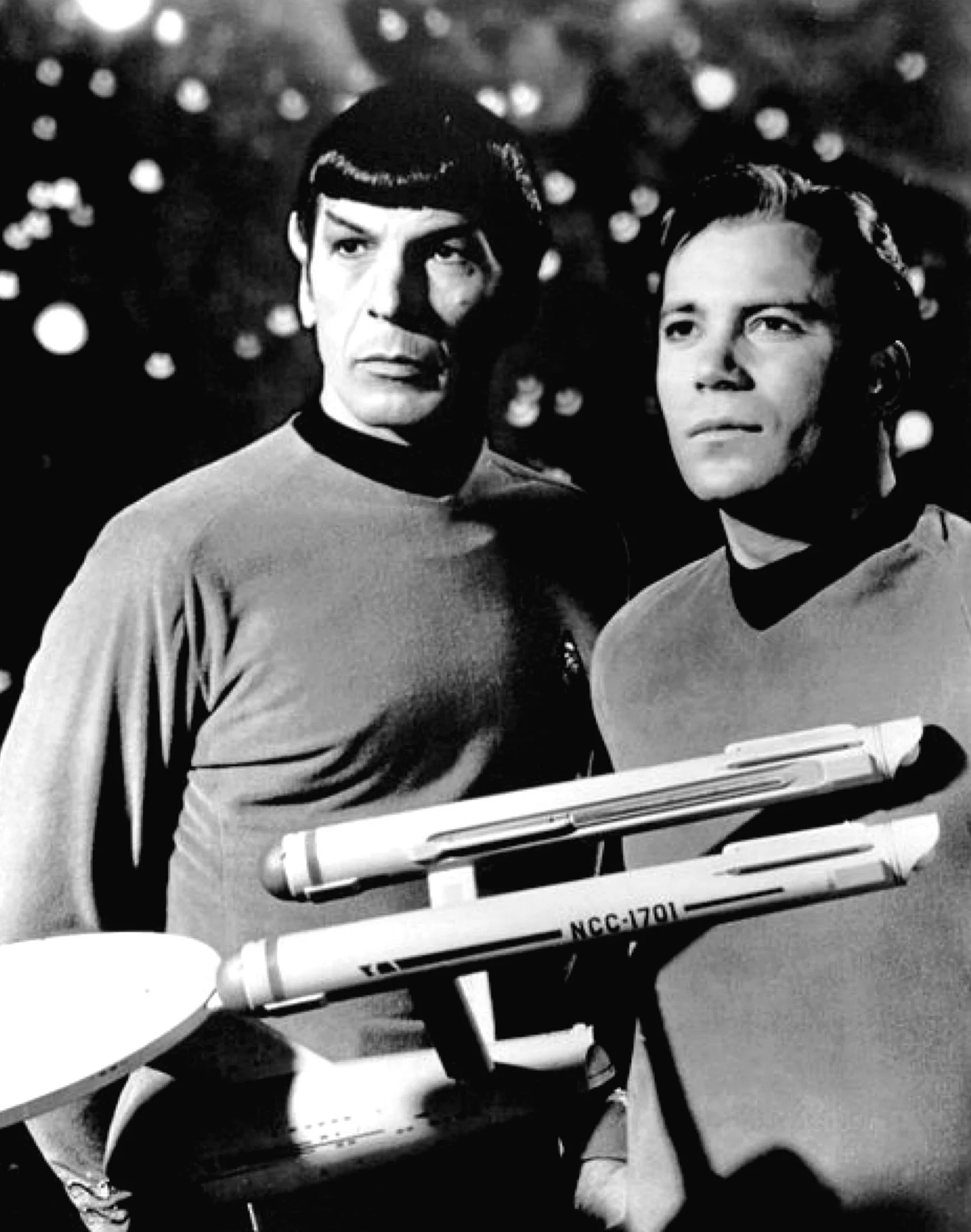
Spock (Leonard Nemoy) and Captian Kirk (Willima Shatner) stand in front of a model of the USS Enterprise. Image credit: Public domain
Today marks the 60th anniversary of the first episode of Star Trek to air in the United States. Gene Roddenberry’s franchise has since become one of the most influential pieces of science fiction in modern history. It offered a vision of humanity’s future that is quite different from what we see in a lot of science fiction today. Star Trek predicts that we will outgrow the divisions and hardships that defined our ancient origins. We will choose to unite as one people to share knowledge, look outward and explore the stars in peace and prosperity.
What makes Star Trek’s optimism feel so remarkable today is how unusual that kind of faith in the future can seem. Almost radical. We live in a time of extraordinary change and uncertainty. People are guarded and insulated. Trust feels fleeting and fragile. The frontiers of space seem distant and inconsequential when there are so many problems here on Earth demanding our attention. You can just feel it out there, can’t you? The fear? The cynicism? We certainly have no shortage of people online to tell us what to be afraid of and how foolish hope is. Perhaps it’s a natural tendency when so much is changing so quickly. Before we barely have a grasp on the way things are, something new comes about. As we try to keep pace and adapt, we make decisions that will define our future. This is at the center of why Star Trek’s optimism is more important than it’s ever been.
We are flawed beings. We misstep, we misinterpret, we miscalculate, we misjudge. But those flaws provide opportunities for us to learn and grow. Even when the original Star Trek series first aired in 1966, America was in the midst of all kinds of social unrest and political quagmires. The Cold War loomed with threats of nuclear annihilation and perpetual war. People openly challenged systems of oppression and cultural norms, leading to protests and violence. Star Trek’s own universe didn’t begin with utopia, either. In the 21st century, humanity was stricken with poverty, disease, prejudice, and tyranny while we were tearing each other apart in an apocalyptic world war.
It was in the light of scientific discovery that humanity was pulled back from the brink and shown a new possibility. Warp drives were born from the very weapons of mass destruction that threatened our existence and now brought the stars directly into our reach. Matter replicators ushered in a post-scarcity society, no longer requiring the pursuit of money. The adoption of the Prime Directive, mandating non-interference in the development of extraterrestrial civilizations, was a self-aware acknowledgment of our own flaws. After all, we too once struggled to find our place in the universe and hard lessons are not as soon forgotten. Mind you, Star Trek does not foresee humanity free of problems. They still struggle with questions of equality, identity, belief, security, freedom, tradition, justice, power, and many other moral quandaries. Advanced technology gave them extraordinary capabilities, but was that what elevated their society in the first place?
For all our faults, humanity has proven time after time that we are capable of extraordinary things when we put our minds to it. Again and again, we have crossed barriers we once believed were impossible. We eradicated smallpox, we sequenced the human genome, we split the atom, we put people on the Moon. However, progress isn’t inevitable. It is a choice. As President Kennedy said in 1962, we chose to put people on the Moon. We chose to devote our time, energy, and resources to that goal, and for a brief moment, its achievement united us not just as a country, but as a species. It demonstrated what we could do when we chose to dream bigger and collectively work towards a common goal.
Then, one day, we chose not to. We stopped going to the Moon. The capability didn’t suddenly disappear. We still had the rockets, astronauts, knowledge and infrastructure. NASA’s budget has never again represented as large a share of the federal budget as it did during the Apollo missions. Our priorities changed. Those values were reflected in the reduced time, energy and resources we put into that endeavor. That’s what separates a technological species from that succeeds from one that doesn’t. The choices we make as a society that reflect our values. But just because we chose something in the past doesn’t mean we could make a different choice in the future. Even at the institutional level, we collectively have great power to steer our civilization in the right direction through our voice and our vote, whichever we decide that to be.
Science is one of the greatest marvels that humanity wields. Through this methodological search for truth we have transformed our understanding of the universe. Through the development of technologies we have transformed how we live our lives in ways we never imagined. Science, more consistently than any other endeavor, has given us the means to build a better future. Perhaps we can go much further than the Moon. We can do more than just look at the stars, but explore them. And if that seems impossible now, remember what used to seem impossible in the past. Even if we don’t end up accomplishing the impossible, the ambition and the choice to pursue it is what will keep us moving forward. As Spock once said: “We will do what we have always done, Jim. We will find hope in the impossible.”