
The James Webb Space Telescope (2025-2026)
by Sam Atkins
This article covers Webb’s fourth year of operation. You can view its first through third year selection of images here.
NOTE: Tap or hover over images for captions and credits.
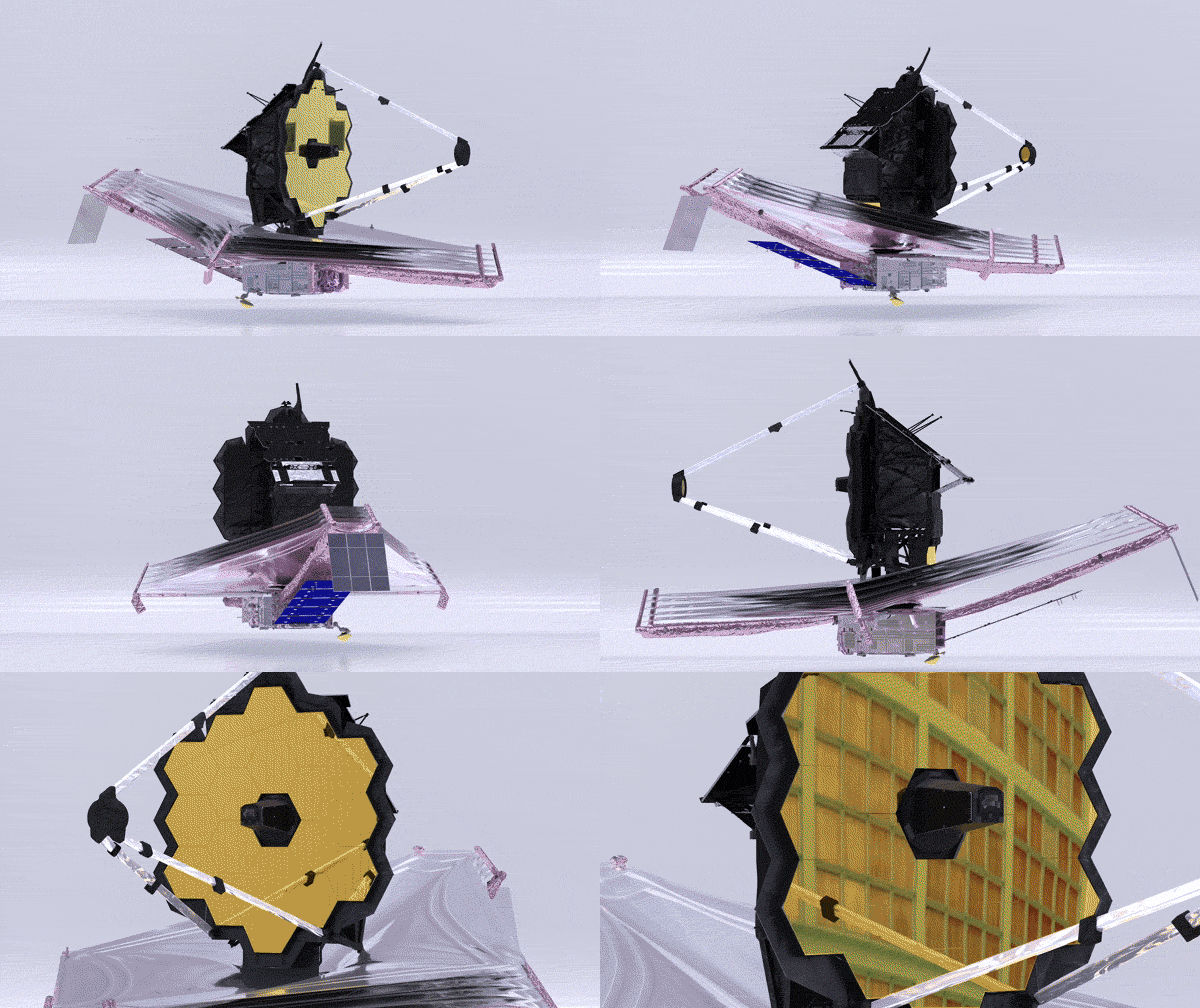
Credit: NASA Goddard Space Flight Center
The James Webb Space Telescope is the largest, most complex observatory sent into space. It was jointly developed by NASA, the European Space Agency, and the Canadian Space Agency. It is, in many ways, the next generation successor to the world-famous Hubble Space Telescope that still remains in operation today. Webb was launched on December 25, 2021 and the public began receiving images from it almost six months later. As of the publishing of this article, Webb has now been transmitting images back to Earth for three years.
Fun fact: The James Webb Space Telescope took ten years and $10 billion to develop and build. It was built at the Goddard Space Flight Center in Greenbelt, Maryland and is currently operated from the Space Telescope Science Institute at Johns Hopkins University in Baltimore, Maryland.
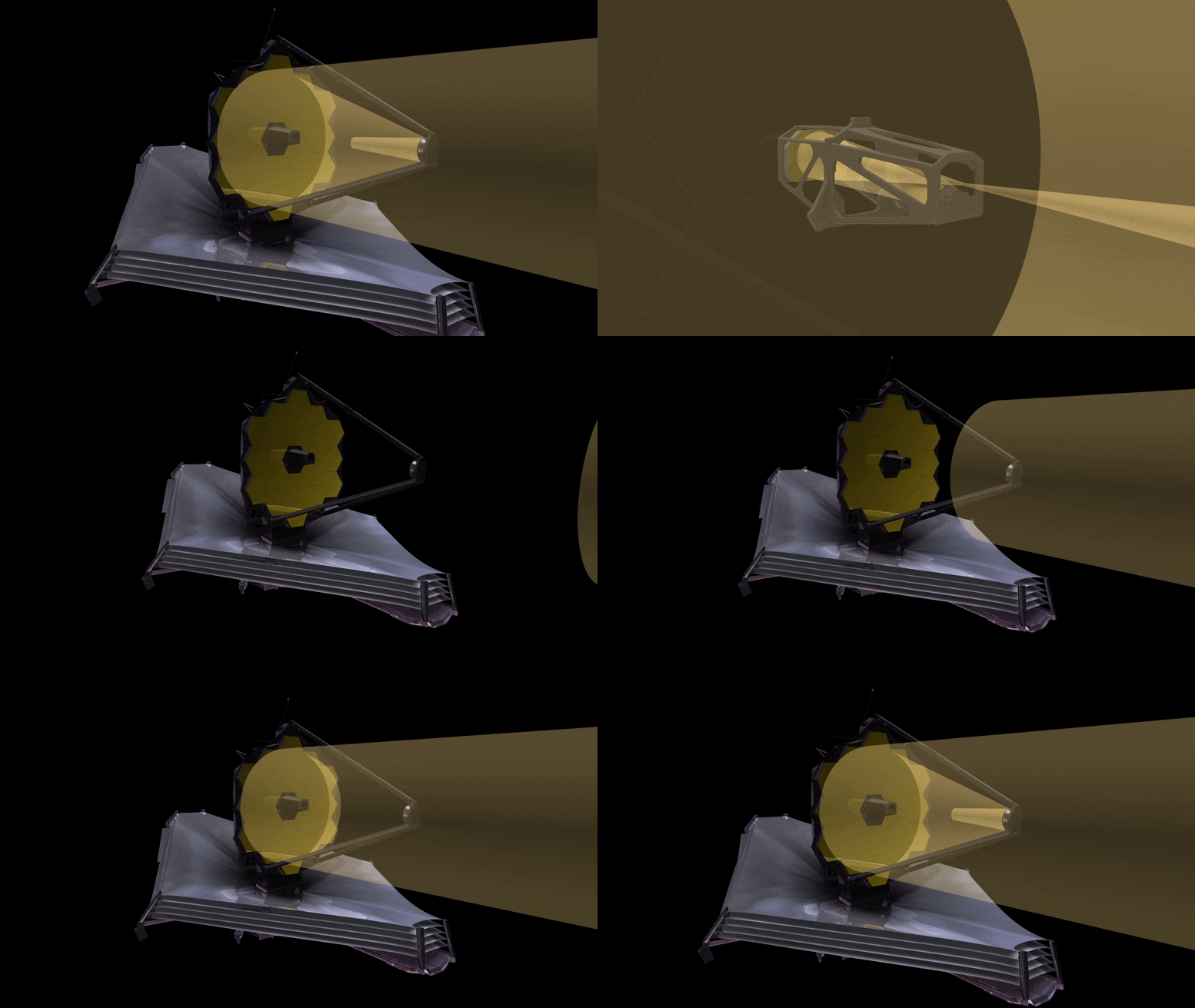
This animation shows the path of light from distant cosmic objects as they reflect off Webb’s array of mirrors and are funneled into its scientific instruments. Credit: NASA
Though it is much, much larger and more advanced, Webb operates off the same basic principles as any reflector telescope you’d find in someone’s backyard. Being in space simply eliminates the distortions from Earth’s atmosphere.
Its concave primary mirror intercepts light traveling through space and reflects it forward into a smaller secondary mirror. The secondary mirror then directs the light into the scientific instruments where it is recorded. Those recordings are then transmitted via radio waves back to Earth where they are received, processed and analyzed by scientists. This is pretty much how the Hubble works too, so what’s the difference between them?
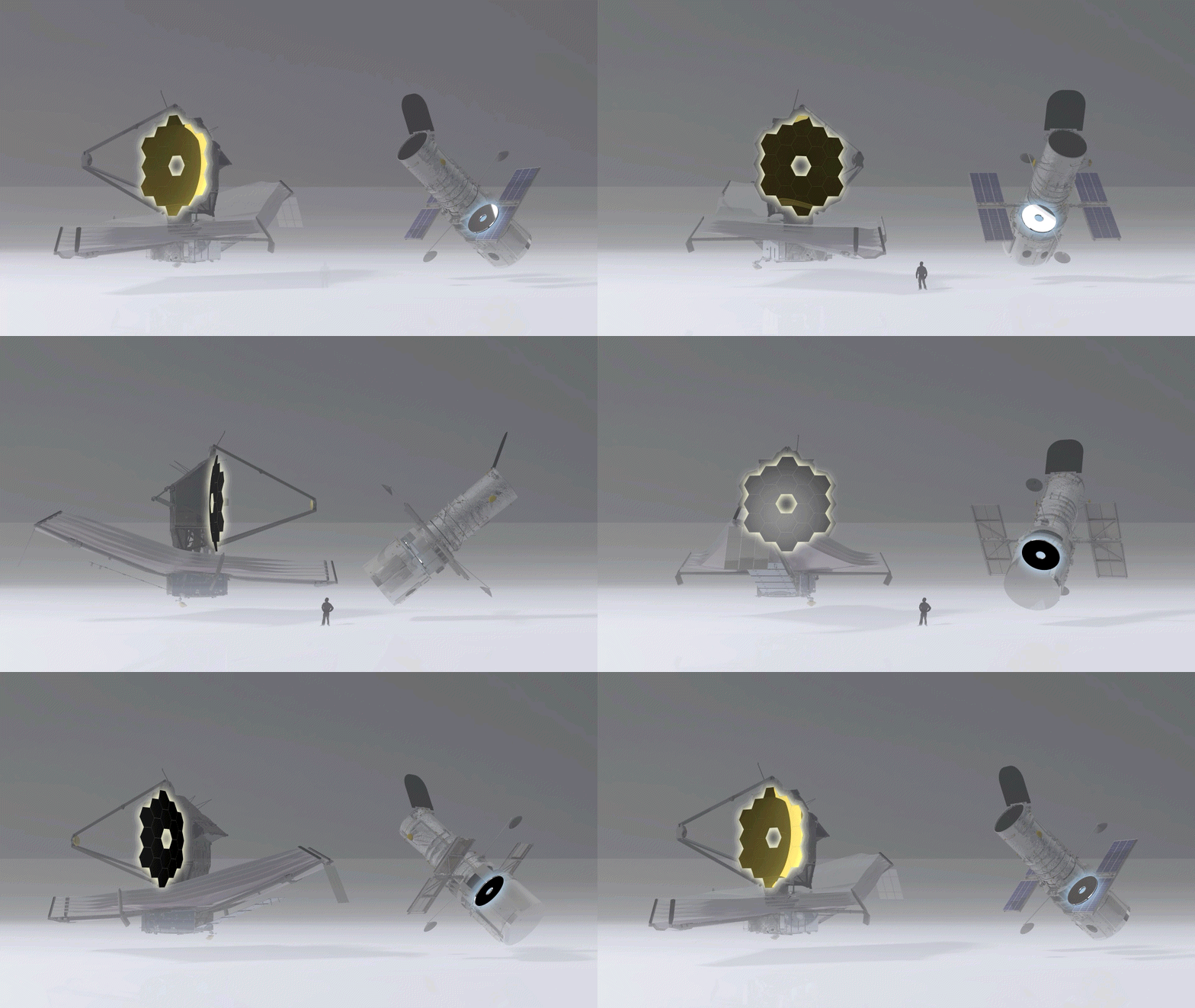
This animation shows the size difference between Webb and Hubble, with their primary mirrors highlighted and a human in the center for scale. While Hubble’s mirror is 2.4 meters in diameter, Webb’s hexagonal mirror is 6.6 meters across. That’s more five times the surface area to collect light! Credit: NASA Goddard Space Flight Center
Bigger is better! Webb’s primary mirror is about six times bigger than Hubble’s. Having a larger mirror means being able to collect more light which allows Webb to see much further objects and with more resolution than we’ve ever seen before. Webb can see so far that it is expected to see galaxies that formed as far back as a quarter million years after the Big Bang.
Fun fact: Despite being several times larger than Hubble’s, Webb’s primary mirror is actually lighter in weight. It is made of beryllium, a metal which is very strong for its weight, good at holding its shape across a range of temperatures, a good conductor of electricity and heat, and is not magnetic.
Why is the primary mirror segmented into hexagons? James Webb Space Telescope’s primary mirror was simply too large to fit inside any currently existing rockets so it needed the ability to fold itself up into a more compact shape. Their honeycomb like arrangement allows for Webb to have the largest possible reflective surface area to make observations, with the least amount of dead space in between each. It also gives the primary mirror a roughly circular shape which can most effectively focus light into a compact point.
Fun fact: Each hexagon is equipped with a set of actuators that allow for impressively accurate fine-tuning of their position, angle, and even curvature.
Why gold? The answer to this is related to the other main difference between Webb and Hubble:
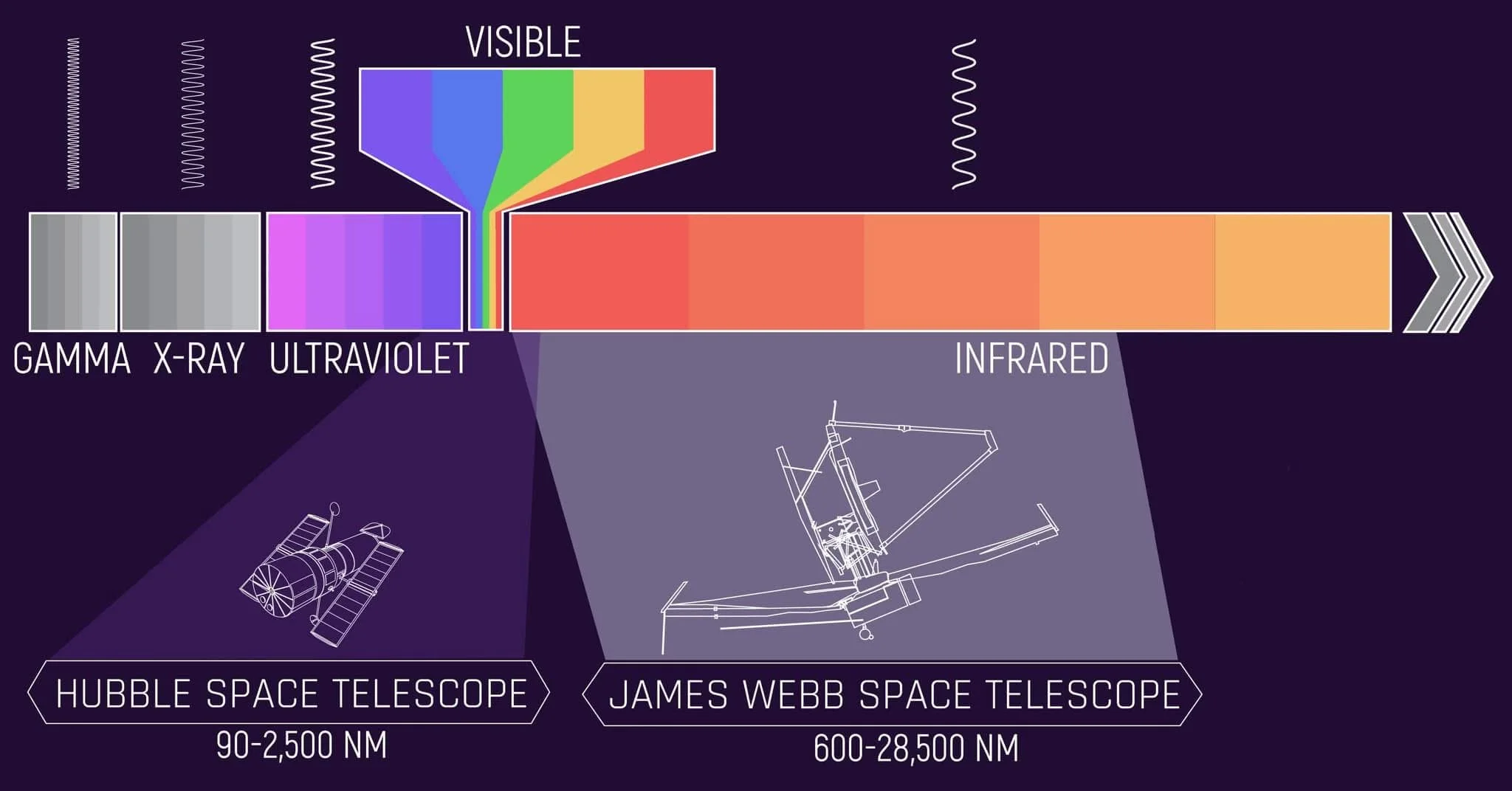
This shows where on the electromagnetic spectrum that Hubble and Webb’s instruments detect light. Hubble is mostly in the visible range while Webb goes much farther into the infrared. Image credit: NASA, J. Olmsted (STScI)
Another primary difference Webb has with Hubble is its focus on a different part of the light spectrum. Whereas Hubble’s main focus is on visible light (as well as a bit into infrared and ultraviolet), Webb’s focus is on the red to mid-infrared part of the spectrum. The thin layer of gold coating on Webb’s primary mirror reflects red and mid-infrared light extremely well.
Fun fact: Astronaut visors are also coated with gold to reflect the powerful solar radiation.
Infrared light has a longer wavelength and can pass through objects in space that visible light is blocked by, such as gas and dust. This is why images taken using telescopes which detect infrared frequencies can pick out objects beyond these clouds, and appear clearer than those taken using other telescopes. This will also allow Webb to focus on infrared-bright objects like extremely old and distant galaxies. This is expected to give us incredible new insight into how the early universe developed.
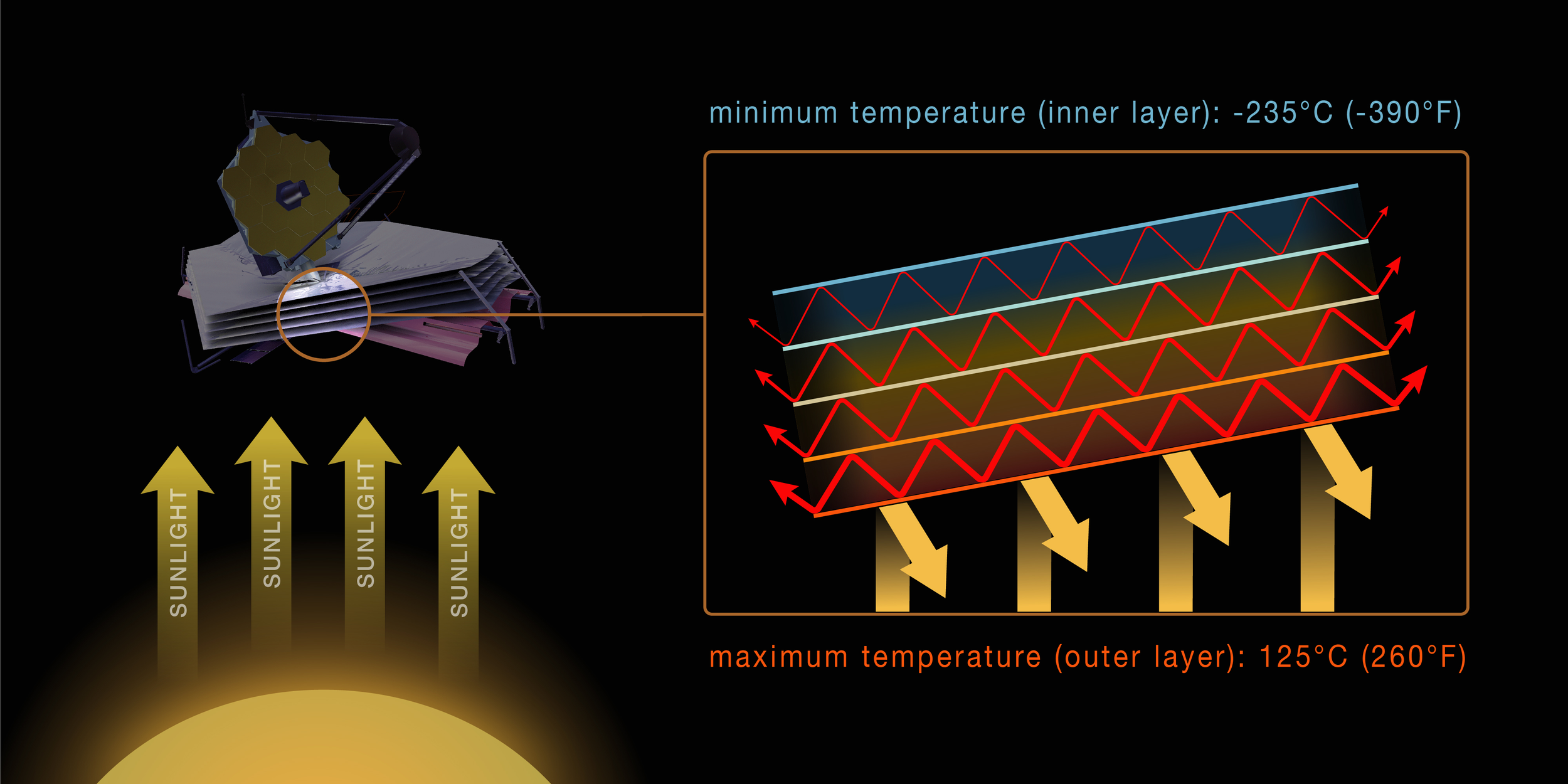
This graphic shows how the five-layer design of Webb’s large sunshield blocks out interfering heat from the Sun, keeping Webb’s mirror in the cold. Image credit: NASA, ESA, CSA, STScI
Because Webb is an infrared telescope, it needs to be kept as cool as possible, as heat sources like the Sun can interfere with its infrared viewing. Mounted under the primary mirror is a five-layered sunshield the size of a tennis court. It is made of a heat-resistant, strong material called Kapton, which is coated in aluminum and silicon.
Fun fact: Kapton is also used to make space blankets and tape. It was also used on the Apollo Lunar Module as thermal insulation.
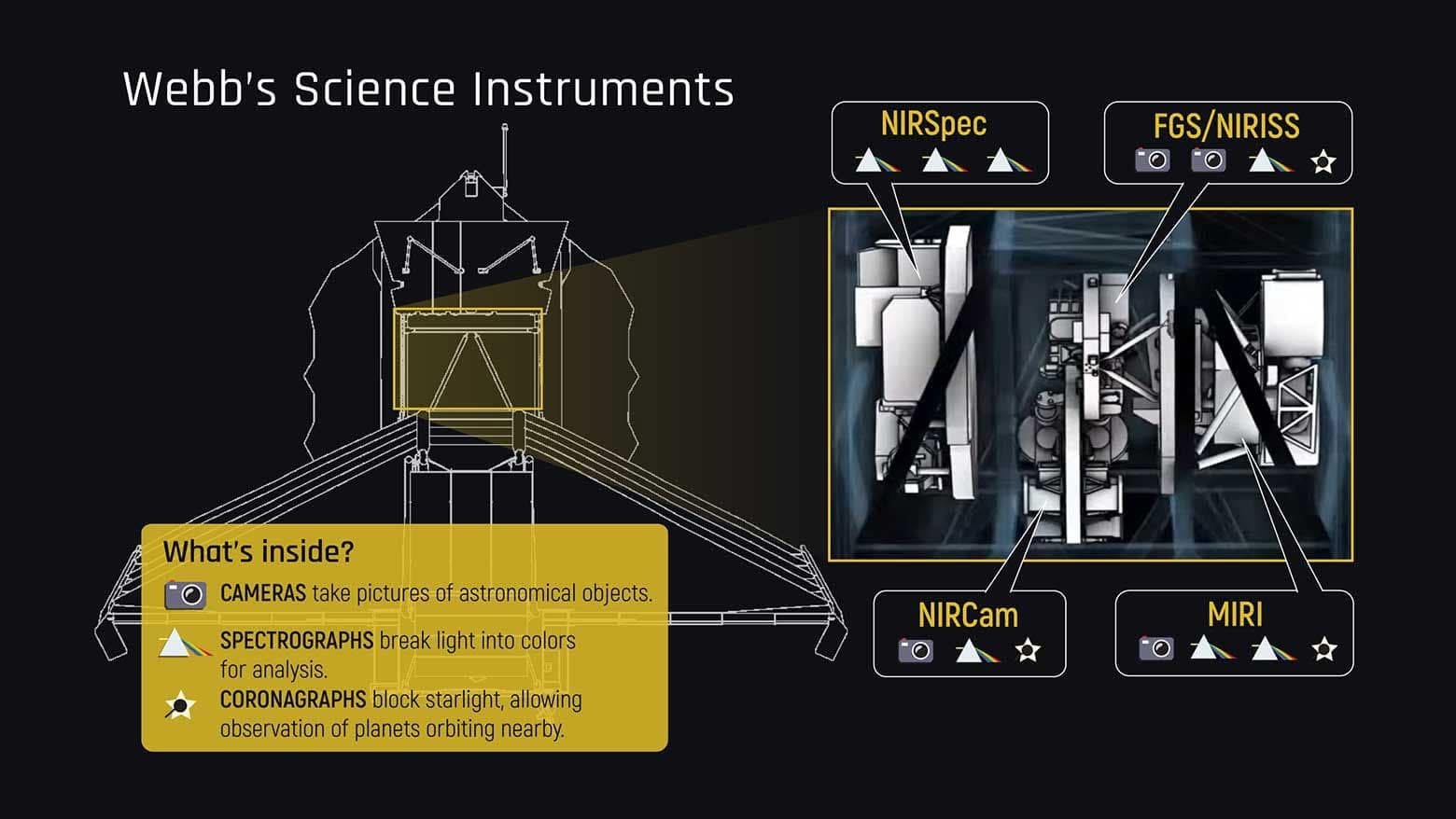
Image credit: NASA, ESA, CSA, STScI
In total, James Webb has four primary instruments for observation. These are like a Swiss Army knife that allow Webb to choose the right tool for the job as it focuses on a wide variety of cosmic objects. These range from high-resolution cameras, spectrographs which can break down light into its component wavelengths, coronagraphs which block the bright lights of stars to better see nearby objects like exoplanets and debris disks.
🔸Near-Infrared Camera (NIRCam)
🔸Near-Infrared Spectrograph (NIRSpec)
🔸Mid-Infrared Instrument (MIRI)
🔸Fine Guidance Sensors/Near-Infrared Imager and Slitless Spectrograph (FGS/NIRISS)
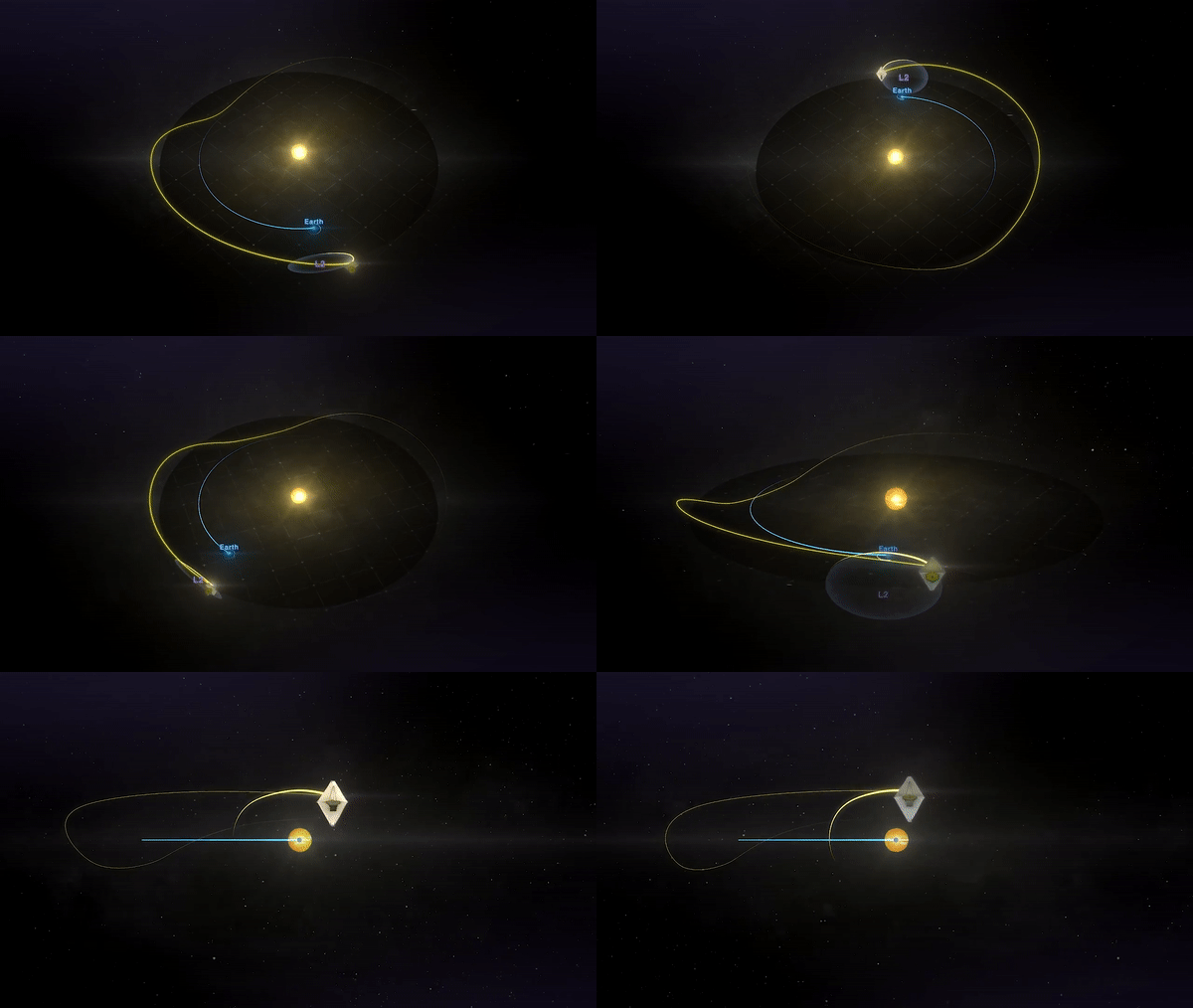
This animation shows an exaggerated version of Webb’s path around the Sun at L2. Image credit: NASA Goddard Space Flight Center
Webb is not in a low orbit around the Earth, like Hubble is. It is actually 1.5 million km away in orbit around the Sun in what is called the Sun-Earth Lagrange Point 2 (L2). Lagrange Points are various regions of space around any two massive celestial bodies in which their competing gravity finds an equilibrium and allows objects to natural find a stable orbit within. What’s special about the L2 orbit is that it lets Webb follow the Earth as it moves around the Sun, while keeping both the light and heat from both blocked by its large sunshield.
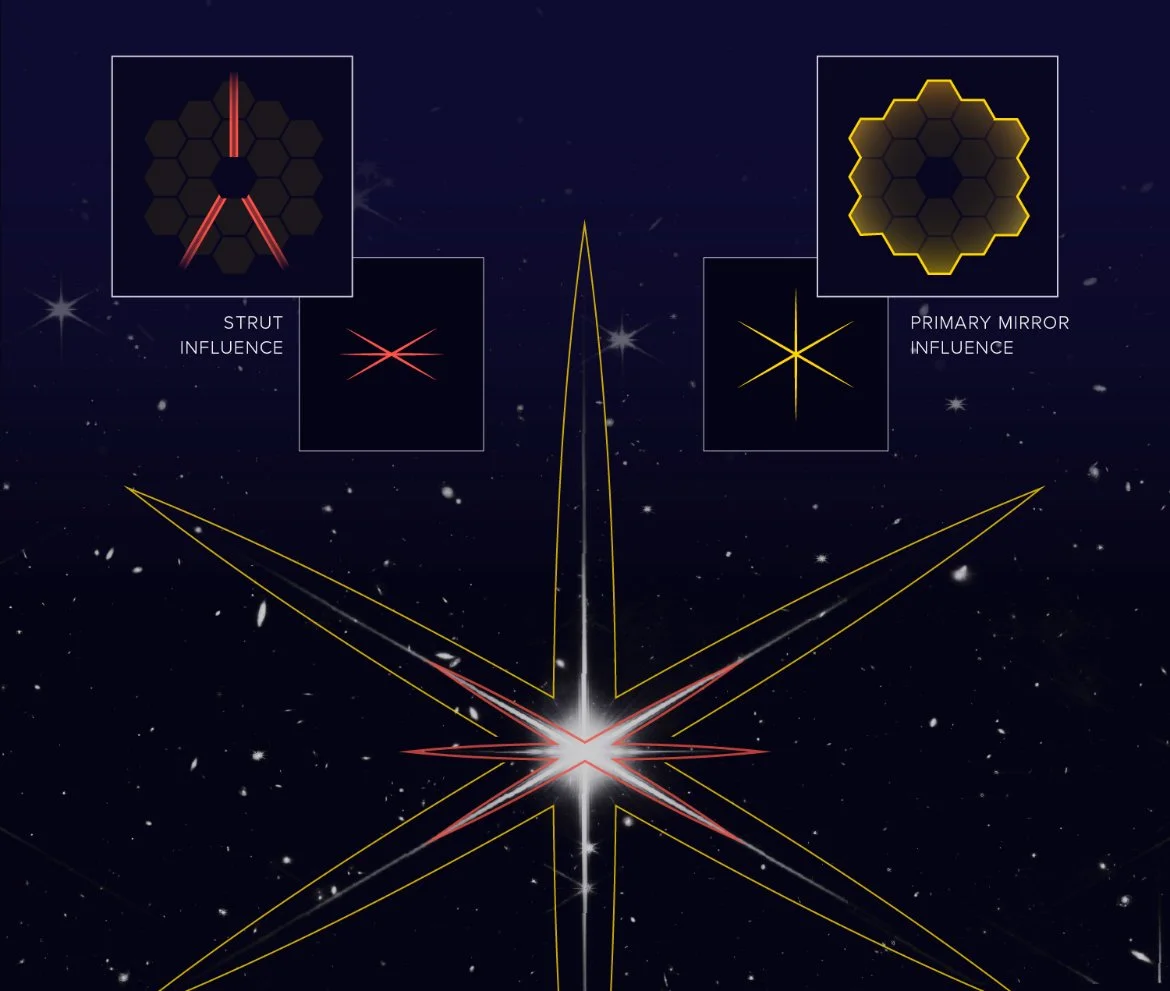
On the left you can see how the struts holding the secondary mirror contribute to the diffraction pattern. On the right you can see how the hexagonal shape of the primary mirror contributes to the diffraction pattern. Together they combine to create a single pattern of six prominent spikes around sufficiently bright points of light. Image credit: NASA, ESA, CSA, Leah Hustak (STScI), Joseph DePasqale (STScI)
Images from Webb can be recognized by the six diffraction spikes that protrude from stars and other significantly bright objects. Diffraction spikes are patterns produced as light bends around the sharp edges of surfaces on a telescope. These six spikes correspond with Webb’s six-sided hexagonal primary mirror and its three-pronged strut that holds the secondary mirror.
What follows is a small but exceptional selection of the vistas and phenomena that Webb has brought to us during each year of operation. Each of the following images has the name of the target and the date of the image’s release.
This article covers Webb’s fourth year of operation. You can view its first through third year selection of images here.
WEBB’S FOURTH YEAR
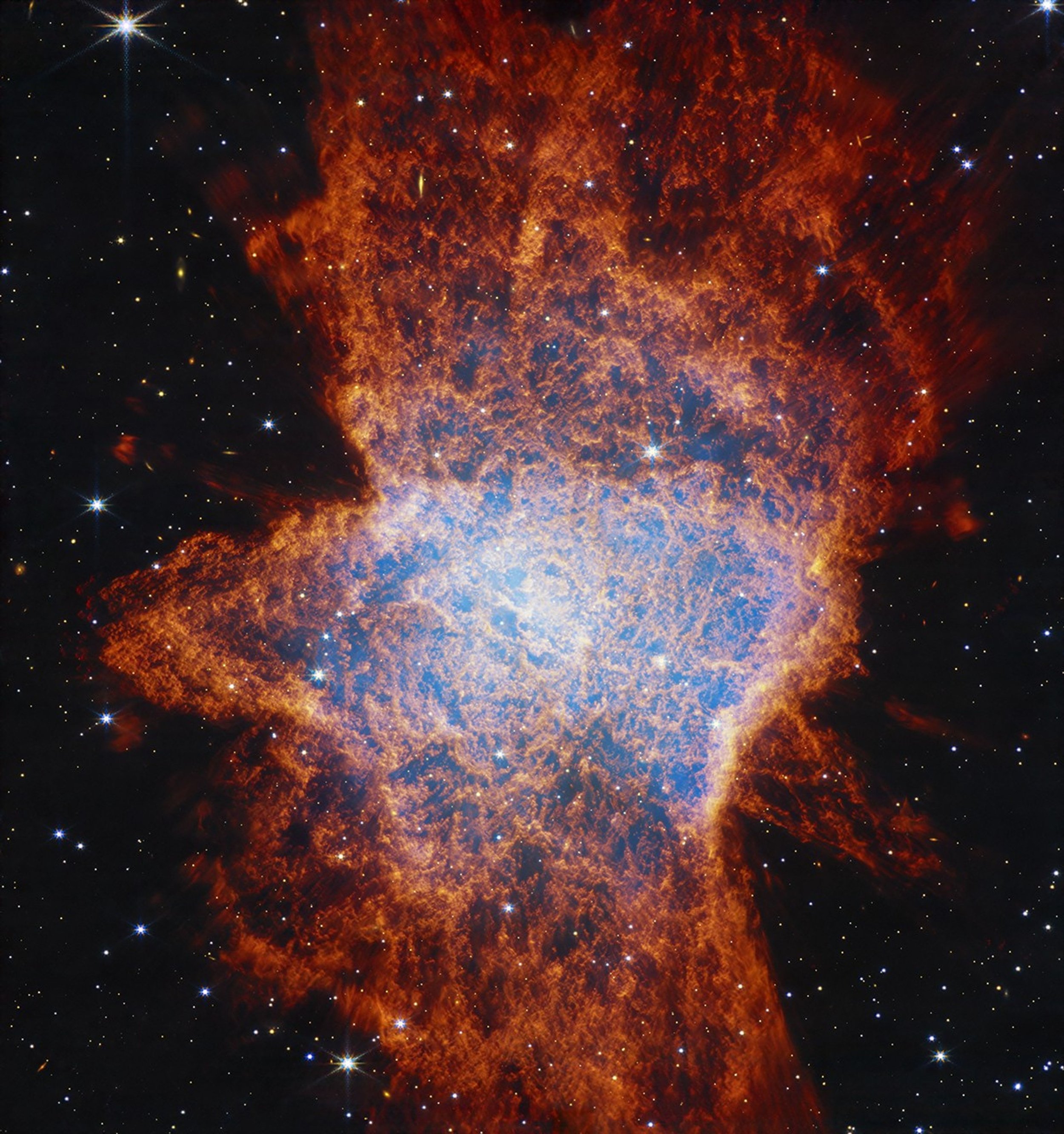
NGC 6072
July 30, 2025
Near-infrared
Kicking off Webb’s fourth year of astrophotography is a detailed look at a planetary nebula, the glowing shell of gas left behind by a dying low-mass star. As these stars exhaust their fuel, they gradually shed their outer layers, exposing the hot core. Intense ultraviolet radiation from the core ionizes the surrounding gas, causing it to glow like an aurora. Because this material is typically expelled in all directions, planetary nebulae often resemble spherical bubbles. NGC 6072, however, has been sculpted into a far more chaotic shape, resembling splattered paint on canvas. The blue central region seen in this near-infrared image marks gas heated by the intense radiation of the central white dwarf, while the cooler outer regions glow red. Multiple outflows from the dying star have also produced the nebula’s distinct lobes.
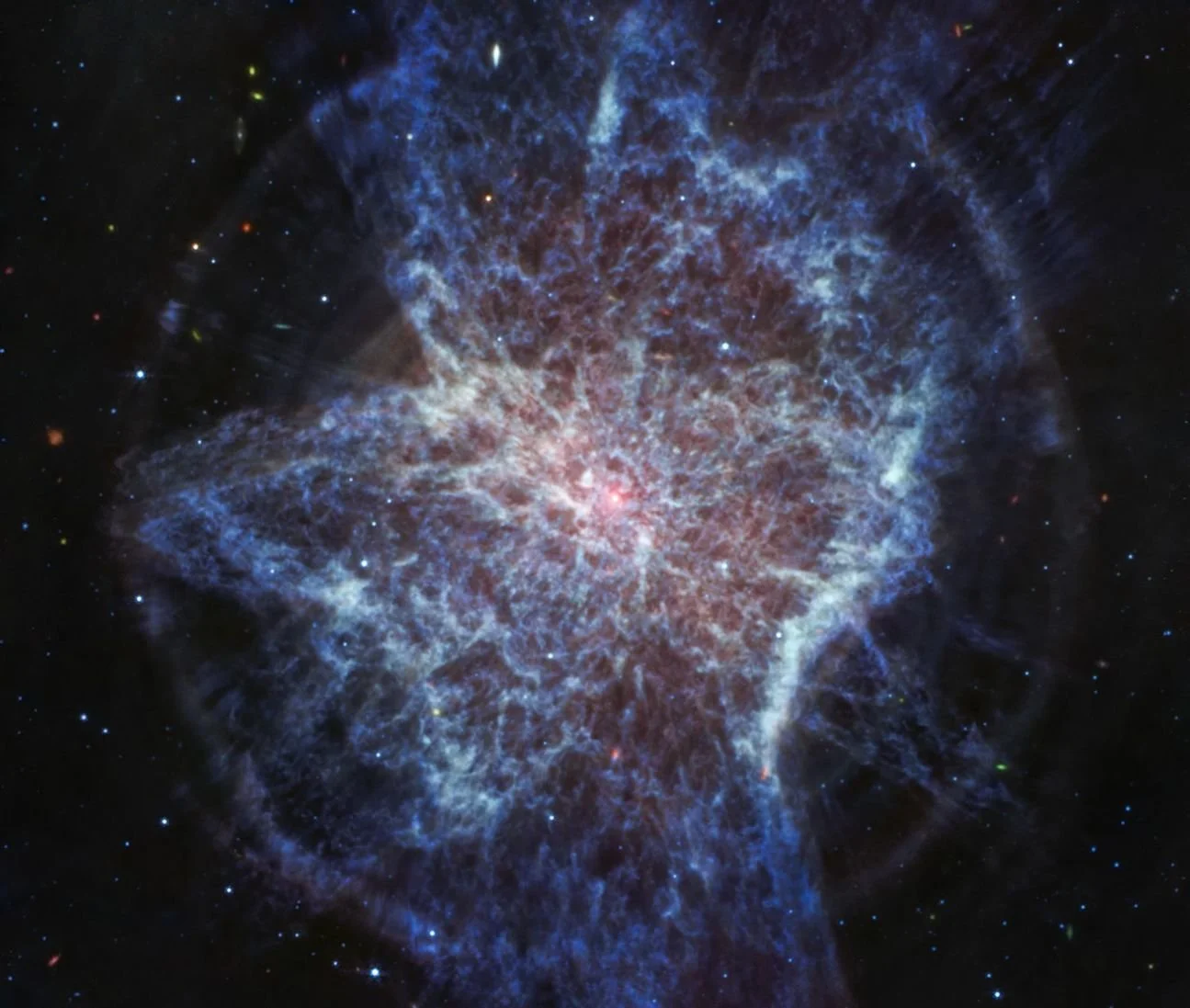
Mid-infrared
Viewed through a mid-infrared filter, NGC 6072 reveals several hidden features. At its center, the white dwarf appears as a pinpoint of pink light. This is exactly the kind of object Webb’s infrared sensors excel at uncovering through thick clouds of gas and dust. More striking are the multiple concentric rings radiating outward. The outermost ring is the easiest to see, but several fainter inner rings are also visible. Astronomers believe these rings, along with the nebula’s lopsided shape, are evidence of a companion star whose orbit has disturbed the expanding gas.
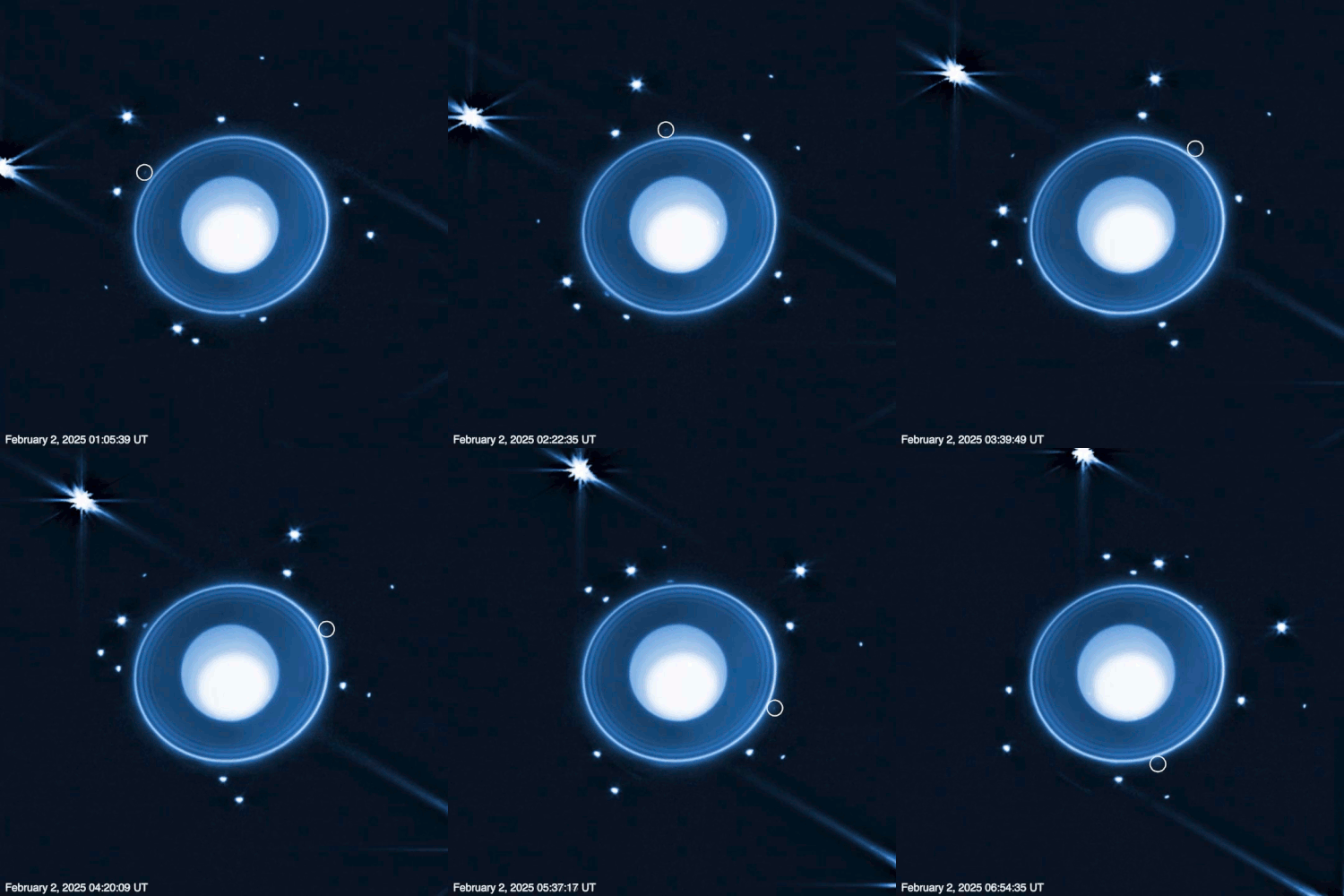
NEW URANIAN MOON
August 19, 2025
A previously unknown Uranian moon was identified in long-exposure infrared images taken by James Webb early in 2025, orbiting just beyond the planet’s outermost ring. The object, which is currently designated Uranus XXVIII, brings the planet’s total to 29 known moons. It belongs to a group of small inner moons closer to the planet than the major satellites, like Titania. Based on its brightness and assumed icy, high-albedo surface, it is estimated to be about 10 km (6 miles) across, likely too small for Voyager 2 to have detected during its 1986 flyby. The International Astronomical Union will assign an official name, traditionally drawn from characters in the works of William Shakespeare or Alexander Pope. The timelapse above shows the moon’s orbit around Uranus.
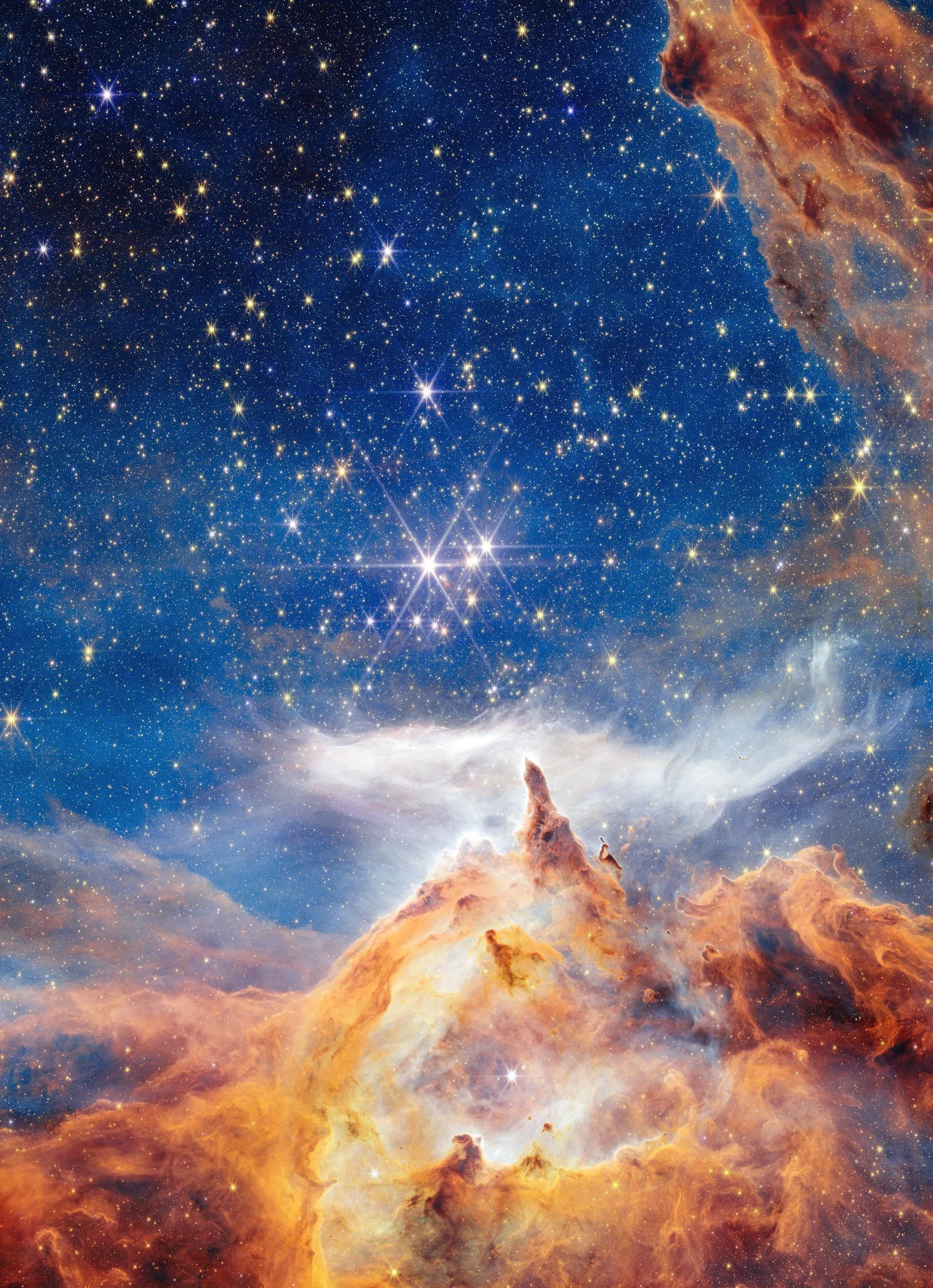
PISMIS 24
September 4, 2025
This colorful image is reminiscent of Webb’s iconic 2022 “Cosmic Cliffs,” showcasing another active star-forming region within a vast emission nebula. Here, Webb captures the Lobster Nebula (NGC 6357), located about 5,500 light-years away in the constellation Scorpius. The bright stars at the center, marked by Webb’s distinctive diffraction spikes, are among the most massive known. Their blistering stellar winds have hollowed out a vast cavity, compressing the surrounding gas and dust into towering, sculpted ridges. The tallest of these spires rises about 5.4 light years from the bottom of the image.
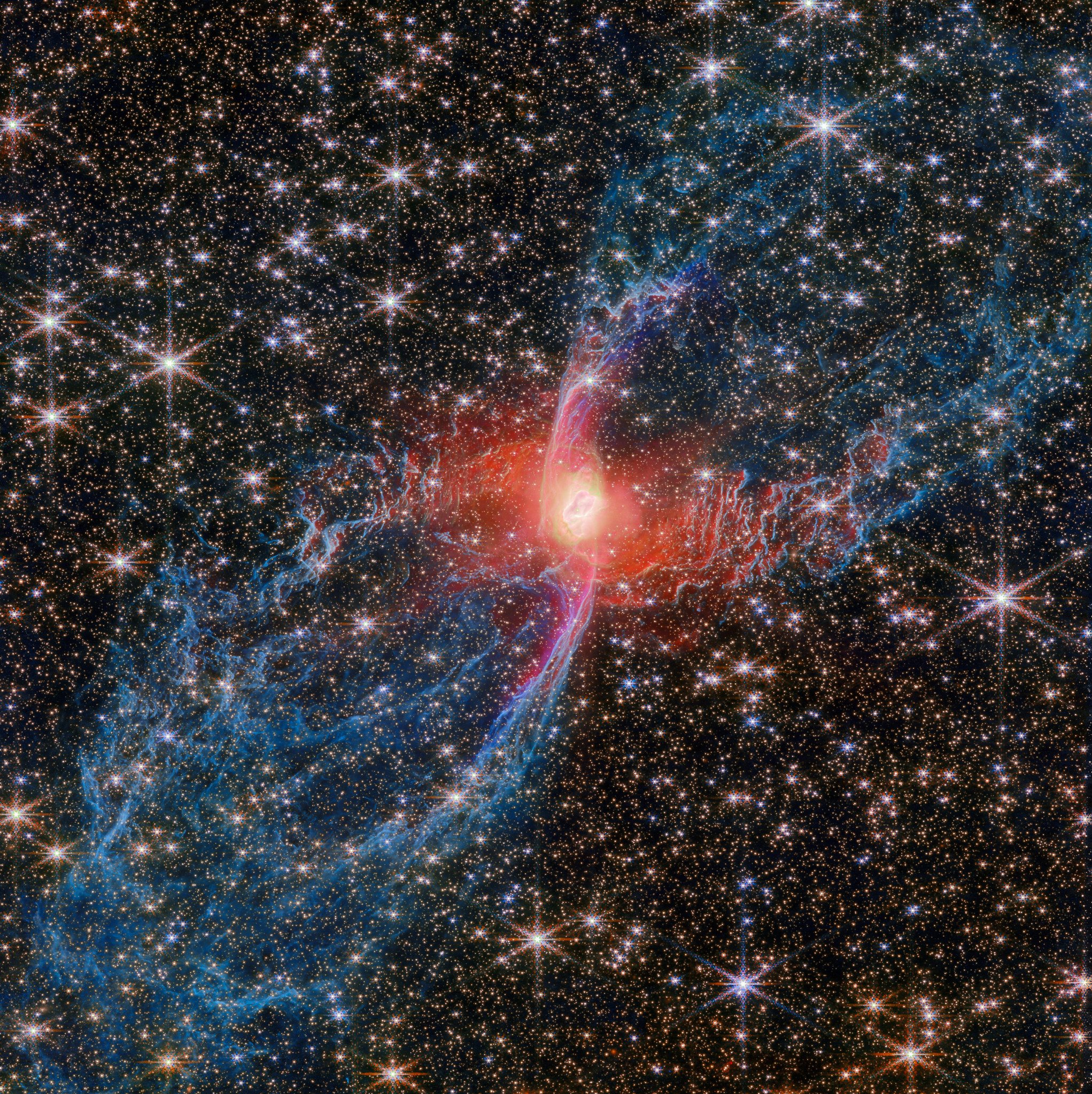
RED SPIDER NEBULA
November 14, 2025
Webb captured another stunning image of a planetary nebula, the expanding shell of gas ejected by a dying star. This one has quite the distinct structure, with blue streams of gas stretching nearly three light-years from the center like the legs of a giant spider. The gas consists mostly of molecular hydrogen. At the center lies the star’s exposed core, now a white dwarf, whose intense ultraviolet radiation causes the surrounding gas to glow. The nebula’s distinctive bipolar structure also hints at a hidden companion star. As the gas expands, the companion’s gravity disrupts its flow, sculpting it into the striking streams and bubbles seen today.
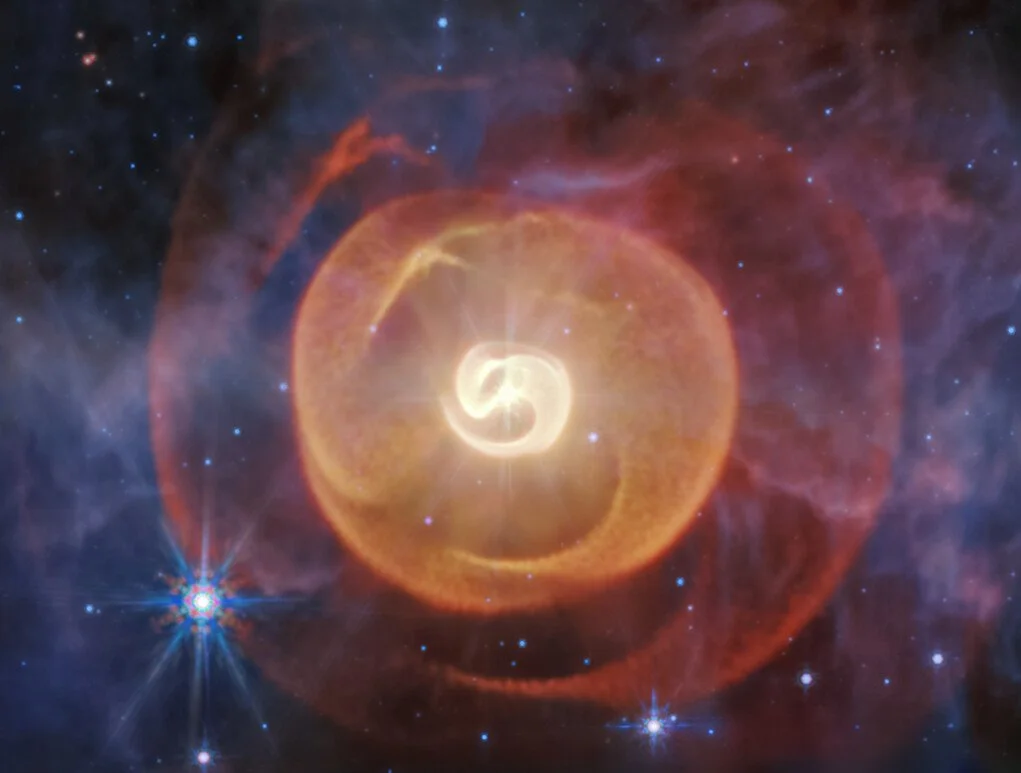
APEP TRIPLE STAR SYSTEM
November 19, 2025
Here’s another example of how the gravity of a multi-star system can craft brilliant designs across the cosmic canvas. While this may look like a planetary nebula, the stars at its center are very much alive. This is actually a vast cloud of carbon-rich dust surrounding a triple star system. Two of the stars are Wolf-Rayet stars, incredibly hot, supermassive stars nearing the ends of their lives. They orbit each other every 190 years in a highly elliptical orbit. During the few decades they spend closest together, they blast each other will powerful stellar winds, blowing huge amounts of carbon dust into space. As the stars orbit, this expanding dust is sculpted by gravity into a series of swirling concentric shells. Farther out, a third supergiant companion orbits the pair in a wide arc and appears to carve holes through the dust shells as it passes.
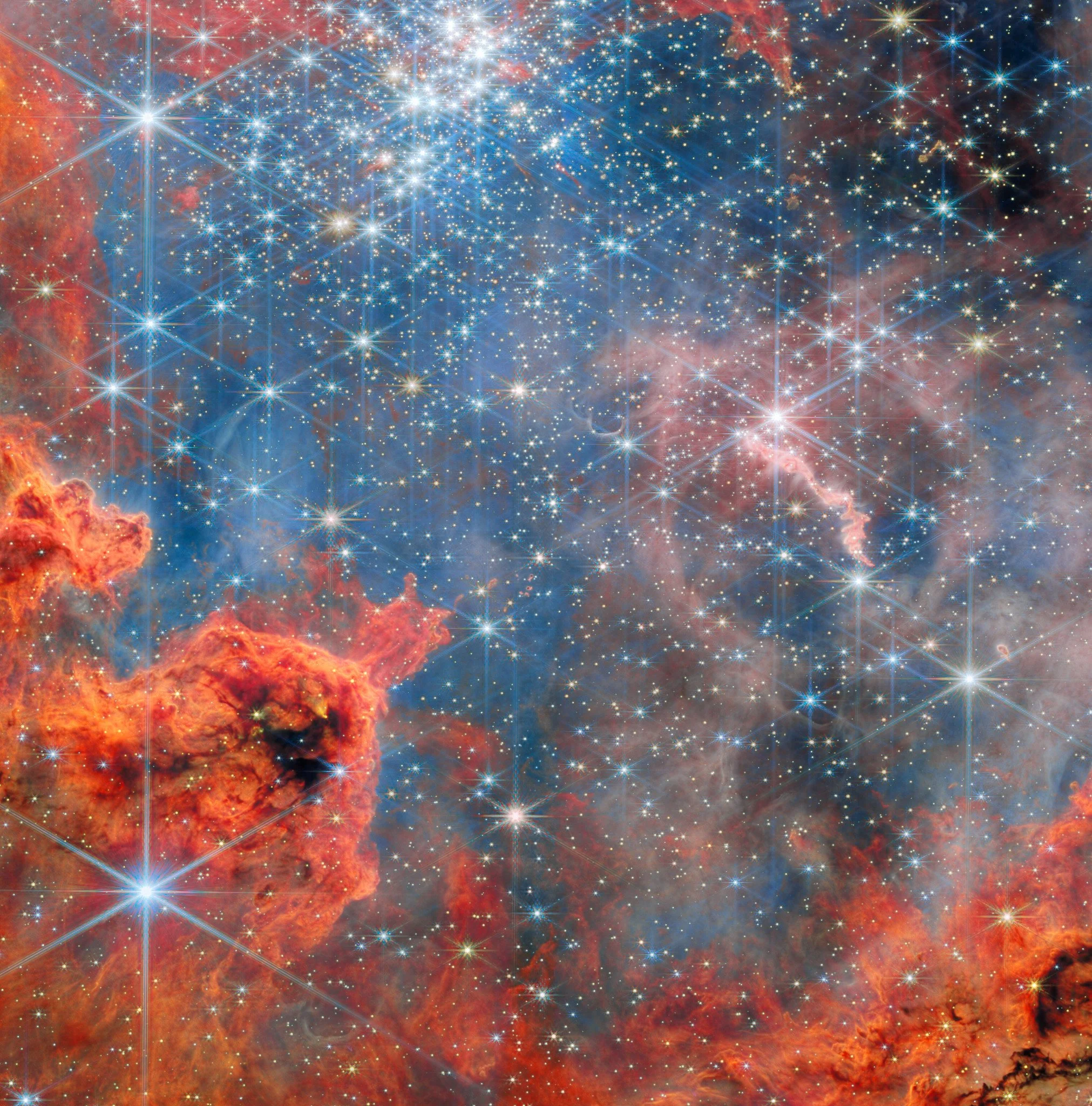
WESTERLUND 2
December 22, 2025
We have another star cluster embedded in a vast nebula called Gum 229, located a whopping 20,000 light years away! Similar to Pismis 24, Westerlund 2 is home to some of the hottest, brightest and most massive stars in the galaxy. The punishing stellar winds of these young stars sculpt the surrounding gas and dust that make up the nebula. What makes this image distinct from Hubble’s 25th anniversary image of the star cluster is the revealing of a full population of brown dwarfs (objects too massive to be planets but not massive enough to be stars).
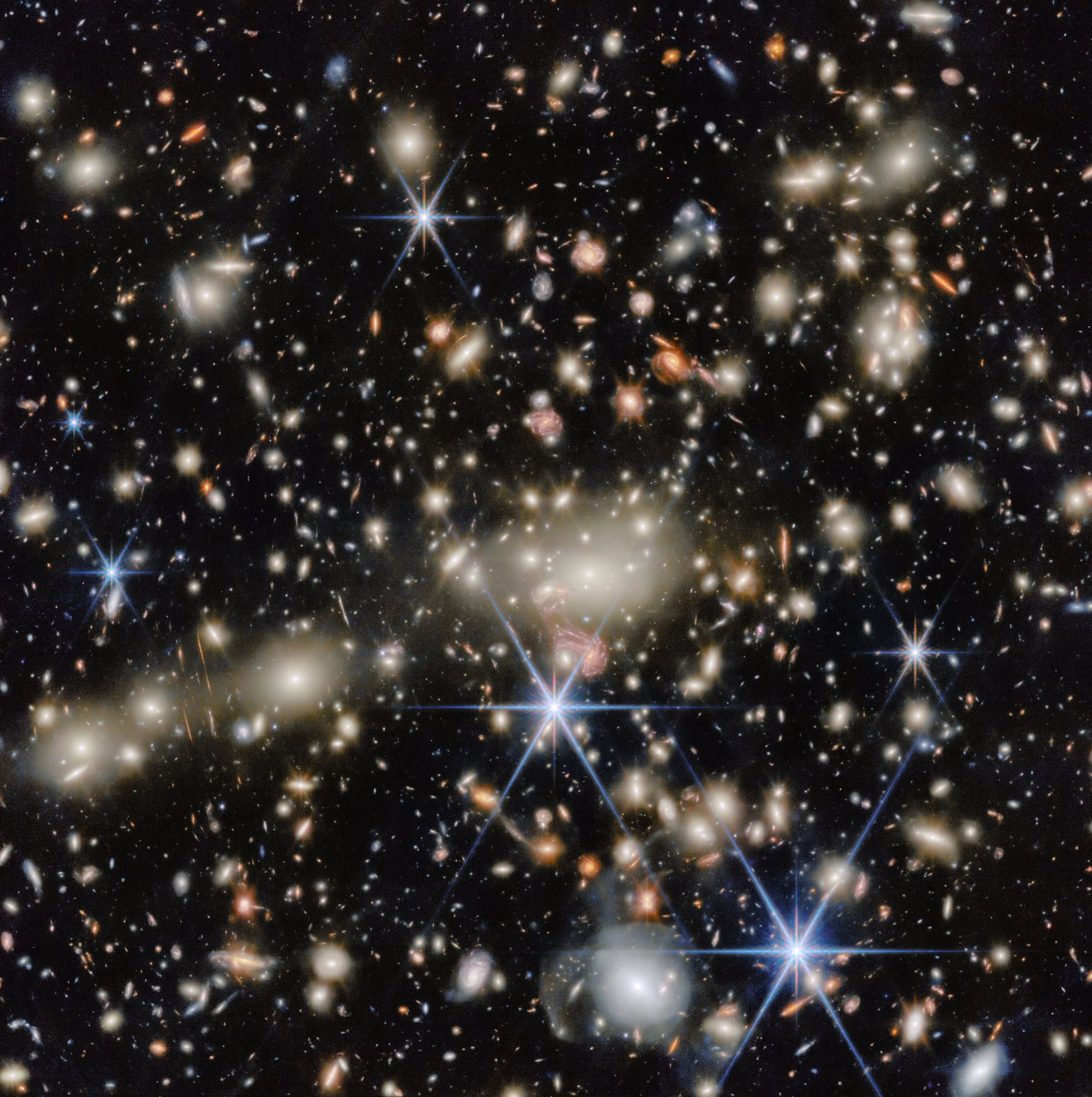
MACS J1149 GALAXY CLUSTER
October 12, 2022
James Webb’s stellar gaze allows it to see profound distances into the smallest patches of sky filled with countless galaxies. This image shows the dense galaxy cluster MACS J1149, located 5 billion light years beyond the Leo constellation. Astronomers have counted no less than 300 galaxies with many more suspected, all gravitationally bound. The combined mass of this cluster actually warps spacetime, causing light from background galaxies to distort and stretch and magnify. This known as gravitational lensing. Can you see the numerous examples of it here?
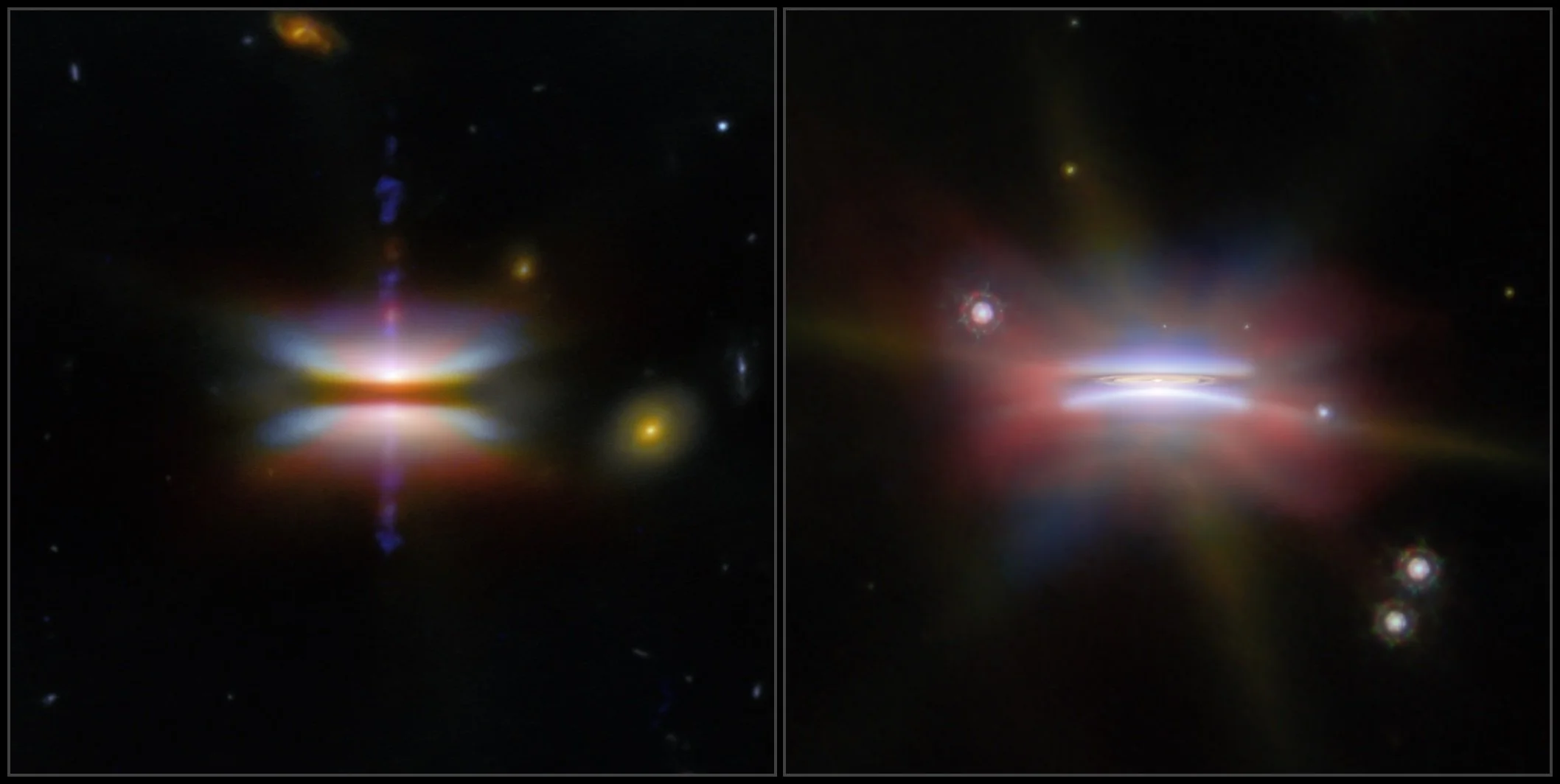
PROTOPLANETARY DISKS
April 3, 2026
This double feature brings us the striking view of two newborn stars hidden within protoplanetary disks. Stars form from the gravitational collapse of massive clouds of gas and dust. As infant stars take shape, the surrounding gas falls inward, spiraling faster and faster. Dust particles constantly collide and change direction until a dominant flow prevails. The material flattens into a swirling disk where asteroids and planets will eventually form.
On the left is Tau 042021 in Taurus. The dark horizontal band is the edge-on protoplanetary disk that hides the protostar, allowing its light to escape only above and below the disk. We can even see twin jets blasting from the star’s polar regions. On the right is Oph 163131 in Ophiuchus. The disk is nearly edge-on, but tilted slightly toward us, revealing the concentric rings within its structure. Surrounding dust scatters the star’s light, creating an ethereal glow around the system.
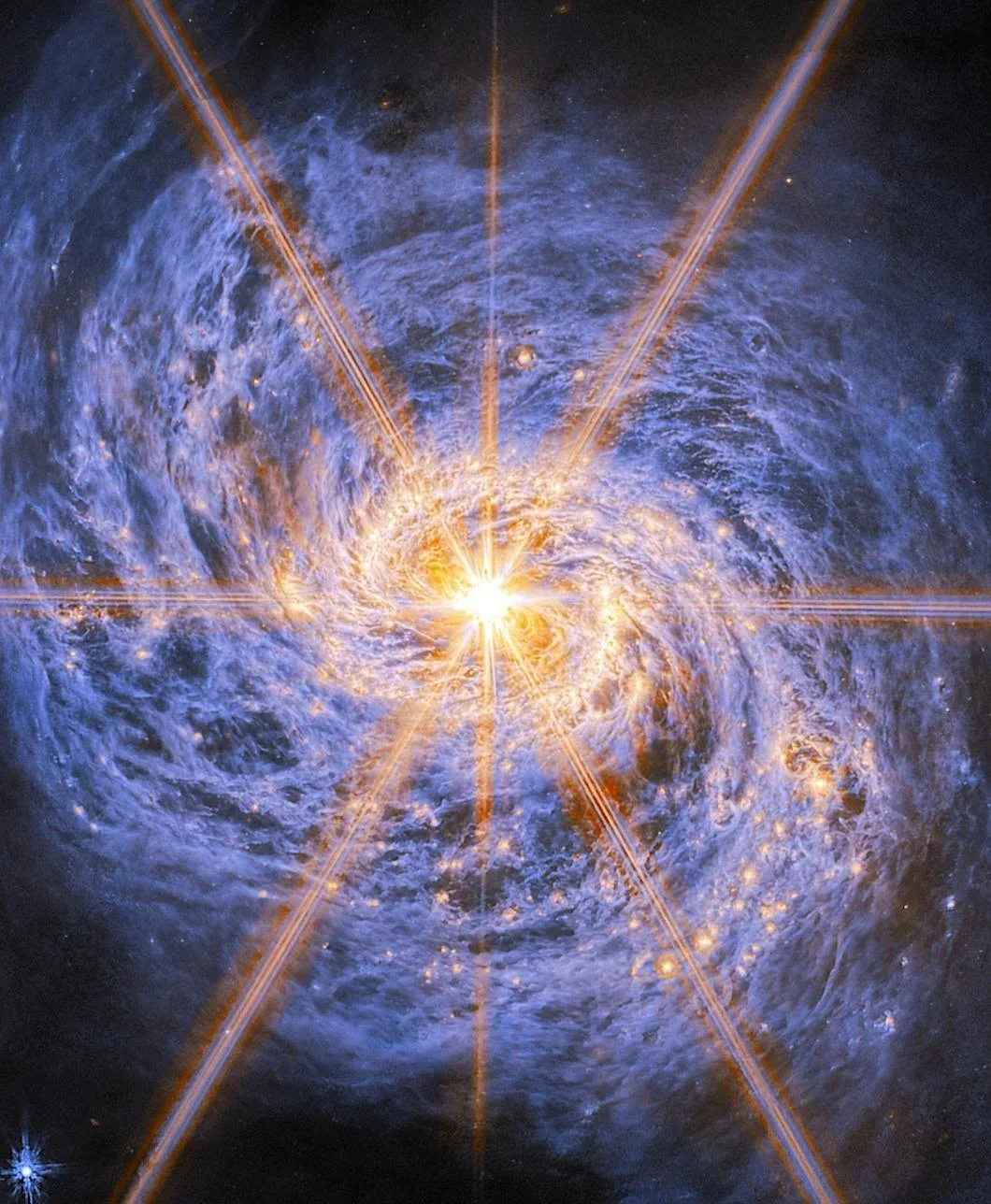
M77
May 7, 2026
This shimmering maelstrom is M77, a barred spiral galaxy located 45 million light years away in the Cetus constellation. Hard to ignore is the orange six-pronged spikes projecting from the center. These are diffraction spikes caused by intense light interacting with the hexagonal shape of Webb’s mirror. The spikes are so prominent because of the sheer radiance of the hot accretion disc churning around M77’s central supermassive black hole. These unusually luminous regions in galaxies are called active galactic nuclei (AGN).
Infrared light has an easier time piercing through thick dust than visible light. This makes Webb an excellent hunter of newborn stars which are often cloak and swirling gas. This image not only accentuates the breadth of the galaxy’s complex dust filaments, but reveals the numerous star clusters cocooned inside, seen as scatterings of glowing orange bubbles embedded.
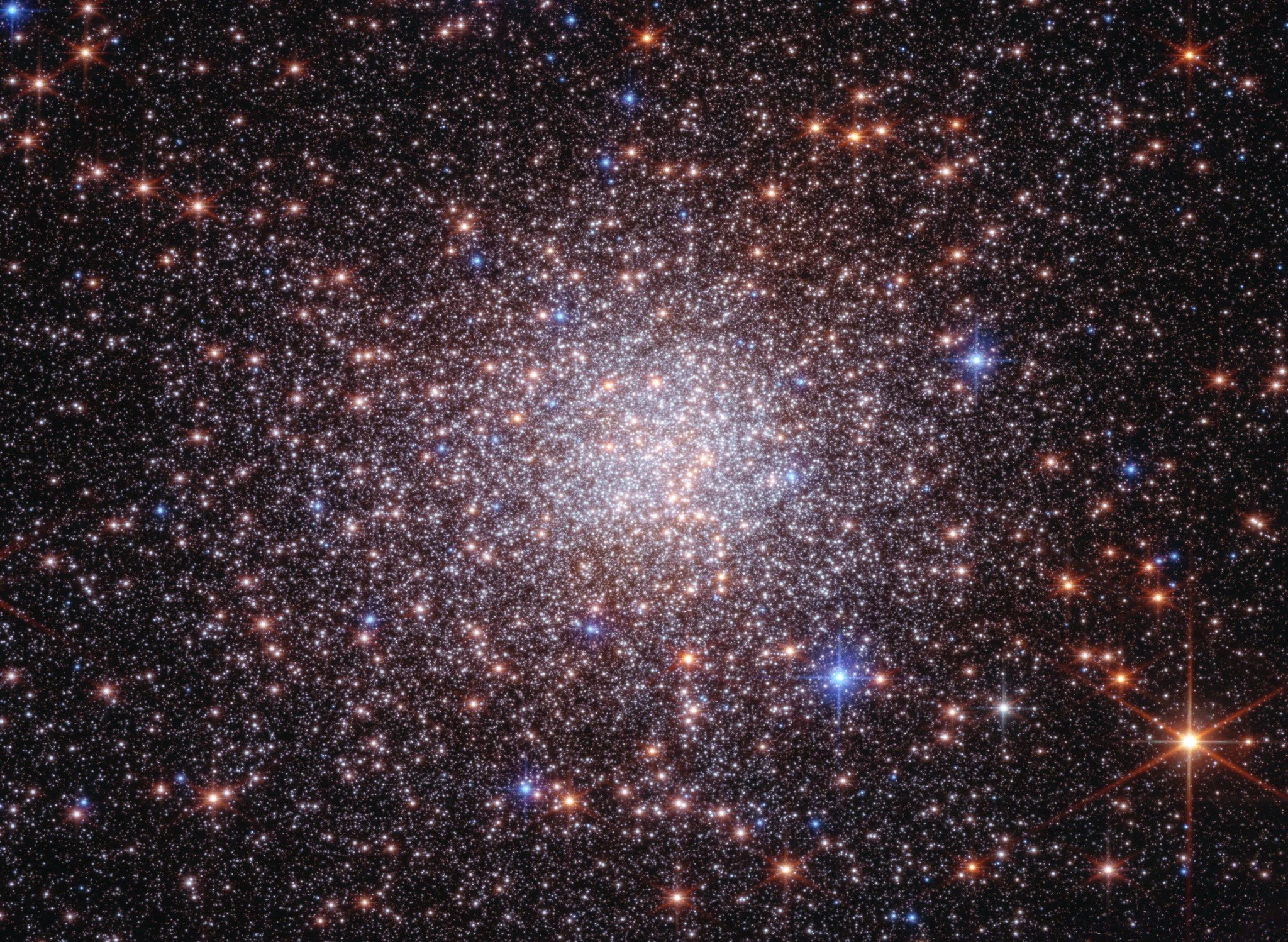
TERZAN 5
June 16, 2026
James Webb and Hubble joined forces to capture this distant star cluster, located about 22,000 light-years away in the Milky Way’s bulge toward Sagittarius. Once thought to be a typical globular cluster due to its dense, spherical shape, it has since been reclassified after spectral analysis revealed multiple generations of stars ranging from about 2.5 billion to 12.5 billion years old, distinguished by their differing metal content. This unusual mix suggests the cluster did not form in a single event, but instead may have assembled stars over time, possibly as the remnant core of a disrupted dwarf galaxy in the chaotic galactic center. As a result, Terzan 5 is now considered a “fossil fragment,” preserving a layered record of the Milky Way’s complex history.
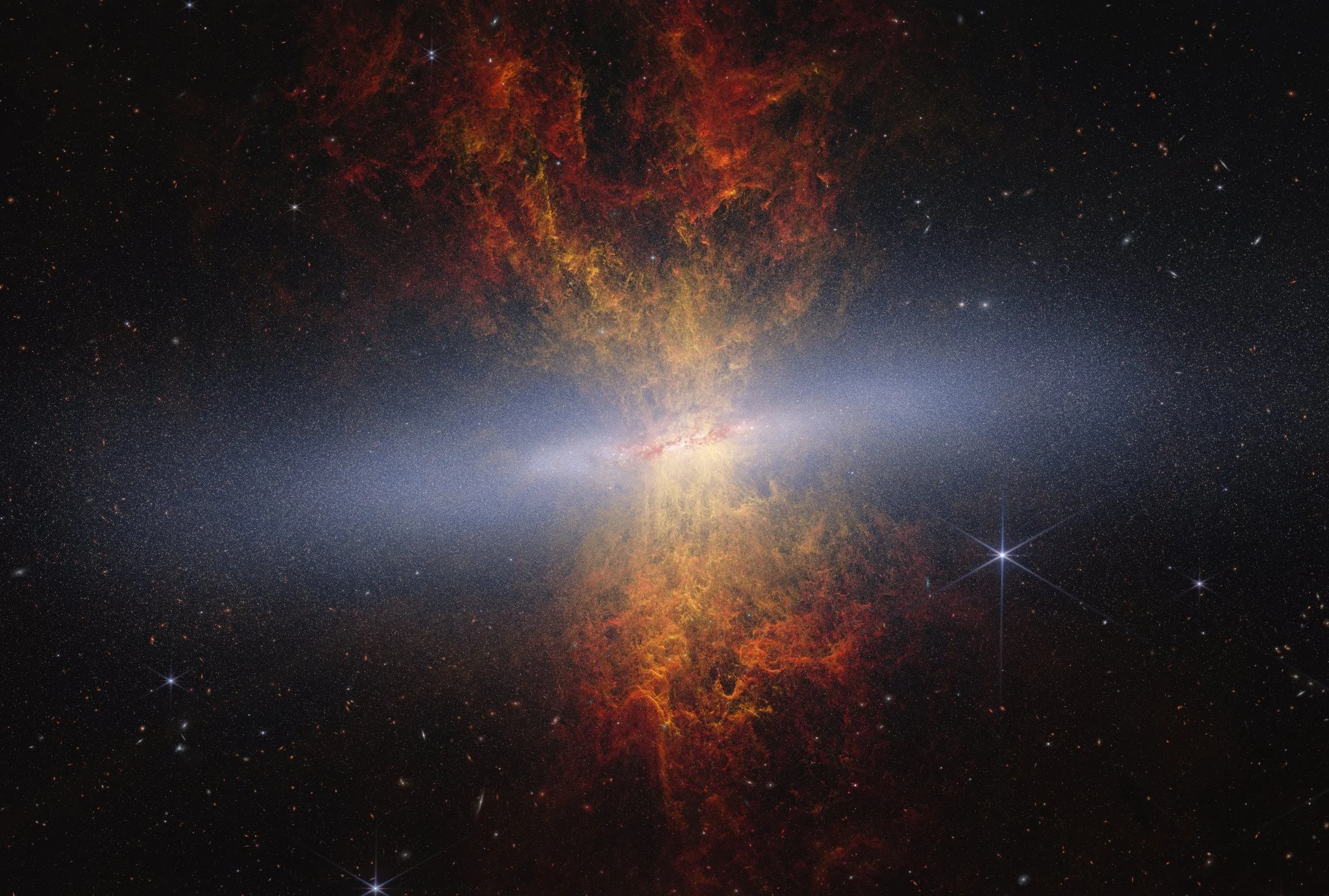
CIGAR GALAXY (M82)
June 23, 2026
James Webb returns its sights to the Cigar Galaxy, a peculiar figure that is ever-present in Maryland’s northern skies. this time James Webb was able to spend a prolonged time gathering infrared light from within M82’s dusty halo. This has allowed Webb to reveal an unprecedented 16.5 million stars. The Cigar Galaxy is of interest to astronomers due to its unusual appearance. While it may look like an amorphous blob, it is actually a spiral galaxy seen edge-on (the hazy white region). Gravitational interactions with the nearby Bode’s Galaxy (M81) have not only curled its galactic disk, but has triggered violently intense amounts of star formation. This has earned M82 the classification of starburst galaxy. It forms stars at ten times the rate of our Milky Way, causing it to be incredibly bright. Its massive stars and their resultant supernovae have blown out so much stellar wind that it has created these expansive dual plumes of gas and dust (shown in red).
This article covers Webb’s fourth year of operation. You can view its first through third year selection of images here.