
Eye Astronomy #14: Motion Overhead
by Dale E. Lehman
Everything in the sky from clouds to stars is in constant motion. On average, stars in our galaxy have velocities of 100 kilometers per second (nearly 224,000 miles per hour), and the fastest stars—called hypervelocity stars—move ten times faster, well over 2 million miles per hour! Yet star maps change very slowly. Why is that?
For one thing, stars are so far away, it takes thousands of years for human eyes to notice any significant shift in their positions. For another, objects in space move in three dimensions, but the sky is a 2-dimensional surface. Not even a hypervelocity star moving straight away from us would change position in the sky. The component of a celestial object’s motion on the sky is called proper motion, while the component towards or away from us is called radial velocity.
Stars have very small proper motions. The moon and the planets are another story. The moon orbits the Earth, traversing a full 360 degrees in about a month. So the moon slips eastward by about twelve degrees each day (360 degrees divided by 30 days; not exactly right but close enough for eye astronomy work). That twelve degrees per day eastward is the moon’s proper motion.
Twelve degrees is a good chunk of sky. You can see this using just your hand. Stretch out your arm and use the following gestures to determine rough measurements:
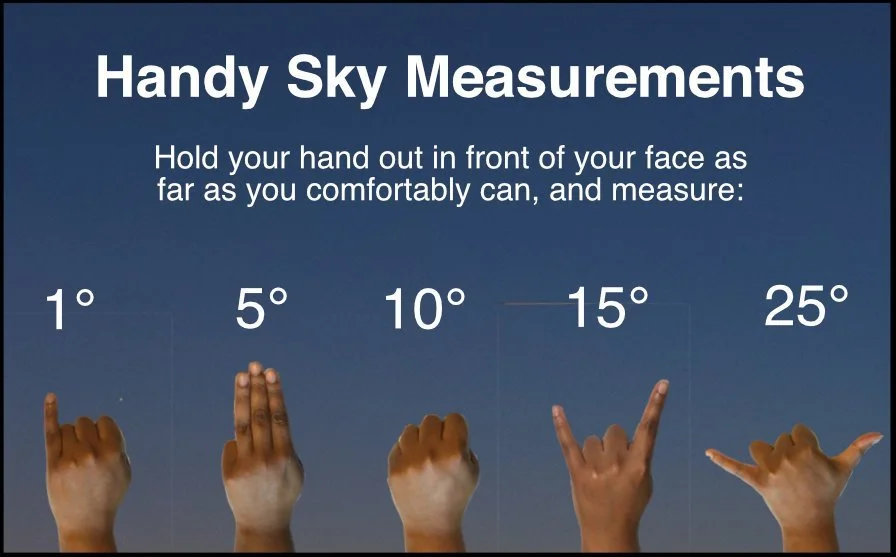
Image from Night Sky Network, https://nightsky.jpl.nasa.gov/news/236/
When you do this, you’ll agree, the moon fairly races across the sky. Indeed, no other celestial object moves anywhere near that fast. (Meteors don’t count. Those aren’t true celestial objects. They are nature’s own space junk burning up in Earth’s atmosphere.) The next fastest “runners” are the planets. They have average proper motions as follows:
· Mercury: 1.3 degrees per day
· Venus: 0.6 degrees per day
· Mars: 0.5 degrees per day
· Jupiter: 0.08 degrees per day
· Saturn: 0.03 degrees per day
The first three move at a walking pace. Jupiter and Saturn crawl through the zodiac. You won’t much notice their movement unless you pay attention over the course of weeks.
Consider Saturn. As of mid-September, 2025, Saturn rises at about 8:00 PM Eastern Daylight Time and sets around 8:00 AM the next morning. It’s currently in the constellation of Pisces, just below said fish’s head:
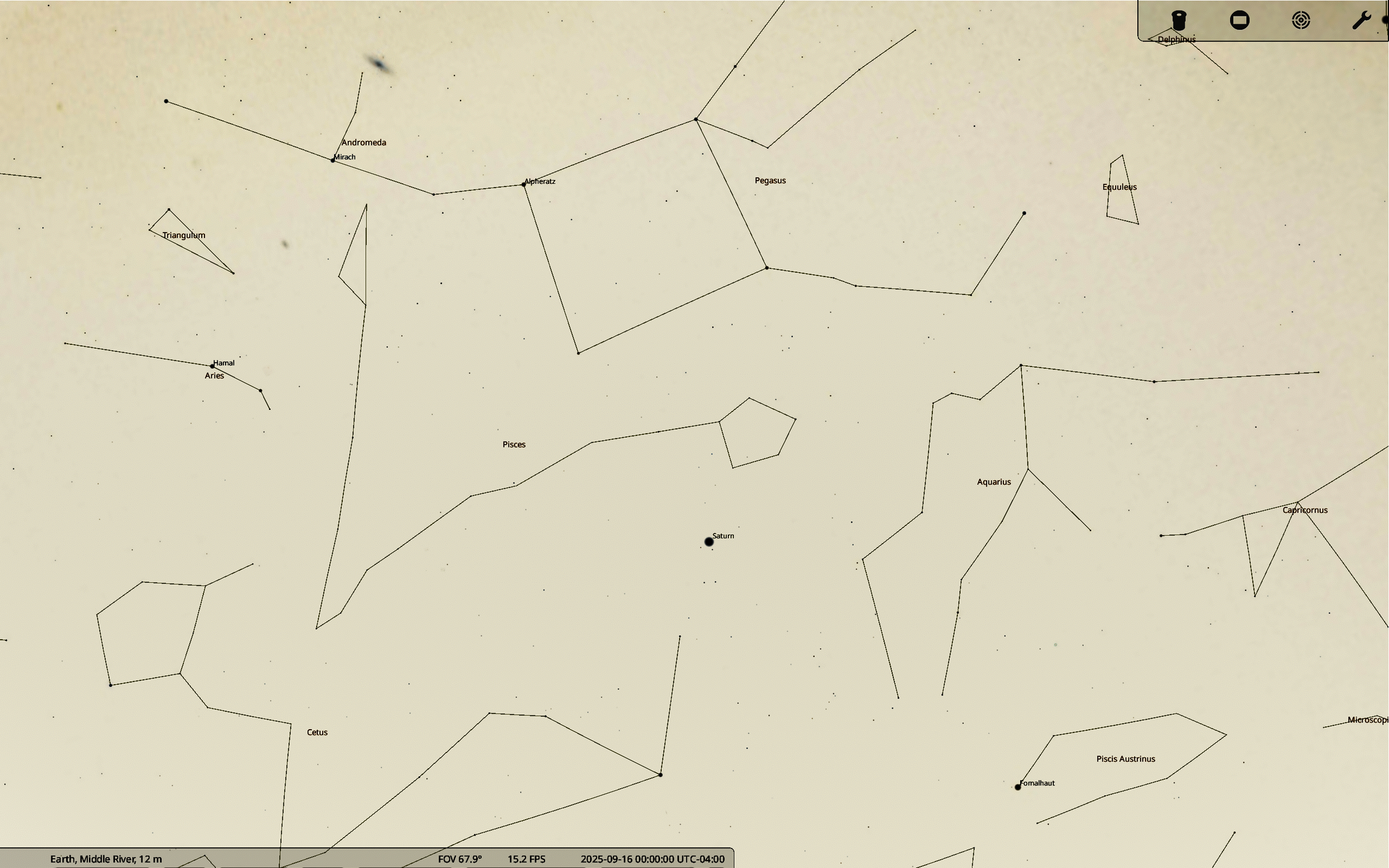
Pisces is faint—its brightest star is only magnitude 3.6—so you may not find it easily or at all unless you enjoy reasonably dark skies. But Saturn stands out at magnitude 0.6 right now. Just face the right direction and you’ll see it.
Now, how slow does Saturn move? Very! In fact, it will remain in Pisces until late February, 2028, when it enters Ares. Its snail’s pace is slowed even more every time Earth passes it. Whenever that happens, Saturn spends over four months appearing to move backwards! Yes, backwards. Every planet does this from time to time. Here’s why.
Each planet orbits the sun at its own speed. Mercury and Venus, being closer to the sun, move faster than Earth. Mars and the other outer planets move slower. Think of all these orbs as runners racing around a (mostly) circular track. Because the inner planets move faster and have smaller orbits, they overtake and lap the Earth every so often, while Earth itself laps the pokier outer planets. Each time we pass one of the outer planets, it appears to move backwards for a time.
Astronomers call this backwards motion retrograde. Right now, Saturn is in the retrograde portion of its path.
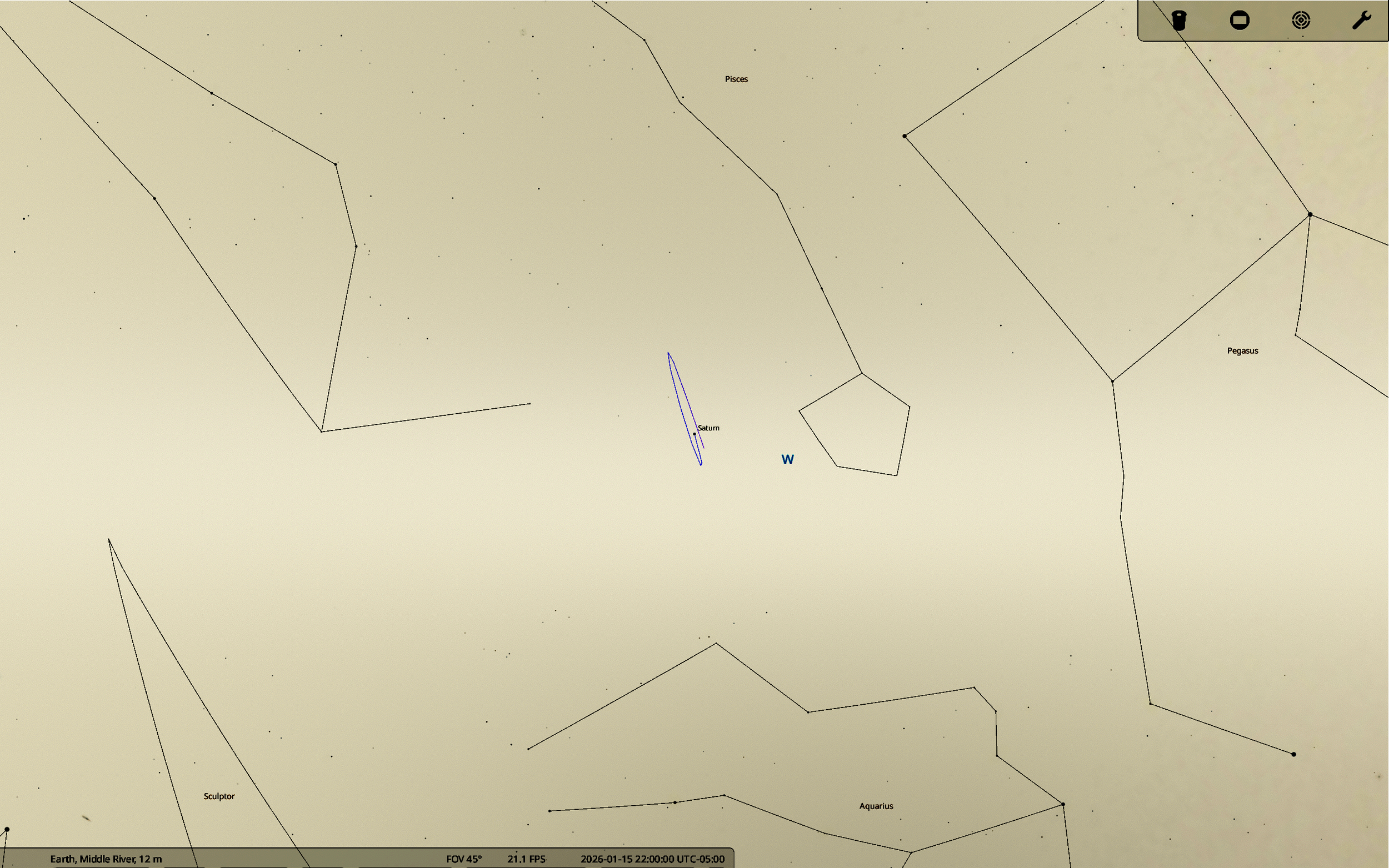
In this image, up is east and down is west. Trace the little blue loop from its open end upward, then downward, then up again to the dot. The start of the loop is where Saturn was mid-April, 2025. The dot is where it will be mid-January, 2026. Normally, Saturn moves eastward, but about mid-July, it slows and turns and begins retrograde motion westward. Then, in late November, it again slows and turns and resumes normal eastward motion. The retrograde part of the path is when Earth is passing Saturn by.
It’s no wonder the Greeks associated this planet with “Father Time.” It moves so slowly, it takes nearly nine months to fly this little loop-de-loop! Still, that’s fast enough to earn a suspended license compared to the proper motion of any star. Remember, Saturn’s proper motion is about 0.03 degrees per day. The star with the largest proper motion is Barnard’s Star, which moves about 0.003 degrees…per year. That’s only .000008 degrees per day. Saturn’s proper motion is 3,750 times faster than that of Barnard’s Star.
But you can’t even see Barnard’s Star without a telescope. The naked-eye star with the highest proper motion is 61 Cygni, which ain’t exactly bright, either. You’d need a pretty dark sky to find it. Its proper motion is only about half that of Barnard’s Star, over 7,500 times slower than Saturn.
That’s why star maps only change over thousands of years. Compared to even the highest proper motion stars, Saturn is a speed demon!
