
Eye Astronomy #15: Lone Star
by Dale E. Lehman
Long ago, my father, who was my first astronomy teacher, pointed out a bright autumn star hanging low in the southern sky and told me its name: Fomalhaut. Fomalhaut, Dad said, is a bit unusual. It’s the only bright star in that part of the sky.
Most bright stars have other bright, or relatively bright, stars for neighbors. Sirius, Rigel, and Betelgeuse cluster together in Canis Major and Orion. Procyon lies nearby in Canis Minor, as does Aldebaran in Taurus, which connects with Auriga, where Capella shines. Vega, Deneb, and Altair form the Northern Triangle. Castor has Pollux to keep it company. Regulus in Leo is joined by Spica in Virgo, and Arcturus, although a bit farther away, connects Spica to the stars of the Big Dipper. Antares has no comparably bright stars close by, but its companions in Scorpius make up for that. You’ll find second- and third-magnitudes stars near all of these. None of them are quite alone, even under suburban light pollution.
But Fomalhaut is. It’s part of a constellation only serious astronomy buffs know: Piscis Austrinus, the southern fish. Smaller than its better-known zodiacal cousin Pisces, Piscis Austrinus swims lower in the sky, to the south of Capricornus and Aquarius. Fomalhaut, at magnitude 1.15, vastly outshines the second-brightest star in the constellation, the 4.15-magnitude Epsilon PsA (PsA indicating Piscis Austrinus). That poor star doesn’t even have a proper name. Moreover, being so low in the sky, none of the constellation’s stars except Fomalhaut are even visible under suburban light pollution.
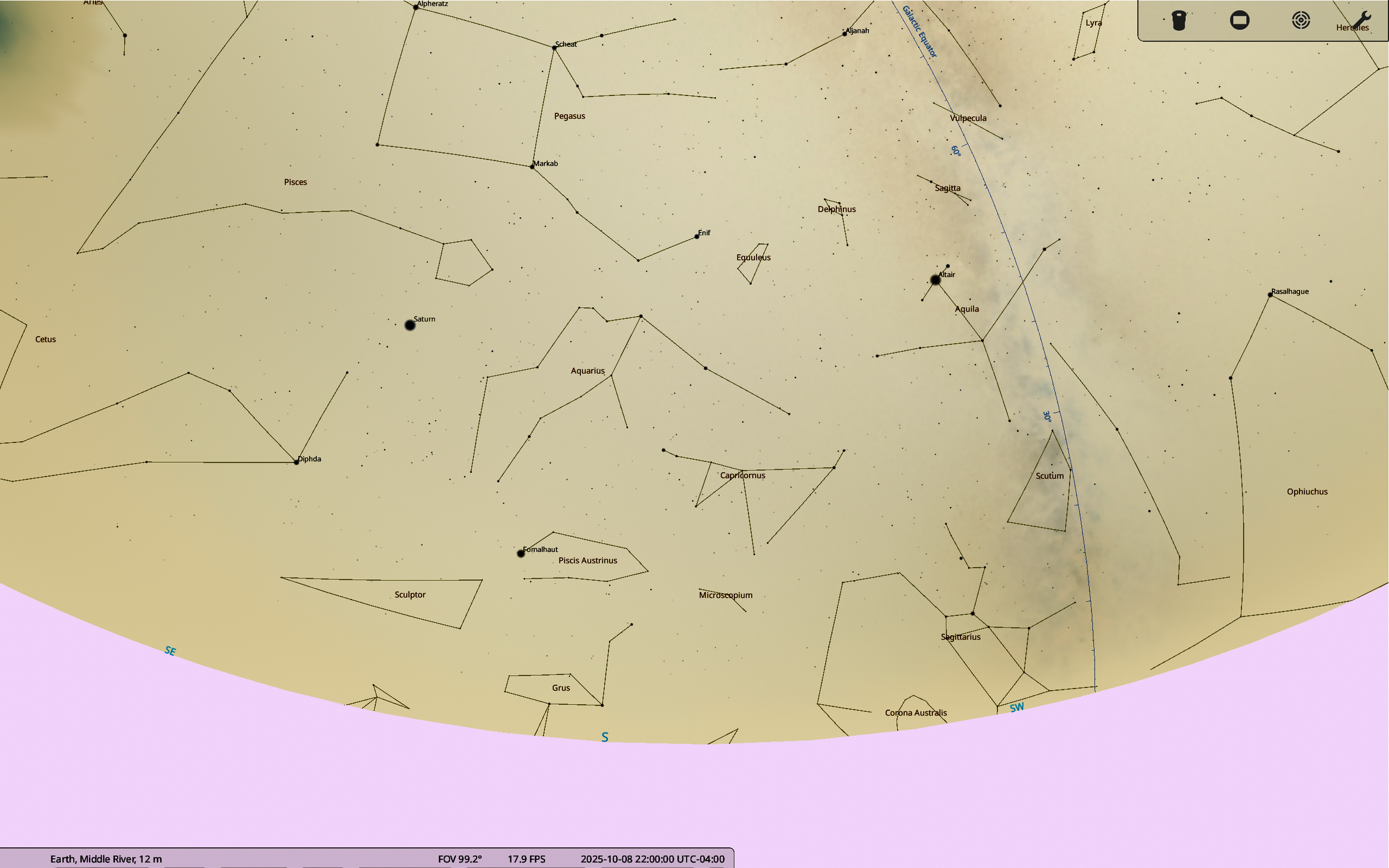
Can you find Fomalhaut? It’s low in the southern sky, below Aquarius in the barely-there constellation Piscis Austrinus.
So what gives? Why is Fomalhaut a lone star in Earth’s sky? In part, it’s because it lies far off the galactic equator. The Milky Way, as you know, is our home galaxy. It’s shaped like a pancake with a big bulge in the middle. When we look through the pancake, we see a lot more stars. The hazy band in the sky that we call the Milky Way is, in fact, the merged light from hundreds of billions of stars. The galactic equator runs through the middle of that haze. In the above graphic, you’ll see the line of the galactic equator cutting across constellations from southwest to northeast.
The farther we look away from the galactic equator, the more we are looking up or down out of the pancake. Stars are less numerous in those directions, and accordingly, brighter stars are less numerous. If we consider the galactic latitudes of the first-magnitude stars farthest from the galactic equator, we find the following:
· Arcturus: +69.11 degrees
· Fomalhaut: -64.9 degrees
· Achernar: -58.79 degrees (this star is always below the horizon for northern observers)
· Spica: +50.84 degrees
Among first-magnitude stars, Fomalhaut is farther from the galactic equator than any star but Arcturus. We would expect to see fewer bright stars near it. Beyond that, it’s just dumb luck. Fomalhaut happens to lie in a direction with way fewer bright stars than do the others on the list.
However it may look from our vantage point, Fomalhaut isn’t alone in space. It’s a triple star. But don’t get too excited. Its companions are too dim to see with just your eyes. Even with a telescope, you’d have to know where to find them. Often, the components of double and triple stars lie very close together in the sky. When you look at the brightest star (always referred to as “A”), the others (“B,”, “C,” and so on) are in the eyepiece, too. But Fomalhaut’s components are widely separated. The “B” component is a faint orange dwarf almost two degrees south, while the “C” component is a red dwarf over five and a half degrees all the way up in Aquarius! As you might guess, they are so far apart in the sky because they really are far apart in space. The distance between Fomalhaut A and B is nearly a light year, while A and C are two and a half light years apart.
And there’s one more neat thing about Fomalhaut. It’s a young star surrounded by debris disks, indicating an asteroid belt where objects are colliding and generating clouds of warm dust. We’ve known this for some time, but recently the James Webb Space Telescope has given us our most detailed view yet.
So Fomalhaut is a pretty neat star, on several counts. In the fall, I always look for it. Its annual reappearance in the southeast is like an old friend returning for a visit. Not only was it one of the astronomy lessons my father imparted, but it’s just an awe-inspiring sight, shining alone in the dark and bringing with it so much hidden wonder. Go out and share in that wonder. With a clear view of the southern sky, you’ll easily find it.
