
Eye Astronomy #16: Mira, Mira in the Sky
by Dale E. Lehman
Pegasus is flying high in the sky right now. (See Eye Atronomy #4: The Winged Horse). Just to the south of it, the zodiacal constellation Pisces swims by. And below that is another sea creature, Cetus, the whale.
In suburban skies, Cetus is conspicuous by its absence. Because it never rises too high at our latitude, the light of its stars is sapped by passage through a thick slice of the atmosphere. And then there’s light pollution. From my location, Cetus swims right through the nasty Baltimore light dome, a blaze of urban light pouring into the sky where it does nobody any good (and in fact a fair bit of harm).
Only the brightest stars cut through that glare, and Cetus has no really bright stars. Its brightest is Diphda, down at the tail end of the whale, shining at a respectable magnitude 2.0. You’ll be able to see that, probably. It’s second-brightest star is Menkar, way east in the whale’s head, shining at magnitude 2.5. The remaining stars in the constellation are magnitude 3.5 or dimmer and are lost to anyone not under somewhat darker skies.
But there is one occasional exception: Mira.
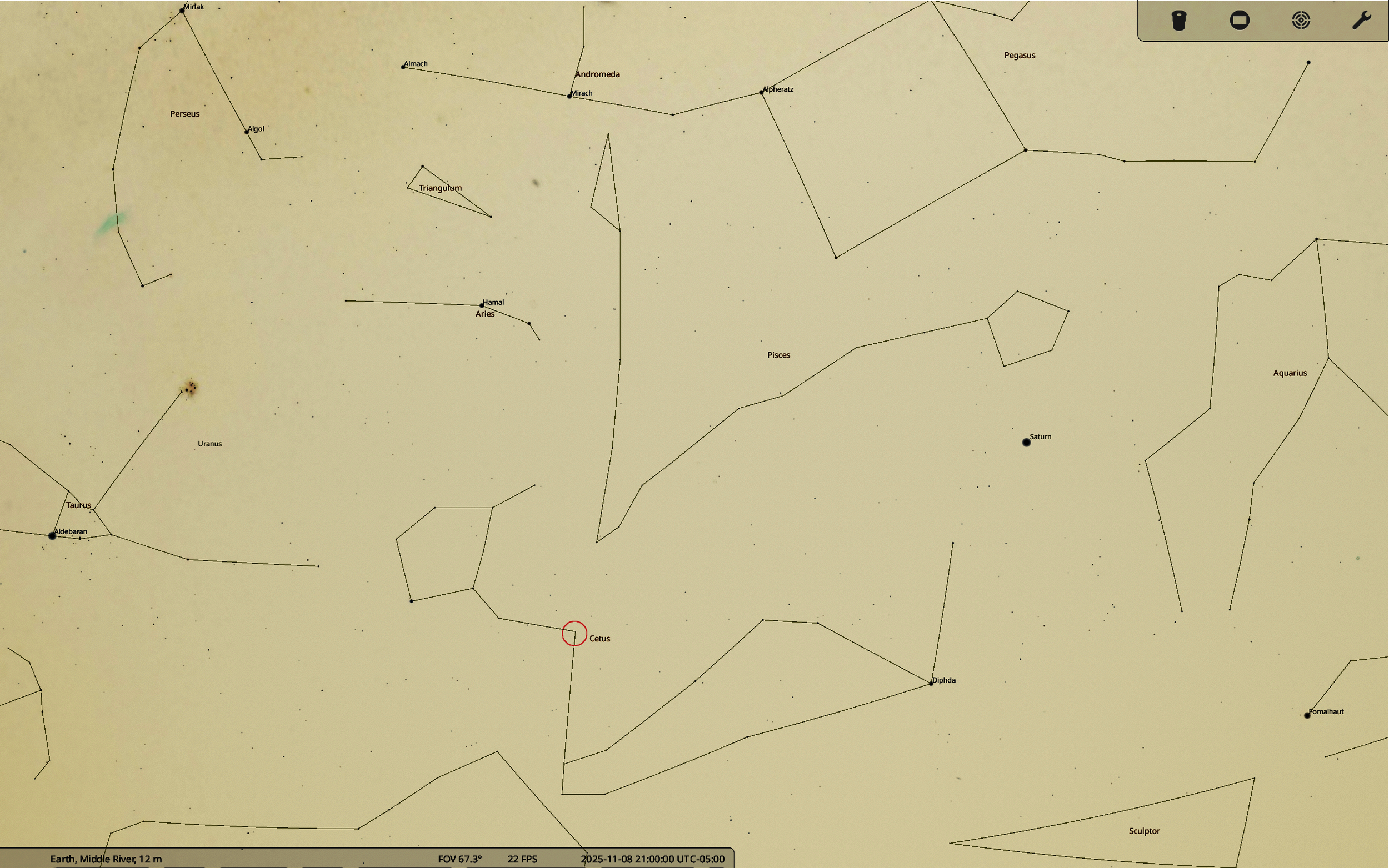
Cetus, below Pisces and Pegasus. Diphda is on the left, Menkar right (unlabeled). Mira is circled in red.
“Mira” means “wonderful” or “astonishing” in Latin, and this star certainly is that. It’s a red giant residing in Cetus’ neck. (I don’t know if whales have necks, but that’s what the stick-figure in the image looks like, so that’s what I’m calling it.) If you went looking for Mira right now, you wouldn’t see it. It’s just too dim. But wonderful, astonishing Mira is a pulsating variable star. Its size and luminosity change over time. Sometimes it’s brighter, sometimes dimmer.
There are many variable stars in the sky, but most of them aren’t obvious. It takes time and careful observation to notice their brightening and dimming. There are several kinds of variable stars, because there are several reasons stars can change in brightness. Some are eclipsing binary stars, two stars orbiting each other such that one passes in front of the other from our vantage point. When that happens, the star appears to dim. The most famous variable star is one of these: Algol, “the ghoul,” (in the constellation Perseus) which was known to be variable in ancient times.
Algol is more obvious than most variables because it’s reasonably bright and has a short period, the time it takes from one point of maximum brightness to the next. Some stars have long periods, on the order of months or years. And some are extremely long. Pulsating variables like Mira are the longest-period variables, with brightness fluctuations ranging from hundreds to thousands of days.
Mira itself is on the shorter end of the scale, with a period of about 332 days, roughly 11 months. What makes it stand out, though, is its huge brightness range. At its brightest, Mira is close to magnitude 2.0, rivaling Diphda, while at its dimmest, it might plunge down to 10.0. How much of a difference is that? At its brightest, Mira is around 1,585 times as bright as at its dimmest!
The problem is, we must sometimes wait a really long time to catch it that bright. As the Earth orbits the sun, different parts of the sky are visible at different times of year. From our latitude, Mira is too close to the sun to be seen between late March and June, so if its maximum brightness occurs then, we’re out of luck. And in fact, that was the case this year. Mira’s last maximum occurred in early April, 2025. The next will be early March, 2026, but it won’t be easy to see, since Mira sets only a little after the sun then. It will be much easier to see at the end of January or beginning of February in 2027, when Cetus swims by due south at about the time of Mira’s maximum.
It will be far enough from the sun to shine in the dark then. Except at my house, where that Baltimore light dome will be mucking things up. Light pollution stinks.
