
The Science (& Fiction) of Star Wars: Part 3
by Sam Atkins
Let’s explore some more things from the Star Wars universe and how they relate to real astronomical concepts.
SPOILER WARNING: This article contains spoilers for Star Wars (1977) and Solo: A Star Wars Story (2018), but you should take this as a general spoiler warning for the Star Wars franchise.
NOTE: Tap or hover over images for captions and credits.
The Kessel Run

Image credit: Disney
In the original Star Wars film, Luke Skywalker and Obi Wan Kenobi attempt to haggle with Han Solo over the price of being smuggled off Tatooine, out of sight of the Empire. Sensing their skepticism about the capabilities of his starship, the Millennium Falcon, Han Solo (in)famously assures them by boasting it as “the ship that made the Kessel Run in less than twelve parsecs.” The infamy of this line lies in that Solo is implying parsec as a unit of time when it is, in fact, a unit of distance.
In astronomy, a parsec is the distance at which a star is displaced against the background stars by one arcsecond when viewed between one side of Earth’s orbit and the opposite side. In other words, if you were to look at a star’s position in the night sky, then waited six months for Earth to move around to the opposite side of the Sun and looked at that star again, you should expect to see its position shifted against the background stars. This optical effect is known as parallax. If the star shifts exactly one arcsecond, the star is known to be 3.26 light years away, also known as one parsec (portmanteau of parallax and arcsecond).
This, of course, makes Han Solo’s claim incoherent. It’s the equivalent of saying that you finished a race in less than 6 miles, rather than 6 minutes. However, Jon and Lawrence Kasdan sought to rectify this scientific error when writing the script for Solo: A Star Wars Story. The film portrays the fabled Kessel Run and brings harmony to the continuity by showing that Han Solo finished the race by taking a literal shortcut (albeit a dangerous one riddled with black holes), thus making sense of his original use of parsec. Is it an elegant fix? I’ll leave that for you to decide.
Coruscant: The City Planet
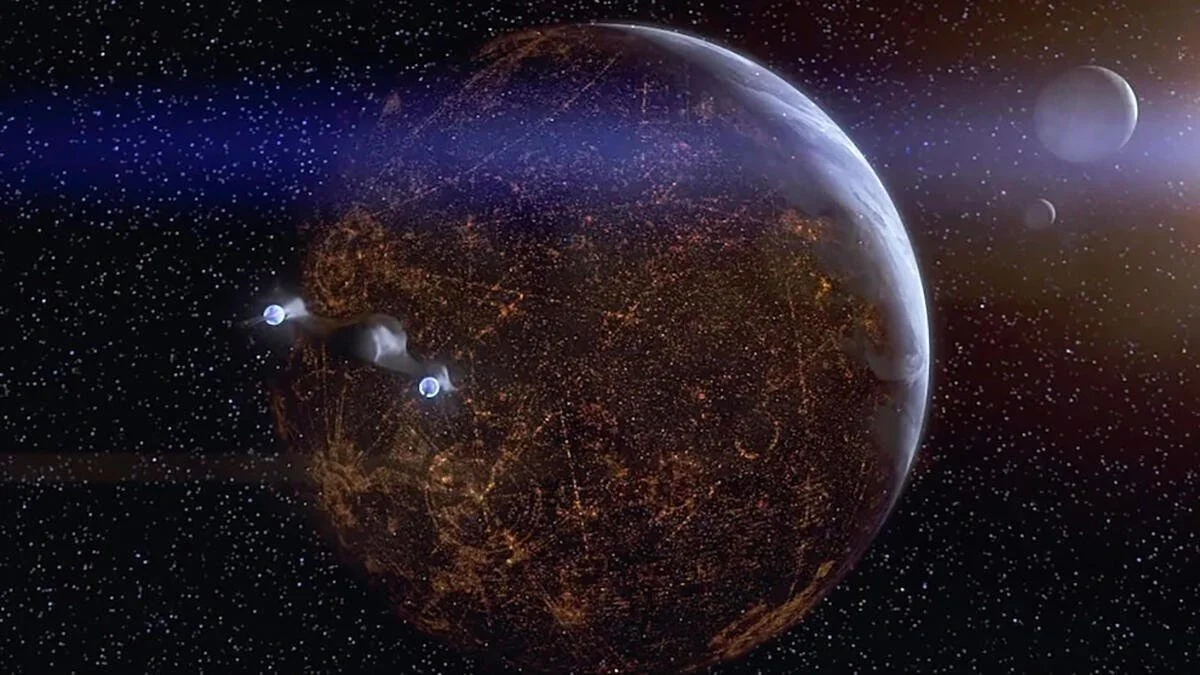
Image credit: Disney
Few things evoke a futuristic setting like vast urban sprawl. Many science fiction universes feature incredibly large cities. From the Sprawl in William Gibson’s Neuromancer to Mega-City One in Judge Dredd, some of these metropolises reach populations in the tens or hundreds of millions, and even into the billions. But very few cities can compare to those that span an entire planet.
Coruscant is one of the most iconic planets in science fiction. In the Star Wars universe, it is the political and cultural hub of the entire galaxy. From space, this “ecumenopolis” appears as a glowing grid of city lights covering the planet’s night side. Its “surface” is an endless skyline of megastructures built upon megastructures, stretching high into the clouds and deep into the planet’s crust. At the height of the Galactic Republic, its population is estimated at around 3 trillion. That’s about 375 times the population of Earth!
Would such extreme urbanization be possible on Earth? It would unquestionably push our planet to its physical limits.
Heat is the most immediate constraint.
Every bit of energy used by people and machines ends up as waste heat and the dark pavement and concrete of roads and buildings of cities absorb a lot of heat while the lack of vegetation reduces evaporative cooling. The temperatures measured in and around large cities have been found to be noticeably higher than the surrounding rural areas. Daytime temperature differences on average amount to 1-6°F (0.5-3.3°C) hotter while nighttime temperatures see spikes as high as 22°F (12.2°C) due to buildings releasing heat. This has led large cities to be called urban heat islands (UHI). In an ecumenopolis, a fully urbanized planet with potentially trillions of people and machines would generate staggering levels of heat with little to none of the rural areas, forests or oceans to act as redistributive buffers.
With all this heat being constantly absorbed and emitted, where can it go? A planet can only shed heat by radiating it into space as infrared light, which is a relatively slow process. If heat is generated faster than it can be radiated away, temperatures rise until a dangerous equilibrium is reached. Mitigation on a city planet would require extreme efficiency by minimizing wasted energy and pollution, along with massive infrastructure to dump heat into space. In practice, that means planetary-scale radiators, vast towers extending above the atmosphere that circulate coolant to carry heat upward and release it into the vacuum of space faster than the planet can naturally.
Resources would be another major logistical challenge.
Humans require air, food, and water, which Earth provides through vast, self-regulating ecosystems. An ecumenopolis would have to replace this with planet-wide artificial systems for oxygen production, water recycling, and food generation, where any significant failure could quickly become catastrophic. On top of this, advanced industry would likely depend on importing metals and other materials from off world (asteroids, moons, etc.) because many local sources would be depleted or inaccessible. That would require a continuous high-volume supply chain involving autonomous mining, large-scale refining, space transport, and planetary processing and logistics networks. Together, resource acquisition and life-support maintenance would become a constant, civilization-defining burden rather than a background activity.
The remaining laundry list of problems and solutions is long and varied: transportation, pollution, waste management, security and law enforcement, social stratification, cultural fragmentation, etc. but those more deal with the organizational logistics. An ecumenopolis might be technically possible but would be as complex as it is vast, consisting of interdependent systems and infrastructure, making it highly vulnerable to cascading failures and difficult to govern at a planetary scale. It’s very doubtful that it would be the optimal way for civilization to function.
Gravity on Starships
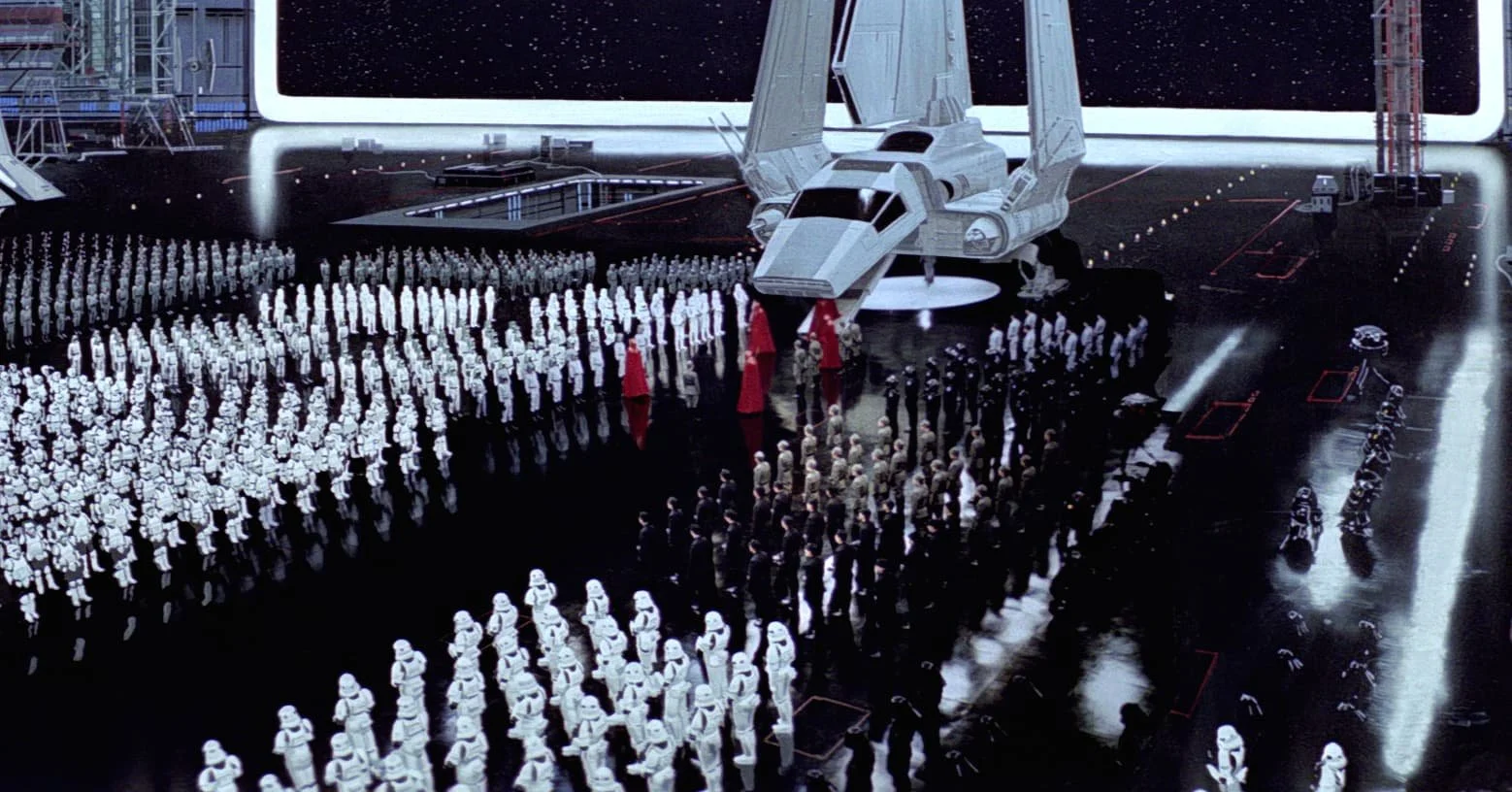
Image credit: Disney
Most humans have spent their entire lives on Earth’s surface, so we take for granted that our feet stay planted and anything we drop falls straight down. In orbit, you and your spacecraft are in continuous free fall around the planetary body, creating weightlessness. It’s similar to the brief lift out of your seat you feel when a roller coaster crests over a hill at speed. Orbiting works the same way, but the hill is the planetary body itself, and your forward speed keeps that falling motion going indefinitely. While weightless in orbit, you float freely inside the spacecraft. It’s important to keep in mind that this doesn’t mean you aren’t experiencing gravity. Astronauts aboard the International Space Station, orbiting 400 km above the Earth, still have roughly 90% of its gravitational force exerted on them. However, both they and the space station are falling together and counteracting the weight.
This makes it peculiar when watching Star Wars and seeing people walking around inside Star Destroyers, the Millennium Falcon, or the Death Star as if they were on a planet’s surface. These structures, no matter their size, should be considered in free fall while orbiting nearby planets (or in near zero gravity when in the far reaches of interstellar space) and everything inside them should therefore be weightless and floating around freely. So why aren’t they? As with much science fiction, the answer here is often technology: large starships and space stations use artificial gravity generators and acceleration compensators to keep everyone’s feet on the floor. How do they work? Who knows! Star Wars is far from hard science fiction (some even call it science fantasy) and rarely focuses on explaining these kinds of technical details. Unlike Star Wars, we can’t simply ignore physics in space.
While extended time in space can have adverse effects on the human body, it’s fine in short bursts, given that you exercise regularly. That being said, there is a way for us to simulate gravity using real and simple physics!
The most realistic method is rotation. If a spacecraft or station spins, the centrifugal force would push people and objects outward against the outer hull and create the feeling of gravity. In this way, the walls of the station would essentially become the floor. This method is often imagined as being used with ring or cylinder habitats where you can walk around the perimeter in a circle with “up” being towards the center of the station. You can see this method being represented in science fiction like Stanley Kubrick’s visionary film, 2001: A Space Odyssey. The faster the rotation or the larger the radius, the stronger the “gravity” you can produce. Thus, larger stations would be able to spin slower to maintain the same gravity as smaller stations. An inconvenient quirk of this method is that dropped objects would not fall straight down but drift away from you, as a free object will follow the motion it was moving at the moment of release.
The other method is constant acceleration. If a spacecraft continuously accelerates forward at about 9.8 m/s², the rear of the ship pushes against you in the same way the Earth does, creating the sensation of gravity. If the ship later needed to decelerate for the second half of the journey, you could turn it around and provide the same thrust forward to continue providing the same simulate gravity. The advantage of this method is that gravity would be uniform throughout the spacecraft. Movement would feel more natural and dropped objects would fall straight down. The glaring problem is that this method would require immense amount of fuel to be constantly burned. Present-day launch rockets burn fuel very quickly and can only maintain 1 g for a few minutes. Even nuclear-propulsion rockets are unable to maintain long durations of thrust. For now, rotation is far more plausible.