
The Artemis II Mission (Updated)
by Sam Atkins
NASA’s Artemis II mission has concluded. This mission sent astronauts around the Moon for the first time in over half a century, paving the way for a future lunar landing. Let’s dive into how we got here, what happened during the mission, and what comes next!
NOTE: Tap or hover over images for captions and credits.
What is the Artemis program?

Animation credit: NASA
The Artemis program is an ambitious initiative by NASA to return humans to the Moon. It will progress across numerous missions, each one building on the last, ultimately aiming to establish a sustained lunar presence and lay the groundwork for the first crewed mission to Mars.
Although the Apollo missions captured the imagination of the world, the last human set foot on the Moon in 1972, over 53 years ago. So why did we stop, and why are we going back now?
While NASA’s motivations were scientific and had planned for many more lunar landings, the funding of the Apollo program was primarily driven by political ends: competition with the Soviet Union. The United States’ endeavors into space were very expensive. NASA’s share of the federal budget during the Apollo missions was higher than it has ever been since. With the urgency to beat the Soviets gone and America beset by unpopular wars and economic strife, continued lunar missions began to feel costly and nonessential. NASA’s share of the federal budget fell sharply from 5% in 1966 to just 1% in 1975. NASA shifted its focus to low-Earth orbit projects like the Space Shuttle program and robotic planetary missions such as the Voyager probes.
Over half a century later, NASA returns to the Moon, driven not by political rivalry and prestige, but by international cooperation, sustainability and science.
Modern technology now makes frequent, complex missions in space far more economically feasible and less risky than during the Apollo era. Rockets are more powerful, reliable and reusable. Materials science can create stronger, lighter spacecraft. Life support systems allow astronauts to remain in space longer and more safely. The advancement of robotics and computers allow for unprecedented levels of precision, problem solving and automation.
At the same time, space exploration is no longer dominated by the United States alone. Countries like China, India, Japan, Israel, South Korea and the United Arab Emirates have launched ambitious scientific missions into space. It’s also no longer the domain of governments. As space travel becomes cheaper and more efficient, private companies are playing an increasingly central role. SpaceX and Northrop Grumman transport supplies and innovate on space technology, Blue Origin and Virgin Galactic are pioneering space tourism, and Firefly Aerospace recently became the first private company to successfully land a spacecraft on the Moon. To avoid being left behind, America must lead the way.
Our evolving scientific understanding of the Moon has also changed the equation. One of the biggest discoveries is water ice found in permanently shadowed craters near the lunar poles. These resources could provide water, breathable oxygen, and even rocket fuel without needing to transport it from Earth. Nearby these reservoirs, at the rims of the craters are regions of near-constant sunlight, providing sustained solar power. All together, these regions could make a permanent presence on the Moon much more realistic and provide a good launch point for manned missions to Mars. Beyond this, the Moon’s rocky, cratered highland terrain offers new scientific challenges and opportunities far beyond the smooth lunar plains visited by Apollo astronauts.
Note: If you want to do a deeper dive into the historic Apollo 11 mission, which put the first humans on the Moon’s surface, you can check out my comprehensive article here (if you are short on time, you can read the abridged version here).
Artemis I
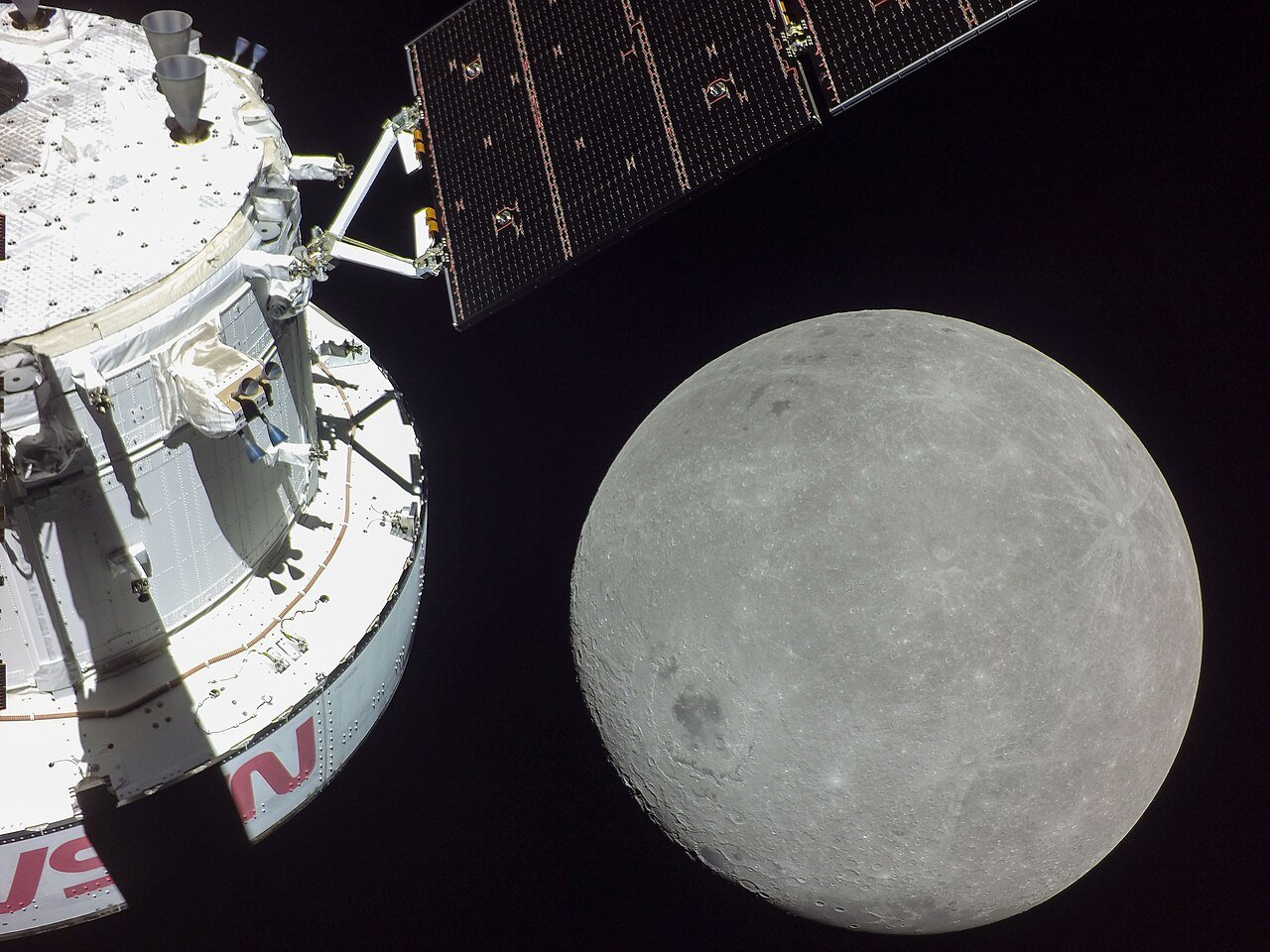
Image of the Moon taken from the uncrewed Orion spacecraft on November 21, 2022 (sixth day of the Artemis I mission). Image credit: NASA
On November 16, 2022, NASA launched the inaugural mission of the lunar return program, Artemis I. Stacked atop the Space Launch System (SLS) rocket, the uncrewed Orion spacecraft was sent on a five-day journey to the Moon where it passed as close as 130 km above the lunar surface. Four days after passing the Moon, Orion entered into a crawling retrograde orbit 50,000 km beyond. After six days, Orion initiated a burn that would put it on a trajectory to perform a second flyby of the Moon and then head home. Upon its second pass, Orion came within 128 km of the lunar surface. On December 11th, 2022 (the 25th day of the Artemis I mission), the Orion spacecraft re-entered Earth’s atmosphere and splashed down safely into the Pacific Ocean.
This mission provided critical data that would support calculations and engineering for the next step, Artemis II.
Originally slated for a 2023 launch, the mission faced challenges that pushed the window back several times. In September 2025, concerns regarding the Orion spacecraft’s life support systems and heat shield forced the most recent delay. Artemis II finally launched on April 1st, 2026!
What is the objective of Artemis II?
Building upon the success of the Artemis I mission, Artemis II was planned as a ten-day crewed lunar flyby mission. It was essentially a faster, more direct version of the Artemis I journey, but this time with a four-astronaut crew on board. This was the second test-flight to ensure the rocket, spacecraft, life support and other systems are capable and ready for a lunar landing. The crew was also tasked with testing various equipment and making observations of lunar surface features.
Meet the Crew and Spacecraft of the Artemis II Mission
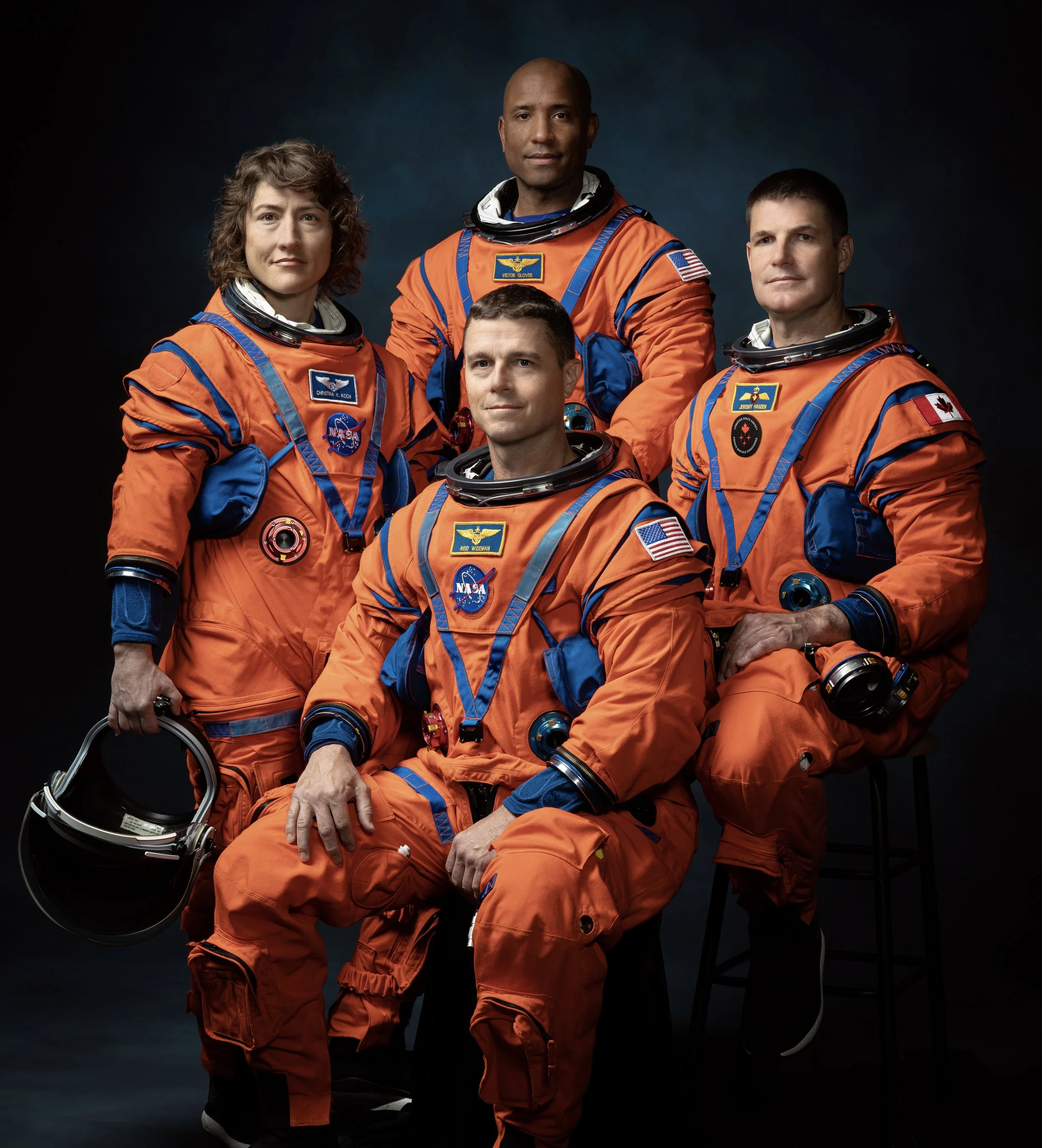
The crew of NASA’s Artemis II mission (left to right): NASA astronauts Christina Hammock Koch, Reid Wiseman (seated), Victor Glover (standing), and CSA astronaut Jeremy Hansen. Image credit: NASA
REID WISEMAN 🇺🇸
Artemis II Commander
Hailing from Baltimore, Maryland, Reid Wiseman is an American naval aviator and engineer. He flew his first space mission aboard the International Space Station in 2014 as a flight engineer, where he spent six months conducting hundreds of scientific experiments and performing two spacewalks totaling over 12 hours. He later served as Chief of the Astronaut Office, acting as the principal advisor on astronaut training and operations. This extensive experience made Wiseman a proven leader to command the Artemis II mission.
VICTOR GLOVER 🇺🇸
Artemis II Pilot
Victor Glover, a U.S. Navy captain from Pomona, California, is a self-described adrenaline junkie who once dreamed of becoming a stuntman, police officer, firefighter, or race car driver. He earned multiple engineering and systems degrees and has logged thousands of flight hours as a fighter pilot and test pilot. Glover piloted the first operational Crew Dragon mission to the International Space Station, where he completed a long duration stay, the first African American to do so. He is the first person of color to fly around the Moon as the pilot during Artemis II.
CHRISTINA KOCH 🇺🇸
Artemis II Mission Specialist
An electrical engineer from Jacksonville, North Carolina, Christina Koch holds the record for the longest single spaceflight by a woman (328 days) and participated in the first all-female spacewalk. She has spent much of her career conducting research to develop space science instruments. Koch is no stranger to extreme environments, having worked for several years in the Arctic and Antarctic, facing isolation and harsh conditions. These experiences made her a natural choice as mission specialist for Artemis II. She is the first woman to fly around the Moon.
JEREMY HANSEN 🇨🇦
Artemis II Mission Specialist
From London, Ontario, Jeremy Hansen is Artemis II’s only Canadian astronaut. He graduated from the Royal Military College of Canada with a degree in physics, where he conducted research on wide-field satellite tracking. He later served as a CF-18 fighter pilot, leading tactical formations. Although Artemis II will be his first spaceflight, Hansen has extensive experience in spaceflight simulations and extreme analog environments, including deep caves (ESA CAVES) and undersea laboratories (NASA NEEMO). He is the first non-American to fly around the Moon.
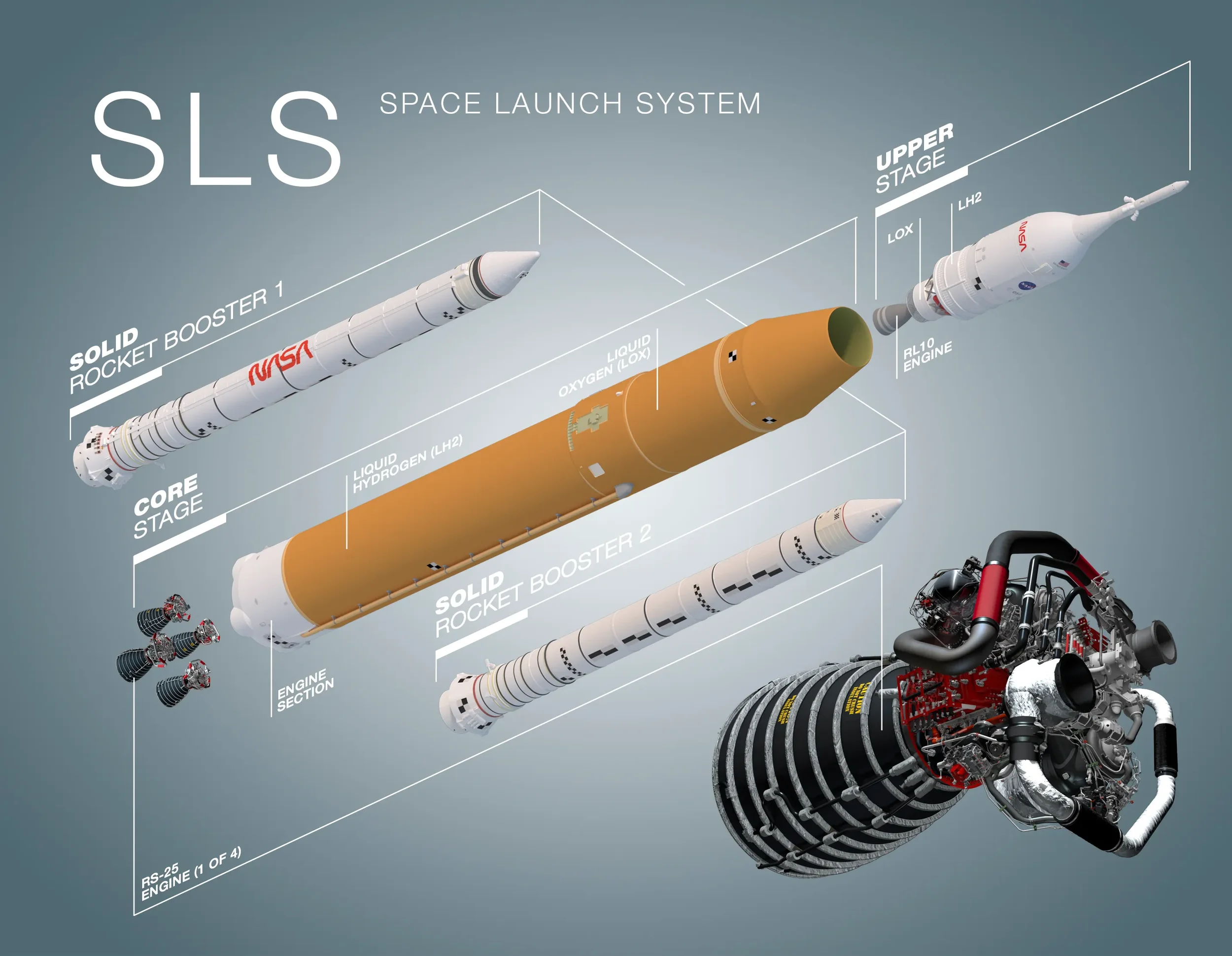
Image credit: NASA
SPACE LAUNCH SYSTEM (SLS)
After the Space Shuttle’s retirement and the cancellation of the Ares rockets, NASA developed the Space Launch System (SLS) as its next super heavy-lift vehicle. SLS is the centerpiece of the Artemis program, designed to launch the crewed Orion spacecraft toward the Moon. It first flew during Artemis I, with Artemis II serving as its second test flight.
At the center of the rocket is the core stage (painted orange), which supports Orion and contains two cryogenic tanks: a smaller liquid oxygen tank above a much larger liquid hydrogen tank. These propellants feed four RS-25 engines at the base, upgraded versions of Space Shuttle engines. When ignited, the engines mix and burn the propellants at extremely hot temperatures, expelling exhaust at high pressure to generate lift.
To overcome the rocket’s enormous weight, gravity, and atmospheric drag at liftoff, SLS relies on two solid rocket boosters mounted on either side of the core stage (painted white). These boosters burn rapidly and provide immense thrust during the most demanding phase of launch. Together, the engines and boosters produce over 8.8 million pounds of thrust, making SLS the most powerful rocket NASA has ever built.
With Orion attached at the top, the whole vehicle stands 98 meters tall. Its height puts it as taller than the Statue of Liberty but shorter than the Saturn V rocket used by the Apollo missions.
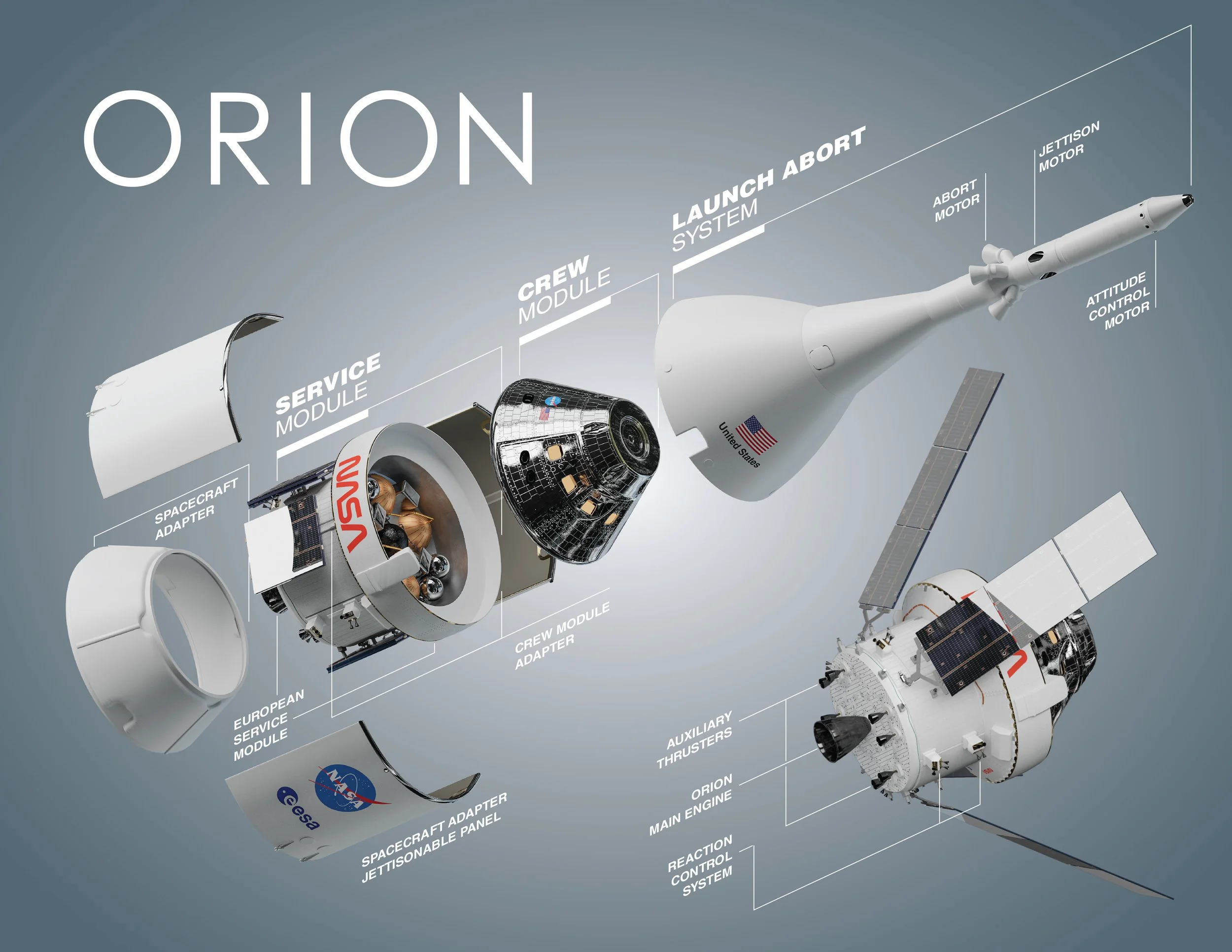
Image credit: NASA
ORION SPACECRAFT
Mounted atop the core stage of the Space Launch System rocket is the Orion spacecraft, which the Artemis II crew named Integrity. This is the multi-purpose crew vehicle that will carry the astronauts to the Moon and back. It is made of an aluminum-lithium alloy. The configuration of the Orion spacecraft is not that dissimilar to the Apollo spacecraft back in the day. At launch, Orion consists of three major components: the service module, the crew module and the launch abort system.
The Service Module, developed by Airbus and provided by the European Space Agency, is a cylindrical section at the base of the spacecraft that houses Orion’s power and propulsion systems. At the base is the single Orbital Maneuvering System Engine (OMS-E) which can provide 6,000 pounds of thrust. Flanking the sides are four deployable solar wings which provide electricity to the various systems (engine, life support, thermal control, etc.).
The Crew Module, developed by Lockheed Martin, is the cone-shaped pressurized capsule mounted atop the service module. It is occupied by the four Artemis II crew members, one more than the Apollo command module. Underneath the capsule is a curved heat shield that will protect the crew from superheated air as they re-enter the Earth’s atmosphere. It is the only part of the Artemis II vehicle that will remain by the mission’s end.
The Launch Abort System (LAS) is a missile-shaped tower mounted to the front (top) of the spacecraft, covering the crew module. In the event of an emergency during launch or ascent, say the rocket is about to explode, the LAS will propel the Orion spacecraft away from the SLS rocket and land it safely in the ocean. Should everything go smoothly, the LAS will be discarded along with the core stage of the SLS.
With all three components attached, the Orion spacecraft stands just over 20 meters tall and 5 meters wide, making up about a fifth of the SLS rocket’s total height.
Artemis II mission overview
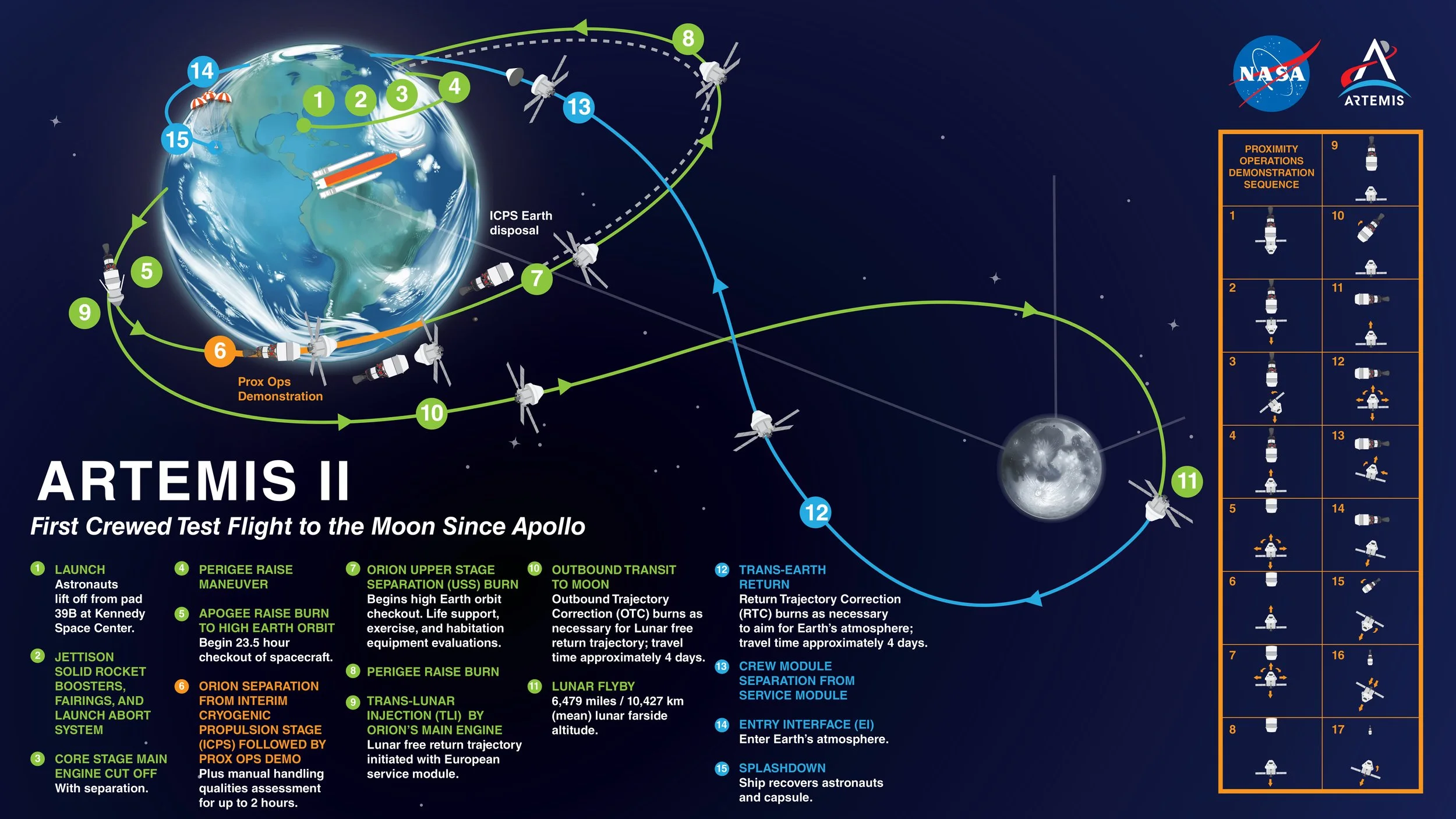
Diagram showing the planned mission objectives of the Artemis II mission. The green path shows the journey to the Moon while the blue path shows the return journey back to Earth. Image credit: NASA
It should be reemphasized that Artemis II was not a lunar landing mission, it was a lunar flyby mission. Artemis II most resembled the 1968 Apollo 8 mission, except it didn’t enter into a lunar orbit.
Taking place over nine days, the Artemis crew left Earth, flew around the Moon and then returned. This was the first time humans travelled beyond low-Earth orbit since the Apollo 17 mission and took the crew further from Earth than any human had ever been.
With that said, let’s dive into the most consequential points in the mission’s progress.
Launch
April 1st, 2026
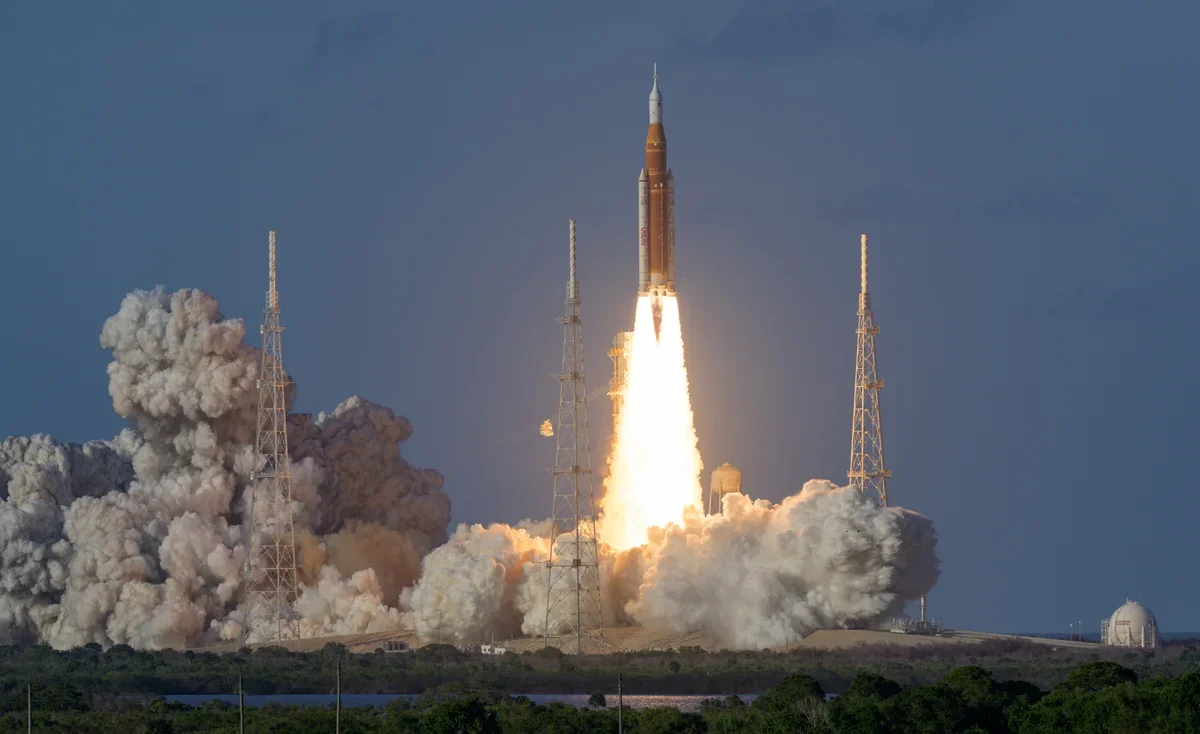
Launch of the Artemis II mission’s SLS rocket on April 1st, 2026. Image credit: NASA / Bill Ingalls
Artemis II began at the Kennedy Space Center in Cape Canaveral, Florida. Throughout the mission, the crew would be in regular radio communication with mission control in Johnson Space Center at Houston, TX.
At 6:35pm EDT, the Space Launch System rocket ignited its four main engines along with its solid rocket boosters. The rocket lifted off from Launch Complex 39B and climbed into the evening sky. About two minutes into the ascent, the SLS jettisoned the solid rocket boosters at an altitude of about 50 km and a speed of 5,000 km/h. Once the SLS was above the densest part of the atmosphere, the Launch Abort System was jettisoned. Eight minutes into the ascent, the SLS reached an orbital velocity of 28,000 km/h. At this point, the core stage of the rocket was shut down and most of it was jettisoned. However, a small upper section of the core stage called the Interim Cryogenic Propulsion Stage (ICPS) remained attached.
Earth orbit
April 1st, 2026
Video credit: NASA’s Eyes on the Solar System
After reaching space, the remaining ICPS used its single rocket engine to place Orion into an elliptical orbit around Earth, ranging from just 185 km at perigee (the closest point above the planet) to 2,200 km at apogee (the farthest point). Integrity completed this first loop around Earth in a little over 90 minutes. Once that orbit was complete, the ICPS ignited again, pushing Integrity into a far more stretched version of the orbit (shown above). This second orbit stretched from a perigee of 380 km to an apogee of 70,000 km (more than five Earth diameters away). This orbit lasted for roughly 24 hours.
The purpose of this extended, highly elliptical orbit was to allow for the Artemis II crew to conduct the proximity operations demonstration. They switched Integrity to manual control and demonstrated the spacecraft’s maneuverability. Commander Wiseman and Pilot Glover used onboard cameras and window views to pilot Integrity toward and away from the then separated ICPS, evaluating the spacecraft’s handling, hardware, and software. The test provided critical in-flight data and operational experience that cannot be replicated on the ground, helping prepare crews for rendezvous, proximity operations, docking, and undocking in lunar orbit in future missions.
Note: Upon separating the ICPS, a cache of CubeSats stored between it and the Orion spacecraft was released. These are shoe box-sized satellites that will enter into high Earth orbit to collect measurements on the effects of the space environment on electrical components.
Translunar injection
April 2nd, 2026
Video credit: NASA’s Eyes on the Solar System
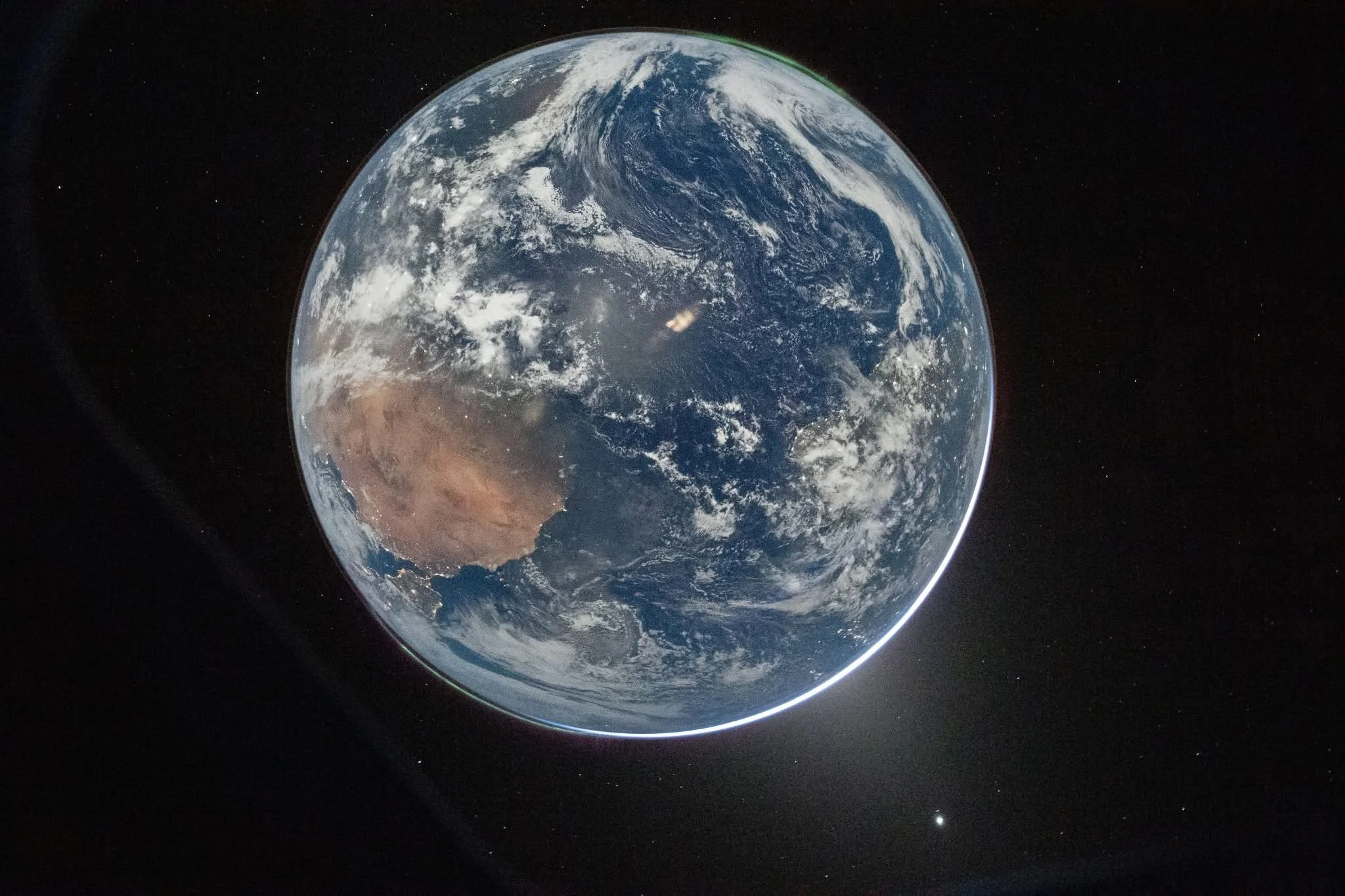
The iconic “Hello, World” long exposure image of the night side of Earth captured by Artemis II commander Reid Wiseman on April 3rd. The landmass at the bottom left is North Africa and Spain. Venus can be seen against the zodiacal light in the bottom right. Image credit: NASA / Reid Wiseman
Once Integrity reached perigee a second time, the Artemis II crew initiated an engine burn from the service module to propel it towards the Moon. This burn, known as a translunar injection (TLI), accelerated the spacecraft into a free-return trajectory (shown above). This means the speed and direction allowed Integrity to swing around the Moon and back to Earth without the need for additional burns (though small attitude corrections were conducted). After reaching a top speed of about 38,000 km/h, Integrity’s path primarily followed the gravitational influences of the Earth and Moon. It took the Integrity spacecraft about four days to travel from Earth to the Moon.
During the four days, the crew monitored spacecraft systems, gathered data on the effects of deep space travel, and performed trajectory correction burns as needed.
Lunar flyby
April 6th, 2026
Video credit: NASA’s Eyes on the Solar System
On the fifth day of the Artemis II mission, humanity made its first crewed flyby of the Moon in over 53 years.
Calculated into its translunar injection burn, Integrity’s free-return trajectory was designed to pass the Moon in such a way that lunar gravity sent the spacecraft around the far side and back toward Earth, all without expending any additional fuel (shown above). Imagine you are running past a friend and, at just the right moment, they grab your arm. You do not stop. Instead, you swing around them in a wide arc, and when they let go, you are flung back in the direction you came from. Integrity did the same thing with the Moon. The Moon’s gravity essentially grabbed the spacecraft, bent its path around the Moon, and redirected it back toward Earth.
At 1:56pm, the Artemis II crew surpassed the record for furthest distance humans have travelled from Earth. This record was previously set by Apollo 13 in 1970 at 400,171 km from Earth.
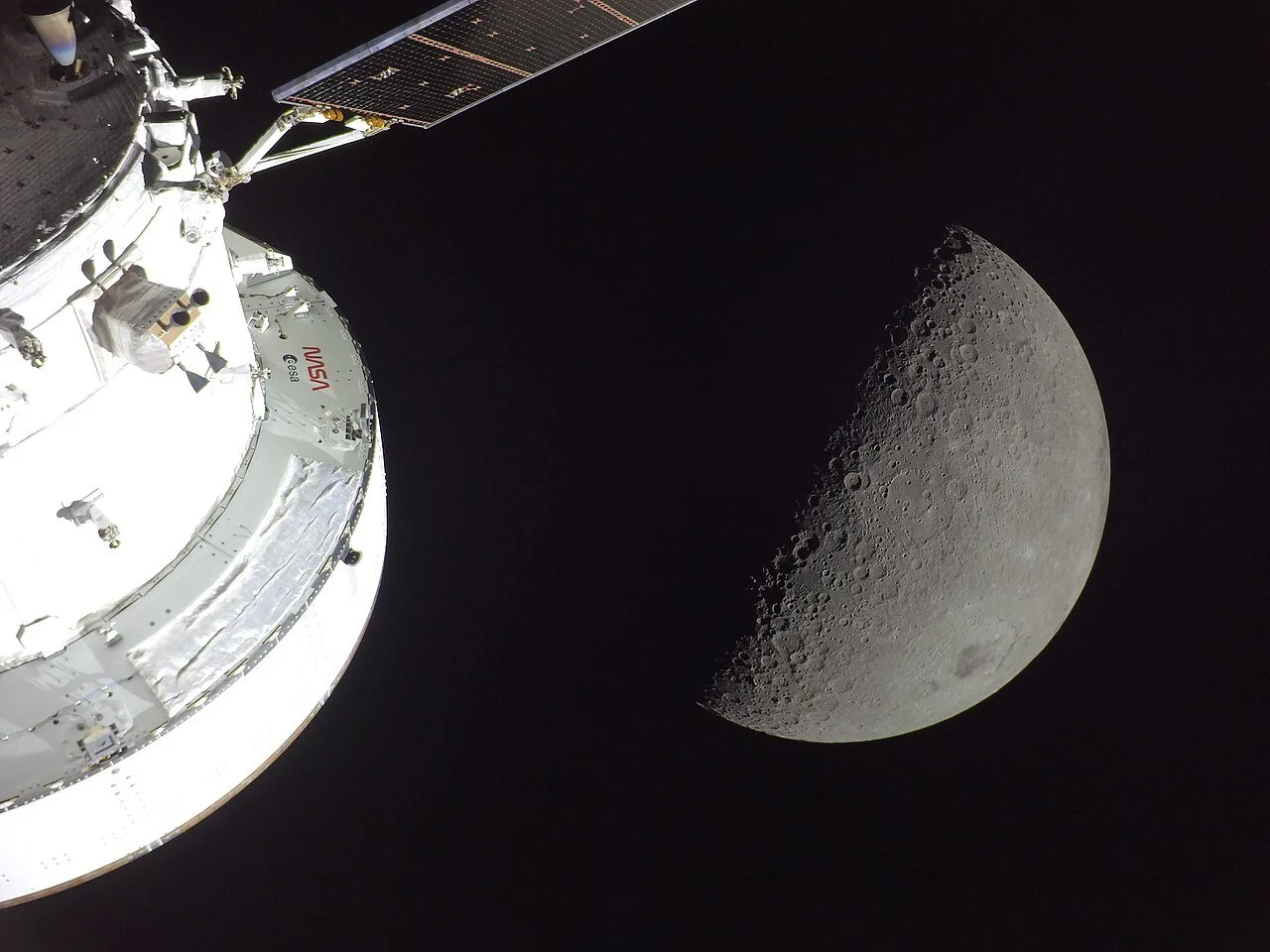
Image of the Moon captured by one of Integrity’s external cameras during its April 6th flyby. At the bottom right of the Moon, you can see Mare Orientale, which straddles the western edge of the lunar disk from Earth’s vantage point. Image credit: NASA

The iconic “Earthset” image captured by Artemis II commander Reid Wiseman as Integrity disappeared behind the Moon on April 6th. Image credit: NASA / Reid Wiseman
At 2:45pm, the lunar flyby officially began. The Artemis II crew was given a predetermined list of lunar surface features that they were meant to observe and verbally describe back to mission control. They observed some fresh new craters on the far side as they continued their approach.
At 6:44pm, Integrity disappeared behind the Moon, losing both line-of-sight and its radio signal with Earth for about 40 minutes. During this expected comms blackout, the astronauts continued to photograph and observe the Moon’s far side, though much of it was in shadow. They are now part of a group of only 28 humans to ever see the Moon’s far side with their own eyes. One of the most striking differences between the far side and the near side, is the lack of maria. These are the dark-gray regions that form the “Man in the Moon” pattern. They are ancient lava plains, created when volcanoes spilled molten basalt across the lunar surface, which cooled into smooth, flat plains. The far side, in contrast, is much more heavily cratered, with very few maria.
At 7:02pm, Integrity reached its closest pass of the Moon at a distance of about 6,400 km (almost two moon widths). From here, the Moon appeared 30° across, about 60 times its typical size from Earth. This is when it reached its fastest speed of the lunar flyby (4,700 km/h). However, the acceleration to this speed was quite gradual so the crew would not have felt any noticeable increase in G-forces. This is also the point that the Artemis II crew reached their maximum distance from Earth at 406,771 km, which is now the record for furthest distance humans have travelled from Earth.
At 7:25pm, Integrity reemerged from behind the Moon and radio contact was reestablished.

Image of the solar eclipse captured by the Artemis II crew as Integrity travelled through the Moon’s shadow on April 6th. Image credit: NASA
At 8:33pm, Integrity entered into the Moon’s shadow, completely blocking the Sun. At this point, the Earth was the only significant light source, and it was just a 2° wide crescent. During this total solar eclipse, the Artemis II crew studied the Sun’s corona reaching out beyond the Moon’s silhouette.
At 9:30pm, Integrity reemerged from the Moon’s shadow, and the lunar flyby officially concluded. All that remained was the four-day journey back home, using the momentum borrowed from the lunar gravity. NASA anticipated further trajectory correction burns during the return flight to ensure accurate Earth re-entry.
Re-entry & splashdown
April 10th, 2026
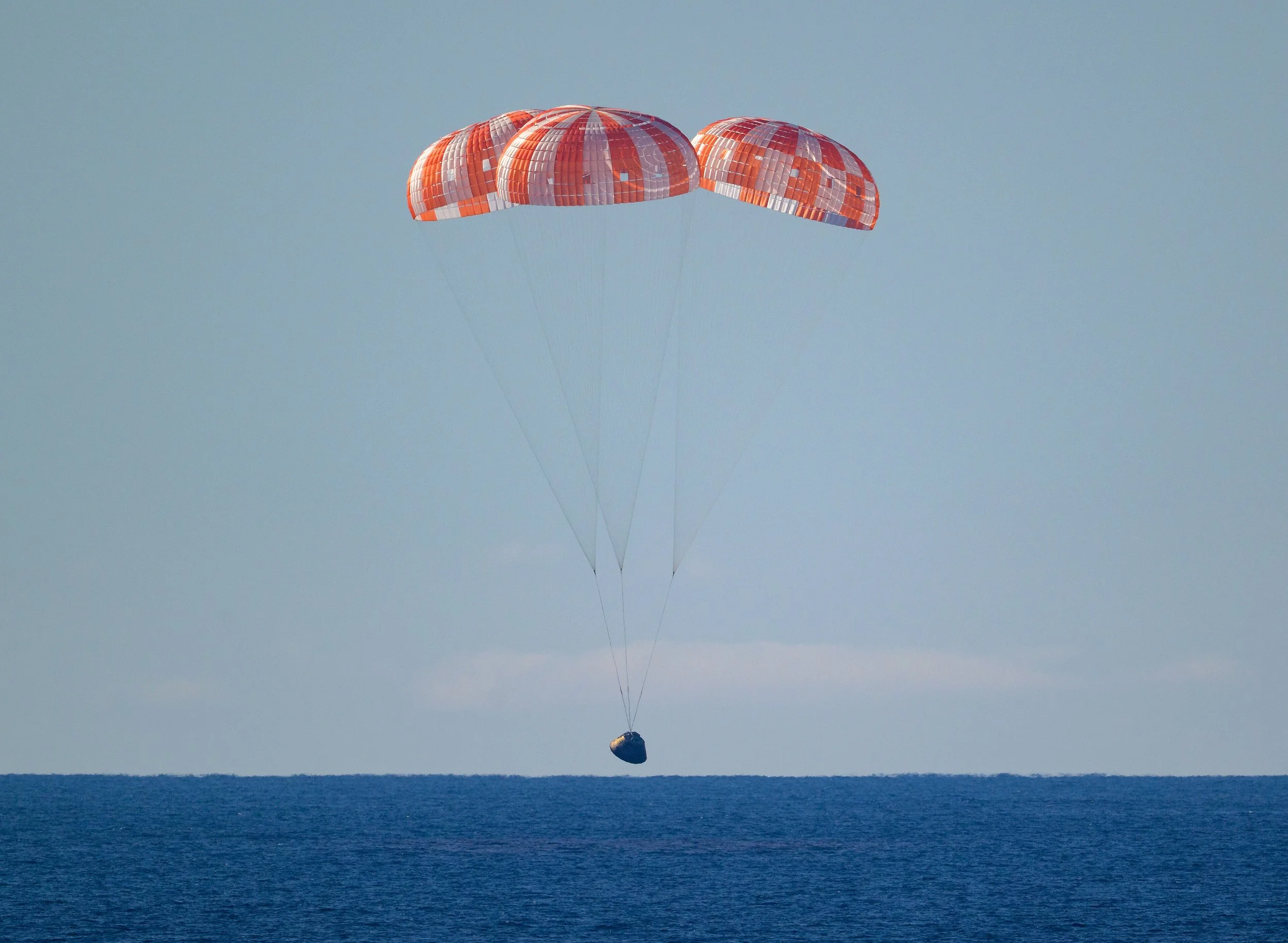
Moments before splashdown of the Integrity crew module in the Pacific Ocean with parachutes deployed, closing out the Artemis II mission on April 10th, 2026. Image credit: NASA
On the tenth and final day of its lunar mission, Integrity returned to Earth.
At 7:33pm, Integrity’s European service module separated and later burned up in Earth’s atmosphere. At this point, all that remained of Integrity was the conical crew module. It was turned around to face backwards, with the convex heat shield facing Earth.
The Artemis II mission originally called for a “skip re-entry” where they would decelerate by skimming the atmosphere like a rock skipping across the surface of a pond. However, this plan was scrapped out of an abundance of caution considering the heat shield had previously faced problems during the re-entry of Artemis I.
At 7:53pm, Integrity began re-entry into Earth’s atmosphere travelling over 38,000 km/h. The extreme pressure and friction of pushing through the air at such incredible speeds dramatically slowed the spacecraft. With the Artemis II crew seated with their backs towards the direction of travel, the deceleration pulled them into their seats with 4 times the force of Earth’s gravity, the most intense g-forces of the entire mission. This was arguably the most nerve-wracking minutes of the entire mission. The heat shield, which protects the spacecraft and crew from burning up, endured temperatures of 2,750°C. The sheath of superhot plasma generated by the friction would block out radio communications for six minutes (which was expected).
Once Integrity slowed sufficiently, communications were reestablished and a cluster of large parachutes was deployed, which slowed Integrity’s decent all the way down to a leisurely 32 km/h.
At 8:07pm, EDT (5:07pm PDT), the crew module of the Integrity spacecraft splashed down into the waters of the Pacific Ocean off the coast of San Diego, CA. The Artemis II mission officially concluded at that time. A U.S. Navy amphibious transport dock called USS John P. Murtha, which was already waiting near the recovery site for the past few days, dispatched teams of divers in boats to egress the crew into helicopters. The floating Integrity crew module was also recovered from the water and stored in the transport’s well deck. Aboard the transport, the crew received medical checks and were transported to San Diego. From there, they would be flown to the Johnson Space Center in Houston, TX.
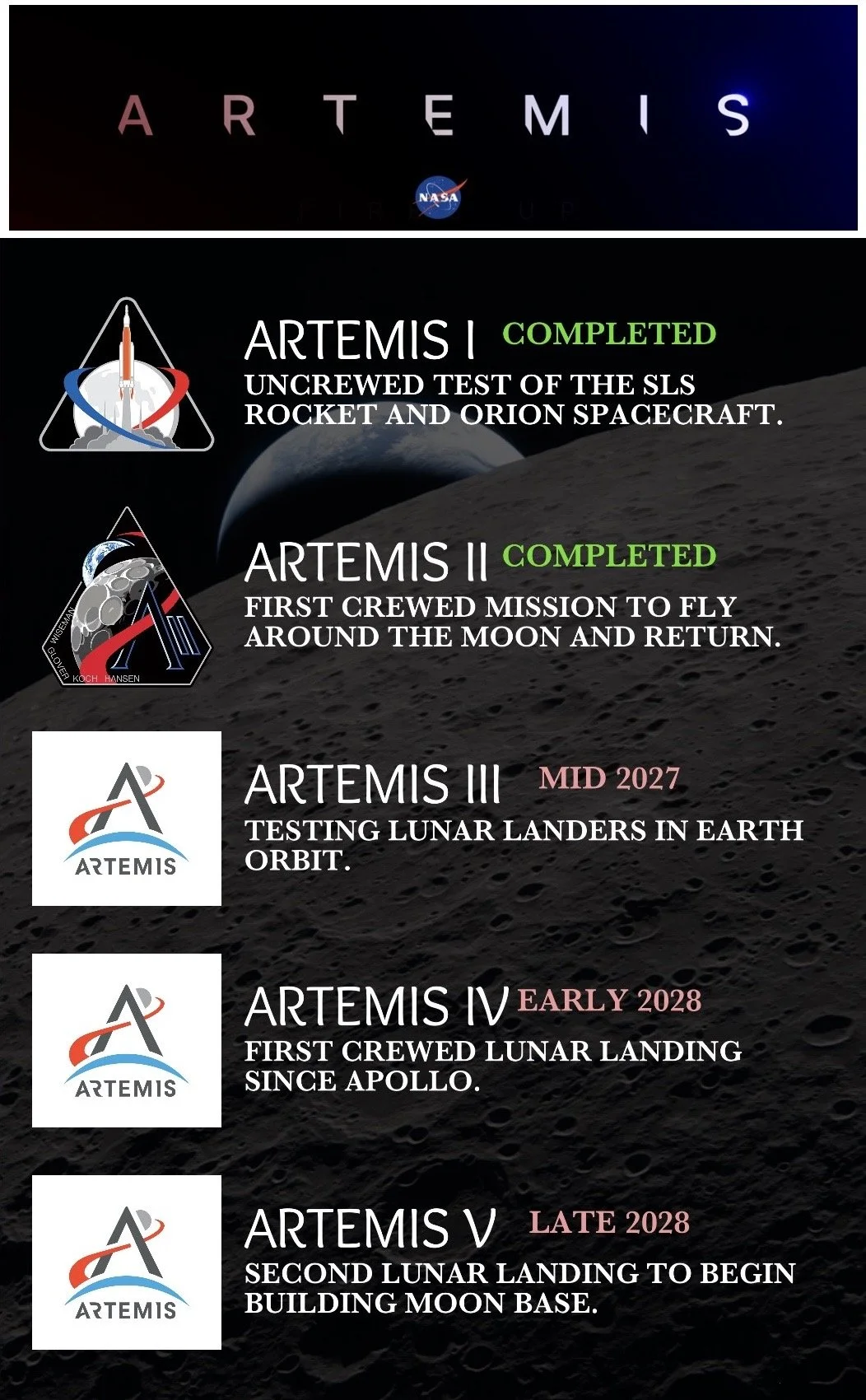
Image credit: NASA / HCAS / Sam Atkins
What comes next?
Artemis II serves as a second test of Orion’s capabilities and life support systems, as well as the operational effectiveness of safety protocols, trajectory calculations, and lunar observation. After this mission, NASA will begin preparations for the next step in the Artemis program. Admittedly, that next step is not as straightforward as originally envisioned.
Artemis III was originally planned as a crewed lunar landing. However, technical challenges, delays and safety concerns have led NASA to restructure the Artemis program. This includes issues like the SLS rocket hydrogen leaks, the Orion spacecraft’s heat shield and the delayed development of two potential lunar landers (Starship HLS by SpaceX and Blue Moon by Blue Origin). Artemis III is now set to be a mission to test rendezvous and docking procedures between the Orion spacecraft and one or both of the lunar landers in low Earth orbit. A broad launch window is currently planned for mid-2027.
Artemis IV is currently planned for an early-2028 window. It will be the first crewed lunar landing since Apollo 17. The mission will consist of a four-astronaut crew entering lunar orbit and rendezvousing with a lunar lander (which will be placed into orbit ahead of time by a support mission). Two astronauts will transfer to the lander and descend to the surface near the lunar south pole and conduct extravehicular activities.
Artemis V is currently planned for a late-2028 window. It will be the first of many annual missions involving crewed lunar landings with the goal of constructing a permanent Moon base. The intention is that this will eventually act as the staging grounds for research and crewed missions to Mars. What a time to be alive, huh?
Whatever the future brings for the Artemis program, you can be sure I will be there to keep you informed. Thank you very much for reading and keep looking up!