
GALAXIES
Galaxies are colossal, gravitationally-bound assemblages of gas, dust and millions to trillions of stars. They come in a wide variety of shapes, sizes and colors, each telling their own unique story. Beyond their sheer scale, galaxies are home to beautiful formations, from swirling spiral arms to dense clusters of stars. Understanding these magnificent structures not only reveals the history of our universe but also ignites our curiosity about not only our own Milky Way, but what lies beyond.
TYPES OF GALAXIES
The most wonderful thing about galaxies is that no galaxy is exactly like another. However, there are some patterns that we see come up again and again that might tell us how these gargantuan cosmic structures formed. Generally, there are three primary types of galaxies that encompass the vast majority of galaxies in the observable universe:
🔸Spirals
🔸Ellipticals
🔸Irregulars
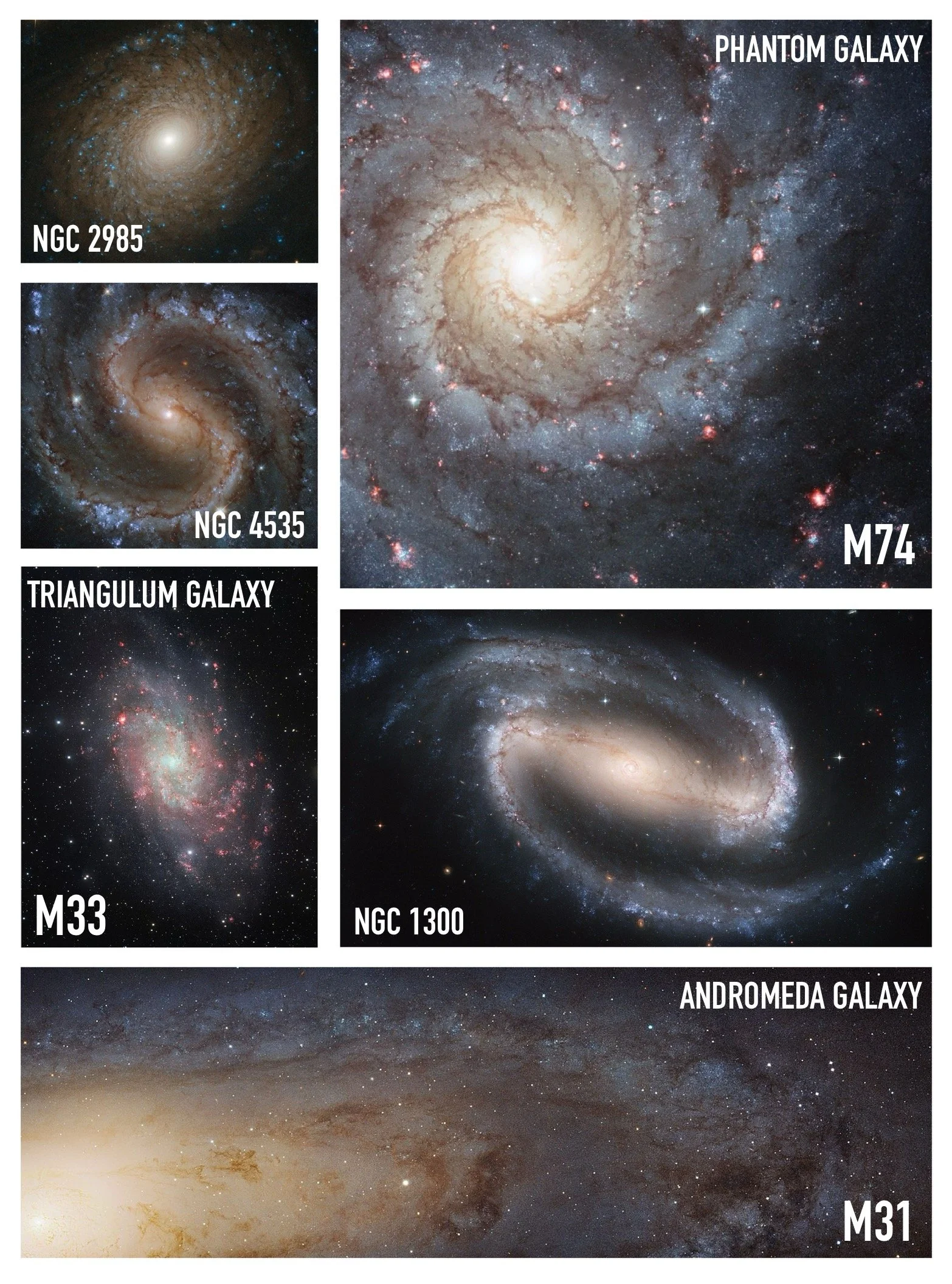
SPIRALS
This is possibly the most common type of galaxy we find, making up maybe 60-70% of all known galaxies. Spiral galaxies are flat, rotating disks of stars, gas and dust. They generally consist of two or more long curving structures called “arms” that extend from a central “bulge.” The arms tend to be crackling with young, hot, blue stars while the core is densely packed with older yellow and red stars. Some spiral galaxies appear very tightly wrapped like NGC 2985 (pictured above) while others are more loose and open like the Pinwheel Galaxy.
About half to two-thirds of spiral galaxies feature a central bar-shaped structure from which the spiral arms extend from. Our own Milky Way is classified as barred spiral galaxy. NGC 1300 (pictured above) features a very prominent barred structure.
It is not fully understood why these galaxies develop spiral arms or why many of them have central bars but there are competing ideas. The most prominent hypothesis suggests that wave-like patterns, called “density waves,” propagate throughout the disk via gravitational interactions which compresses the stars, gas and dust into condensed lanes and trigger star formation. The rotation of the galaxy mixed with these density waves may result in the formation of spiral arms.
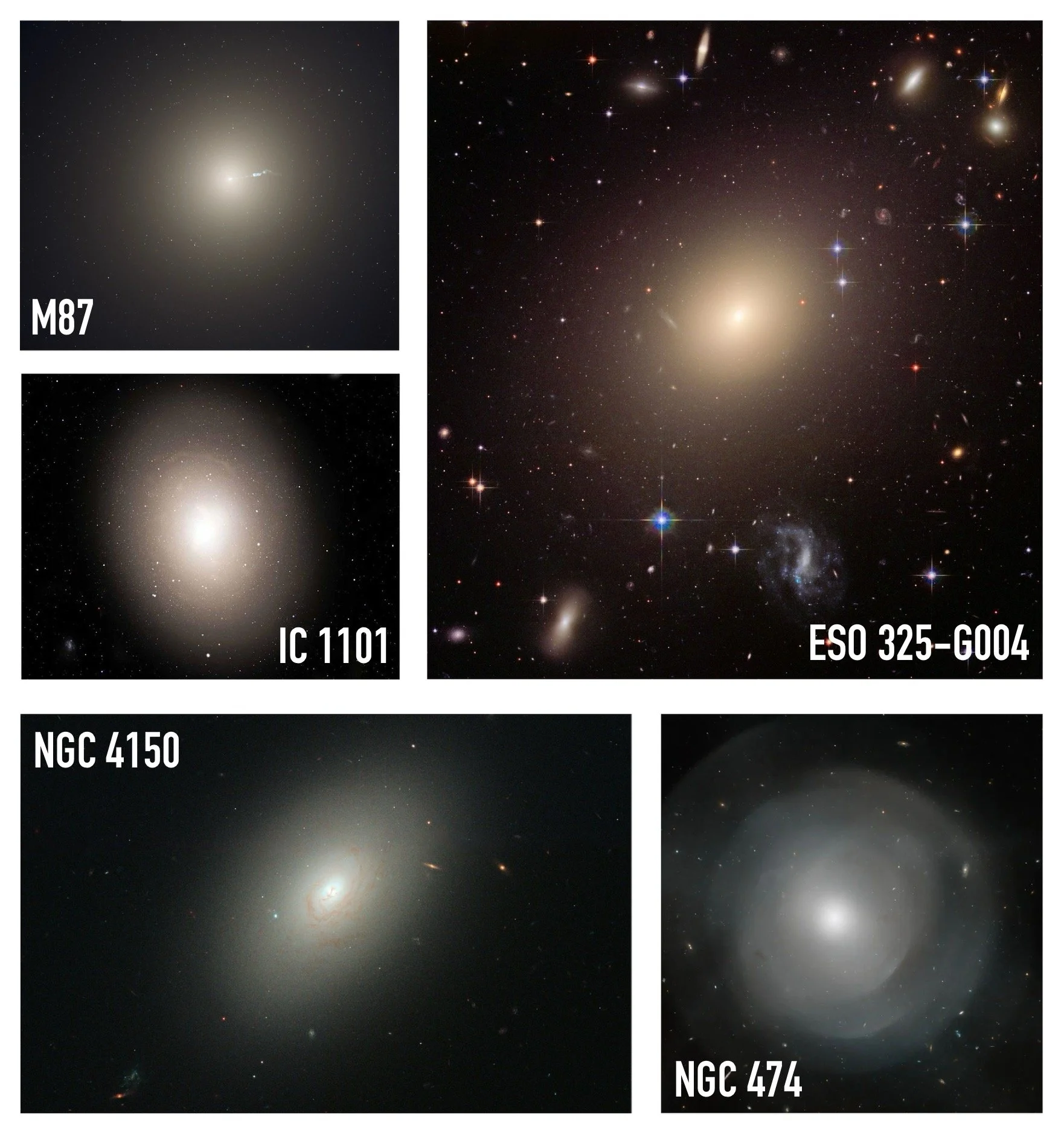
ELLIPTICAL
Elliptical galaxies are most recognized by their smooth oval-shaped appearance with varying levels of elongation. They lack a distinct spiral arm structure and instead tend to be smooth and featureless. They are largely composed of older, cooler, low-mass stars with a sparse interstellar medium. This means that they are usually lacking in active star formation compared to spiral galaxies.
They vary wildly in size, ranging from dwarf ellipticals containing millions of stars to supergiant ellipticals containing trillions of stars. The latter tend to be some of the largest galaxies in the universe and often dominate their respective galaxy clusters. Examples of these behemoths would be M87 and IC 1101.
Ellipticals are not as common as spiral galaxies, making up maybe 20-30% of all known galaxies.
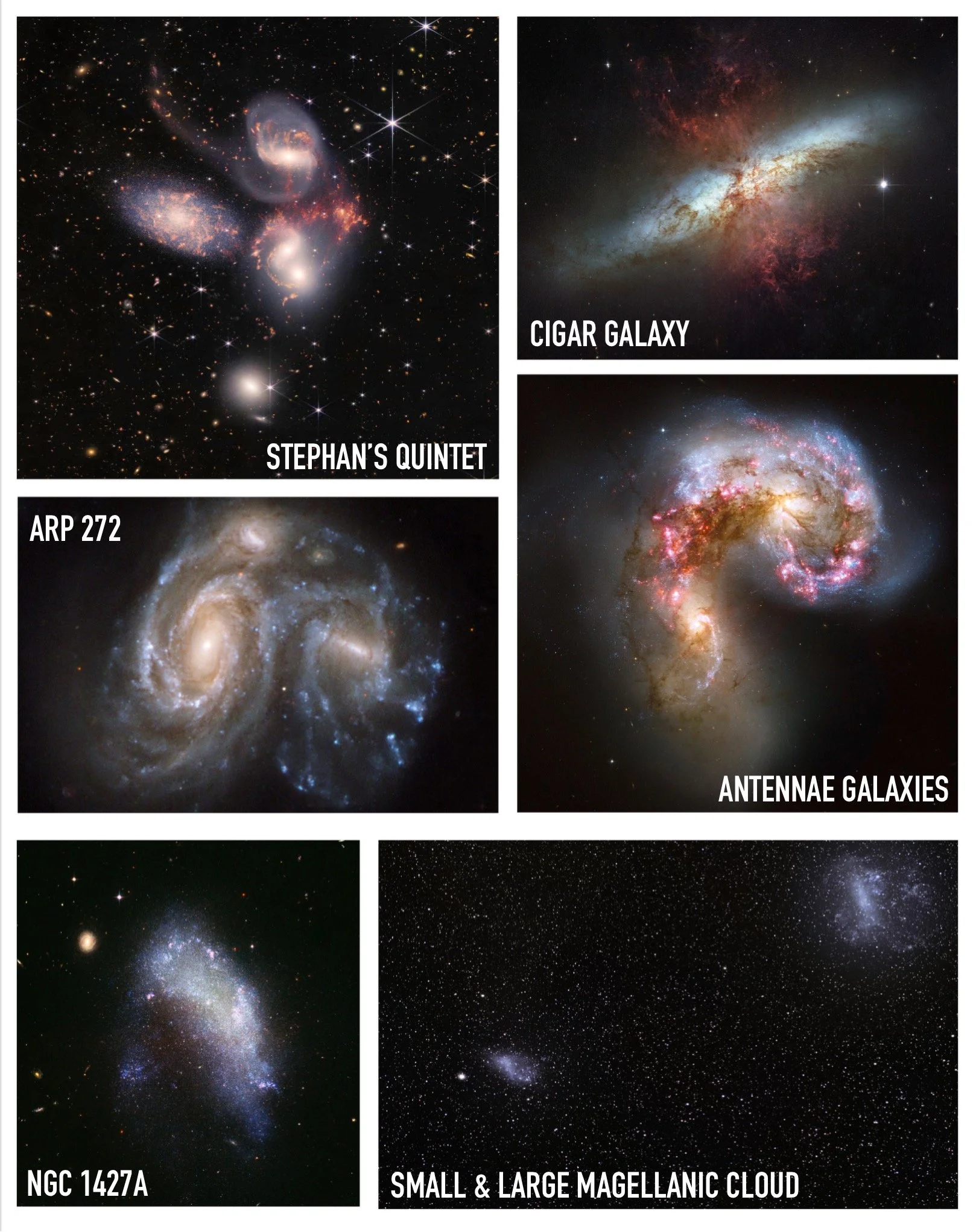
IRREGULAR
Irregular galaxies do not have a distinct, symmetrical shape or structure like spiral or elliptical galaxies. They are characterized by their irregular, chaotic appearance and lack of clear rotational symmetry. They are often rich in gas, dust, and young stars, and they exhibit ongoing star formation activity. These galaxies are striking but uncommon, making up only 5-10% of known galaxies.
There are two primary types of irregular galaxies:
Irr-I: These galaxies have some loose structure in the form of arms or regions of enhanced but irregularly distributed star formation. However, they still lack the definition found in spirals and ellipticals. They are predominantly composed of young, bright stars, as well as clouds of gas and dust.
Irr-II: These galaxies have little to no structure remaining, appearing disturbed and twisted in shape often from gravitational interactions with other nearby galaxies via collisions or tidal forces.
Some examples of these irregularly shaped or interacting galaxies would be NGC 1427A, Cigar Galaxy, Arp 272 and Stephan’s Quintet and NGC 4449.
There are also irregular dwarf galaxies such as the Large and Small Magellanic Clouds. These are satellite galaxies orbiting the Milky Way which are clearly visible with the naked eye from Earth’s southern hemisphere year-round.